Category: Processes

  • TYPES OF SERVICE DRAWINGS USED FOR PRECAST DETAILING

    Types of Service drawings:

    • Crane drawing
    • Lift drawing
    • PT drawing (Post tension)
    • Mechanical service drawing
    • Electrical service drawing
    • Fire service drawing
    • Steel detail drawings
    • Hydraulic service drawing
    1. Crane drawings
      1. Refer crane drawings for loading platform location, Crane tonnage & its relevant circles and other crane related data’s. (Refer Fig.01)
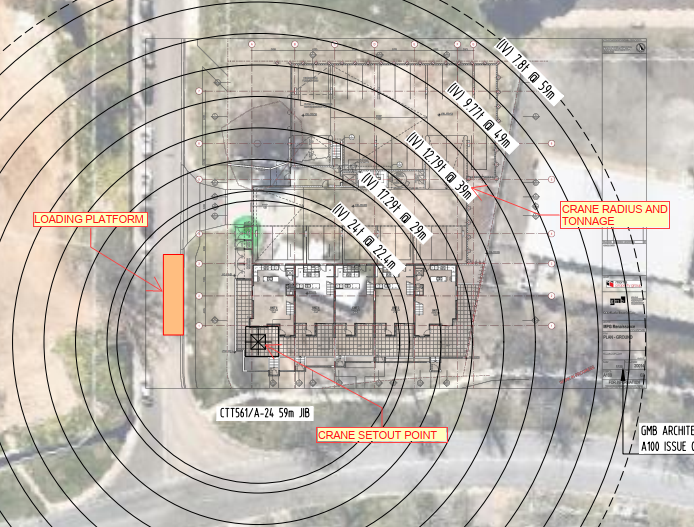
    Fig .01 (Ref. Crane drawing)

    2. Lift drawings

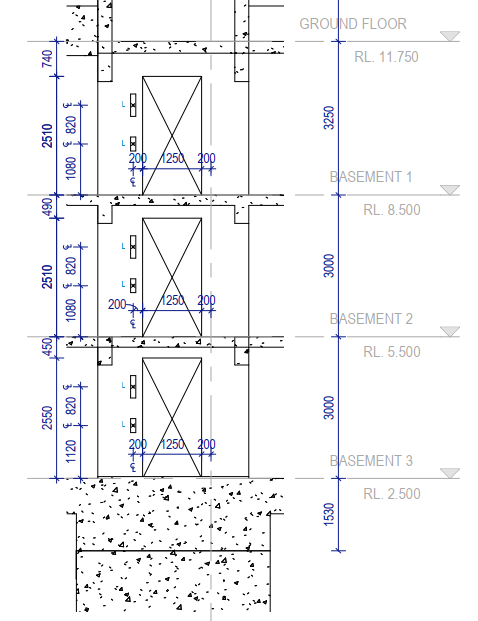
      1. Refer these drawings for lift door opening size & set-out, lift door fitment rebates, landing RL’s, penetrations and rebates for call buttons & indicators, service hatch openings, Unistrut’s locations, lifting eye locations and loading factors, switch cut-out on final floor and other lift related data. (Refer Fig.02)
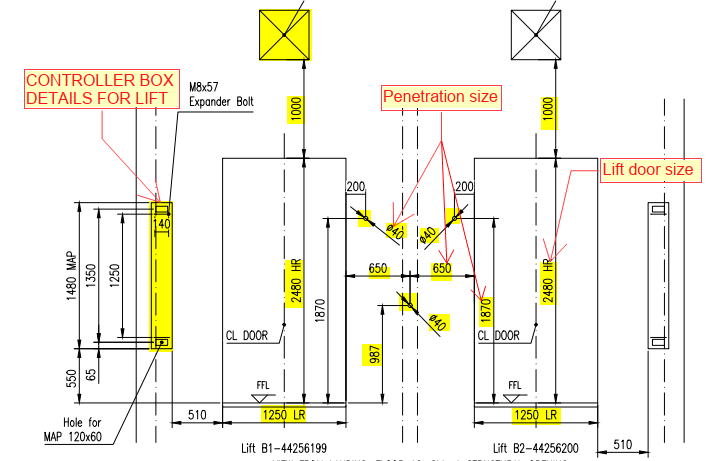
    Fig .02 (Ref. Lift door & penetration details)

    3. PT drawings

      1. Must refer these drawings for PT tendons passage location. Wherever the PT tendons passing through the precast we must provide block-outs to suit accordingly. The nominal size of block-outs for PT to pass through as per engineer requirements. If not shown on any drawings, we need to raise RFI (Request for information). (Refer Fig.03)
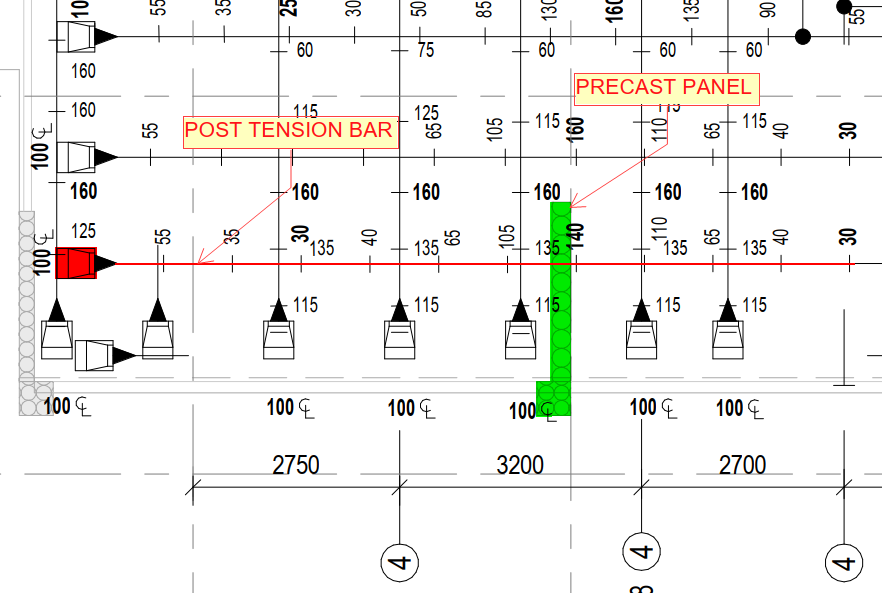
    Fig .03 (Ref. Post tension drawing- PT)

    4. Mechanical service drawings

      1. Refer these drawings for mechanical openings in slabs & walls. Mainly for duct works, garbage chutes, kitchen exhaust chutes, stair pressurization openings, etc. (Refer Fig.04)
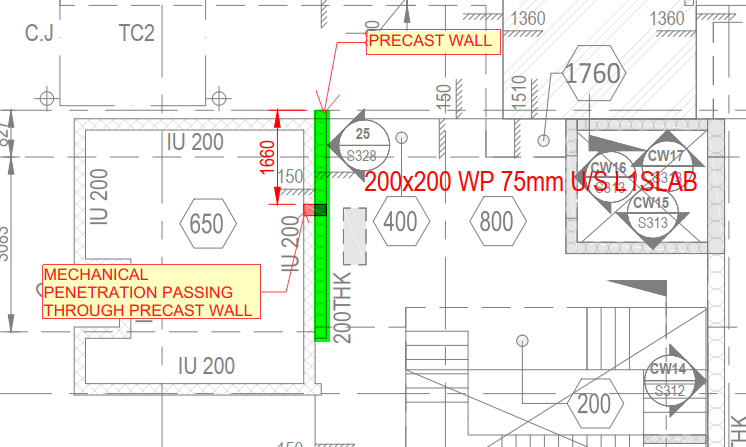
    Fig .04 (Ref. Mechanical service drawing)

    5. Electrical service drawings

      1. Refer these drawings for electrical penetration requirements in slabs & walls. Mainly for communication, power and other electrical related accessories to pass through. (Refer Fig.05)
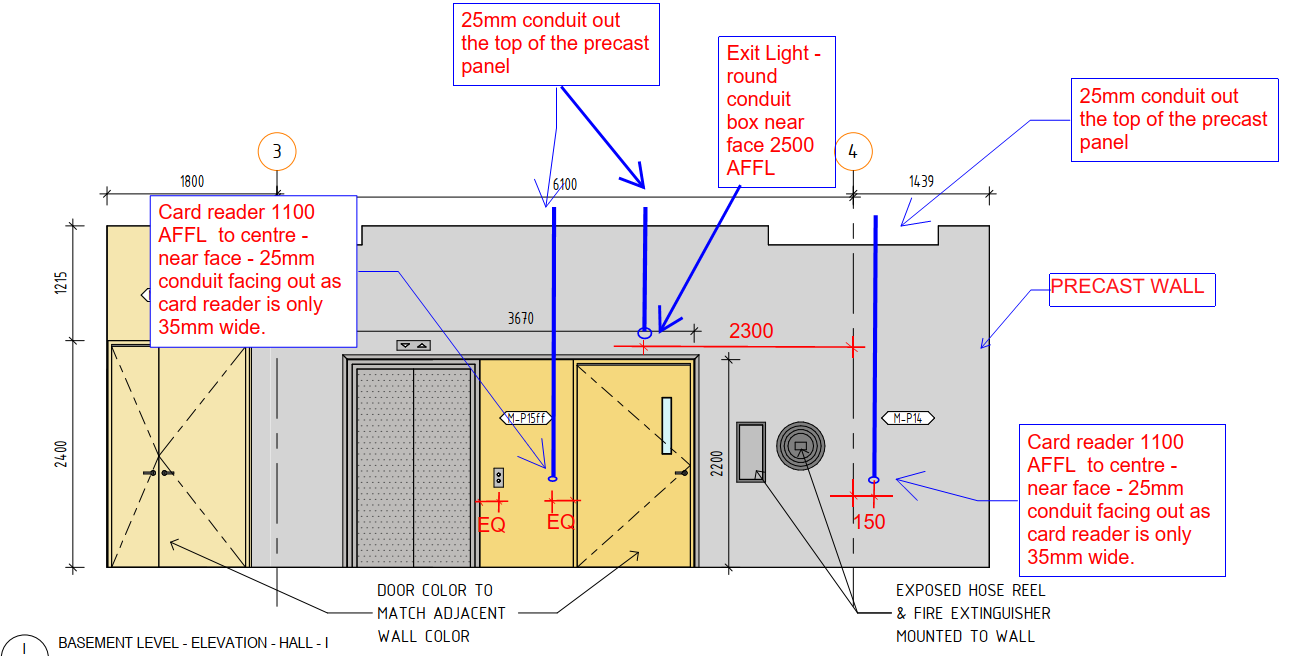
    Fig .05 (Ref. Electrical service drawing)

    6. Fire service drawings

      1. Refer these drawings for Fire service penetration requirements in slabs & walls. Mainly for fire hydrants, sprinkler system and its pipe accessories to pass through. (Refer Fig.06)
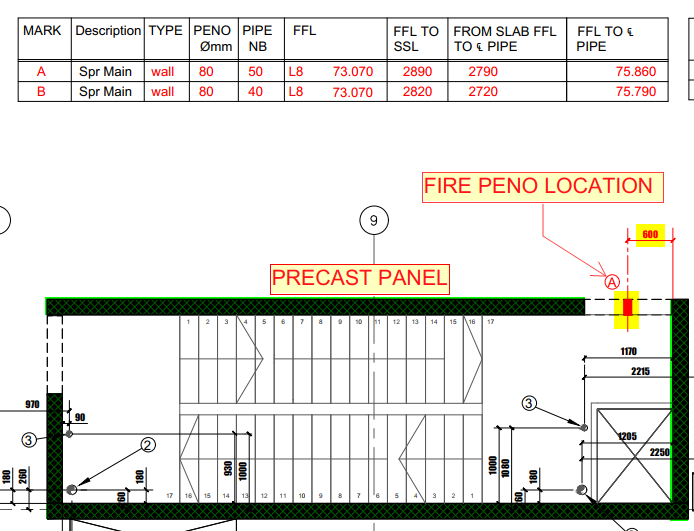
    Fig .06 (Ref. Fire penetration drawing)

    7. Steel detail drawings

      1. Refer these drawings for Steel to precast connection details. Mostly if some connection like this present, we will get intimated beforehand. (Refer Fig.07)
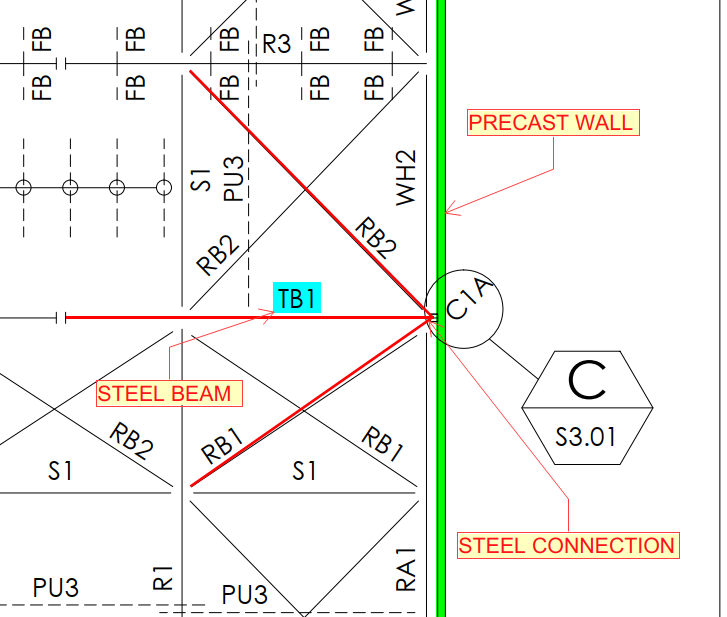
    Fig .07 (Ref. Steel drawing)

    8. Hydraulic service drawings

      1. Refer these drawings for Hydraulic service penetration requirements in slabs & walls. (Refer Fig.08)
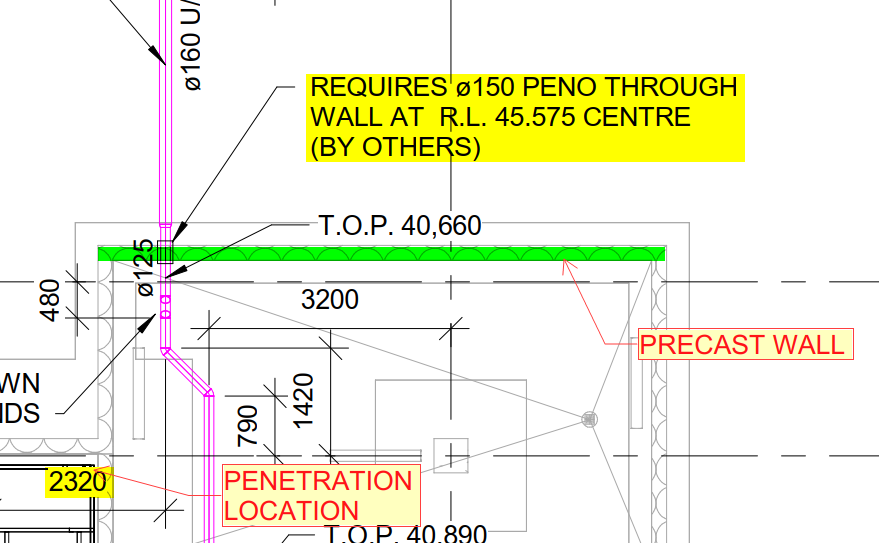
    Fig .08 (Ref. Hydraulic service drawing)
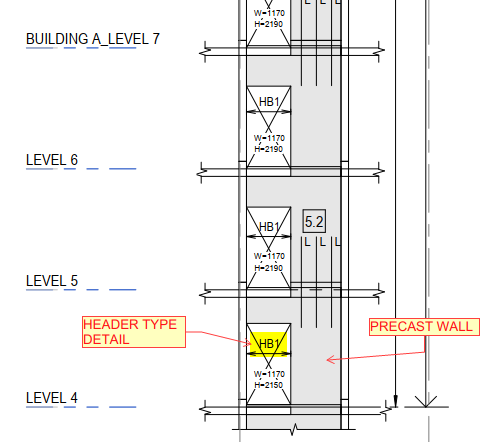
  • HEADER WITH DETAILS

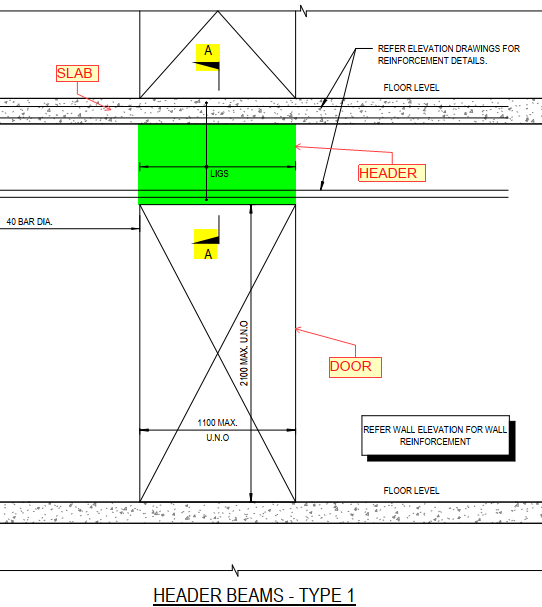
    1. In-situ or Precast element present above the door or window opening is called header. (Ref.Fig.01&02)
    2. Usually, the height of header will be small, and it will have more load impact for the smaller load distribution area.
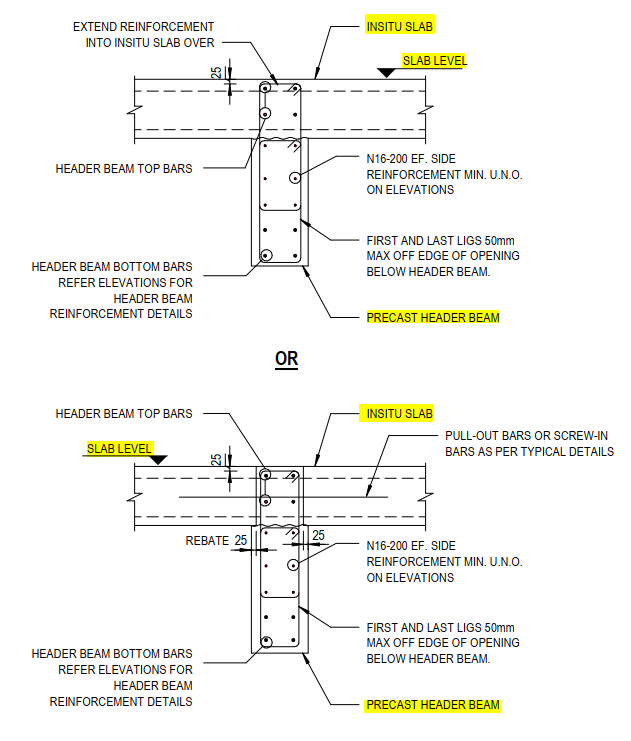
    3. For structural stability that header needs to have high strength. If structural engineer didn’t specify more strength means it won’t have higher load distribution impact. So, that area requires more reinforcements. (Ref.Fig.03)
    4. Structure engineer drawings specifies that detail in separate header beam detail or in core elevation drawing or even in nominal elevation or as a separate document as per the need and availability.
    5. While providing reinforcement arrangement for header, we need to consider room space on header beam. So, for header reinforcement arrangement we need to the arrangement in 1:1 scale to ensure that no complication & difficulty will arise in factory as well as site.
    6. If any penetration comes at header which is larger in size than for ties spacing, we need to add two ties at both sides of penetrations.
    7. We need to raise RFI (Request for information), if header reinforcement details not provided by structural engineers.

    Fig.01 (Ref. Precast elevation)

    Fig.02 (Ref. Header detail)

    Fig.03 (Ref. Header reinforcement detail)

  • GROUT TUBE WITH DETAILS

    GROUT TUBES:

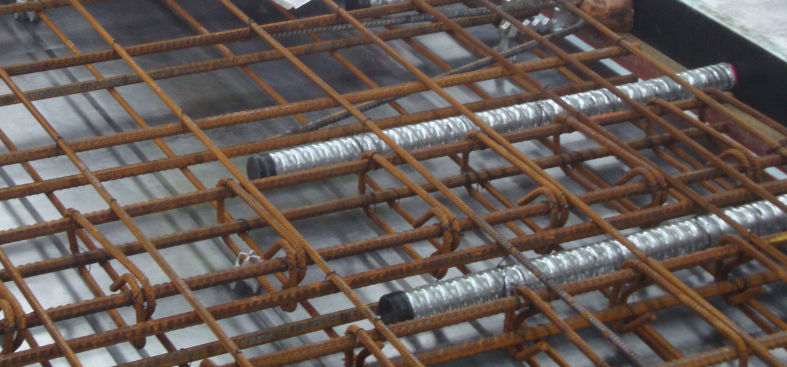
    • Grout Tubes are hollow components and are made of plastic or thin sheet metals.
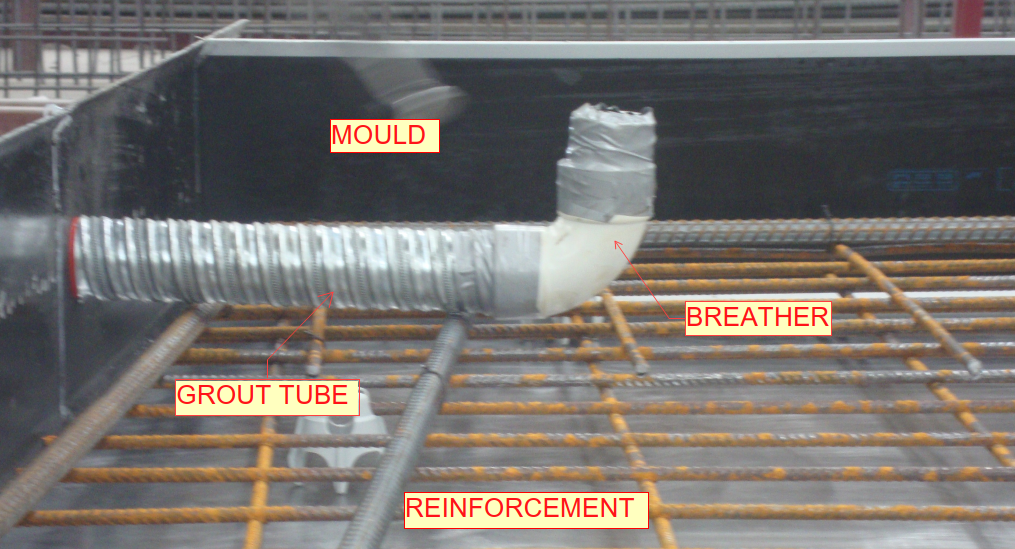
      (Refer Fig.01)
    • Grout tubes are cast into precast elements which create a void to locate and connect the elements (between two precast elements or in-situ to precast elements) together using starter bars or dowel bars.
    • Once the elements are in position, the grout tubes are filled with grouting material and locking the elements in position.

    Fig.01 (Sample bottom Grout tube with breather)
    Purpose of Grout tubes:

    • Grout tubes are used in the construction of precast concrete buildings for connecting elements like walls, tilt-up panels, beams, columns, etc.
    • It will help to increase the strength and durability of the precast or in-situ elements.

    General details for Grout tubes

    1. Hollow components with spiral designs or key ways in its walls
    2. Selection of grout tubes based on dowel size
    3. Alternatively, NMB splice sleeves or penetrations can be used or dowel bars can be directly casted if having rebar’s arrangement congestion
    4. Grouting materials must be filled for Load bearing areas and voids will be present for NLB (Non load bearing) portions.
    5. Must not clash with other components in precast (Cast in plate, Lifter, Lig-cage, lig-cage hooks, Prop, Grooves, Ferrules and etc.) – Refer Fig.02
    6. Face of breather must be inside of building and must have access, must not be placed where sequential grooves or architect patterns present.
    7. If breather has no access must provide breather extent to where the access is possible (not required when it is NLB)
    8. Must have a minimum gap of 200mm with other components especially lifters & block-outs (this value can be modified, if having difficulties to maintain that gap)
    9. Avoid the Grout tube placement near to window & major openings (wherever possible)
    10. Grout tube must be placed within 300mm from panel edge. (But can be modified if having any difficulties.)

    Fig.02 (Sample Top Grout tubes)

    Advantages:

    • Lightweight and easy to process
    • Available in a range of sizes
    • It will help to reduce the construction time on site
    • Easy to connect with precast or in-situ elements

    Disadvantages:

    • The huge amount of grout tubes needed to fill up the duct in order to secure the connection between the precast wall or in-situ.
  • DOWEL BAR WITH DETAILS

    Dowel bars:

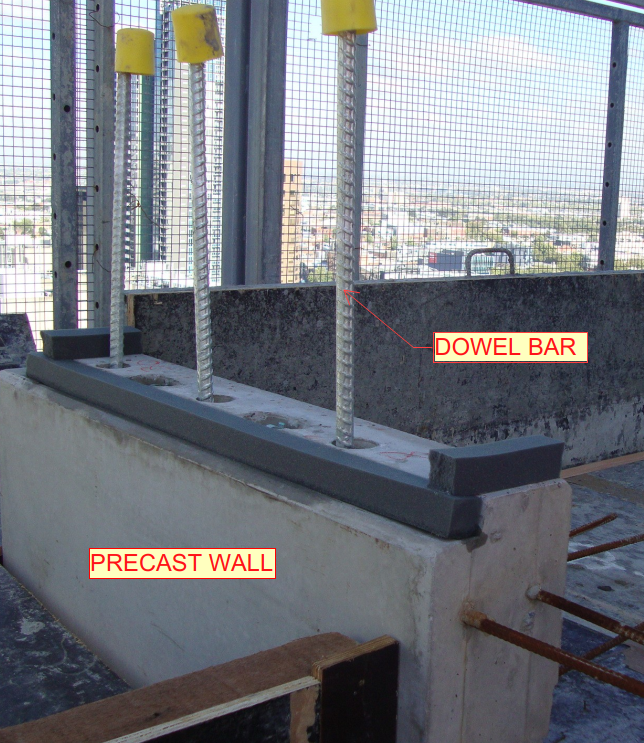
    • Dowels are short straight steel bars and also cogged bars, used to provide mechanical or structural connection between two precast elements or in-situ to precast elements.
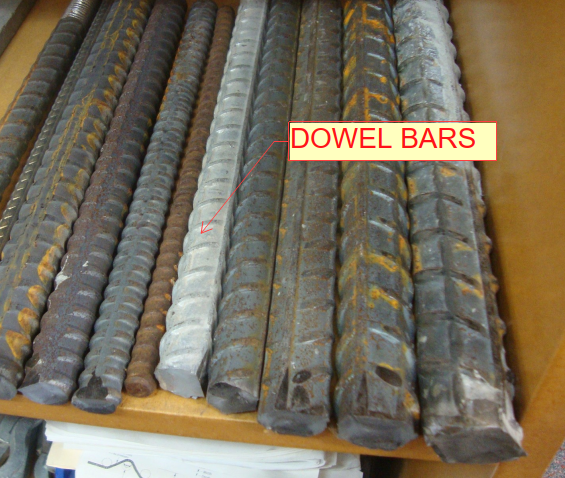
      (Refer Fig.01)

    (Fig.01) Dowel bars

    Purpose of Dowel bars:

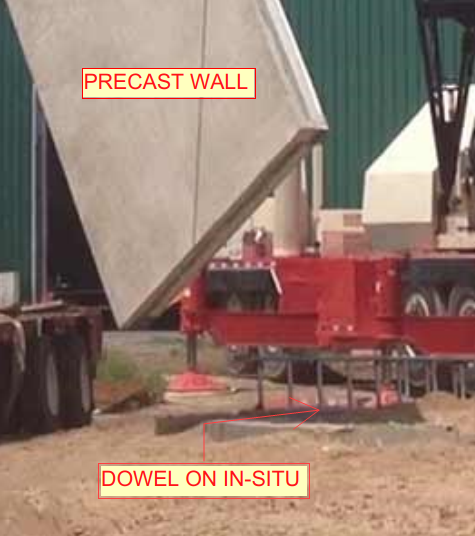
    • Dowel bars used to maintain the horizontal and vertical alignments of slab and precast panel. (Ref Fig.02)
    • Dowel bar connection used to transfer the loads between two concrete elements or two precast elements or precast to in-situ elements. (Refer Fig.03&04)
    • Dowel bar is used to extend the structure easily with small drilling to insert the steel for the extension of the structure.

    General details for Dowels:

    • Dowel bar is a steel rods with spiral outer design. (Refer Fig.01)
    • Used in all the locations where Grout tubes are required.
    • Selection of Dowel based on Engineer requirement.
    • Dowel can either be black finish or galvanized finish.
    • Black finish for load bearing dowels and galvanized finish for NLB (non-load bearing) dowel. (It may be varied).
    • Alternatively, bars connected into NMB splice sleeves can be used. Also, starter bars can be casted into panel.
    • Plastic tube will be placed over upper half of dowel. And 20mm compressible cap will be placed over the top of the dowel bar for NLB (non-load bearing) portions whereas grouting material will cover the entire dowels for LB (Load bearing) conditions.
    • Dowels must be positioned within Grout Tubes with minimum amount of clearance on precast walls or slabs.

    Advantages:

    • It is reducing the corner cracking.
    • It will reduce joint faulting.
    • Dowel bar is also used to reduce the deflection and stress.

    (Fig.02) Precast wall connection

    (Fig.03) – Precast to in-situ connection
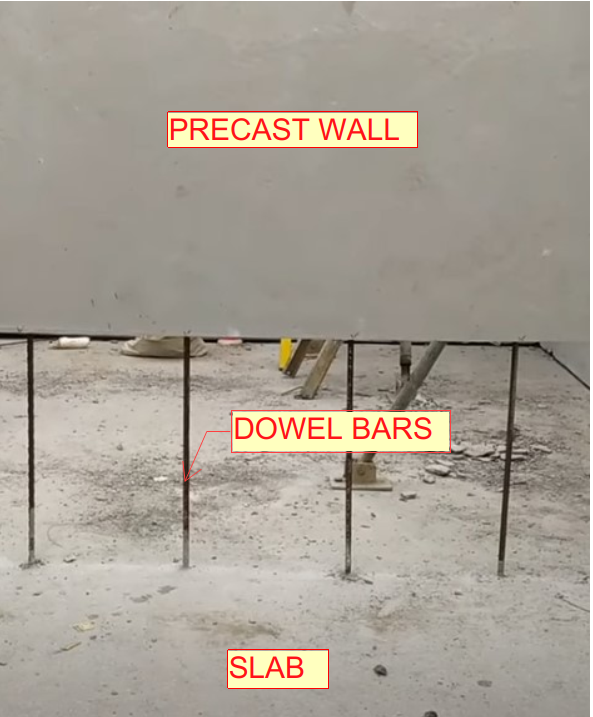
    (Fig.04) – Precast to slab connection
  • STRUCTURAL CORE PLAN AND ELEVATION DRAWINGS STUDY

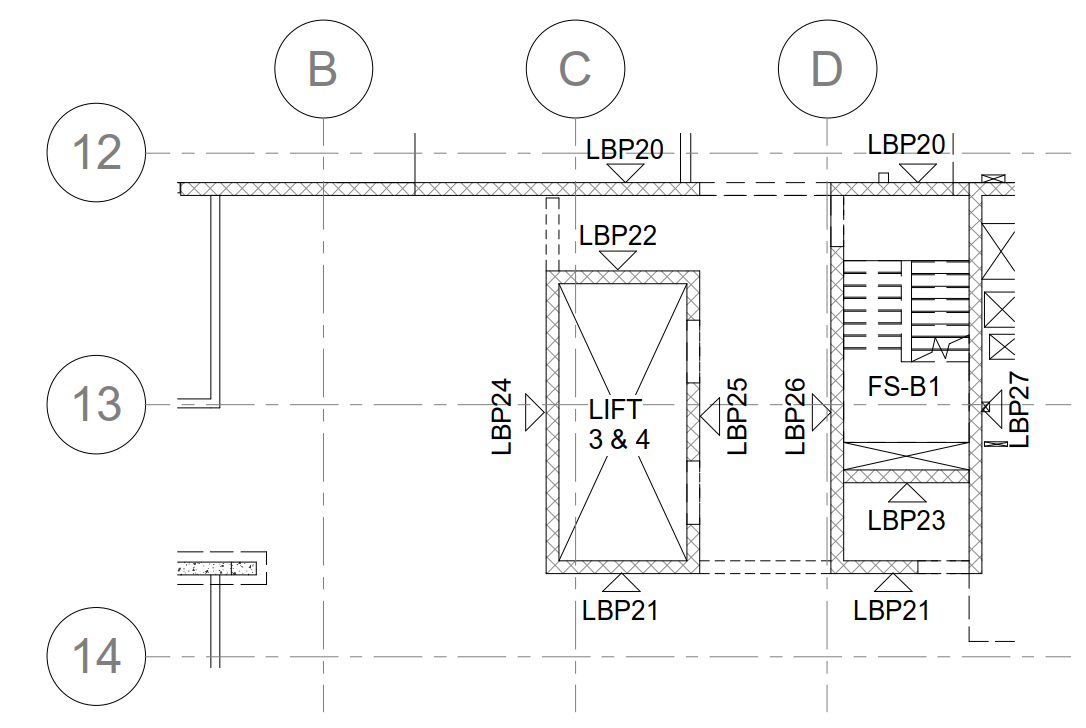
    1. Core plan shows the core wall, shear wall and overall slab boundary. (Only if it is provided by separate structural engineer specifically working for cores & shear walls).
    2. Also, it’s shown the elevation number and viewing direction. (Only if it is provided by separate structural engineer specifically working for cores & shear walls) – Refer Fig 01.
    3. Precast legends will be provided at title sheet.
    4. If too many building means, they highlighted the site key plan with current building.
    5. For single building area of working, they provided the key plan with elevation numbers and views. (Only if it is provided by separate structural engineer specifically working for cores & shear walls).
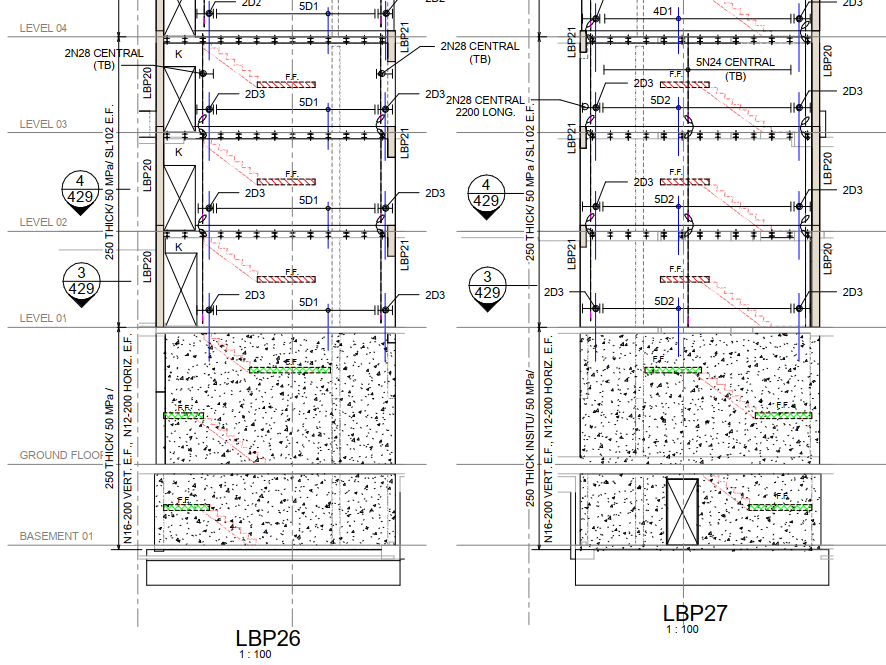
    6. In Core/Shear walls elevation, concerned engineer will provide below details – Refer Fig 02
      • Dowel bar requirement
      • Tension bar requirement
      • Thickness of panel
      • Grade of panel
      • Reinforcement requirement (in some cases it will be given in a separate sheet)
      • CIP requirement
      • Wet-joint details (usually wet joint only specified. Brief details will be given in separate sheet)
      • Header detail schedule type (in some cases header type only given, and will be defined in another sheet)
    7. In core elevation and plan, we prefer to give more importance to elevation than plan, if any issue in it we can raise RFI (Before raising RFI we have to completely analyses the discrepancy, and make a call inward and finalize the deviation. If it is not finalized then only, we can raise RFI (Request for information).

    (Fig.01) SAMPLE CORE KEY PLAN

    (Fig.02) SAMPLE CORE ELEVATION
  • ARCH STAIR PLAN DETAILS AND DRAWING STUDY

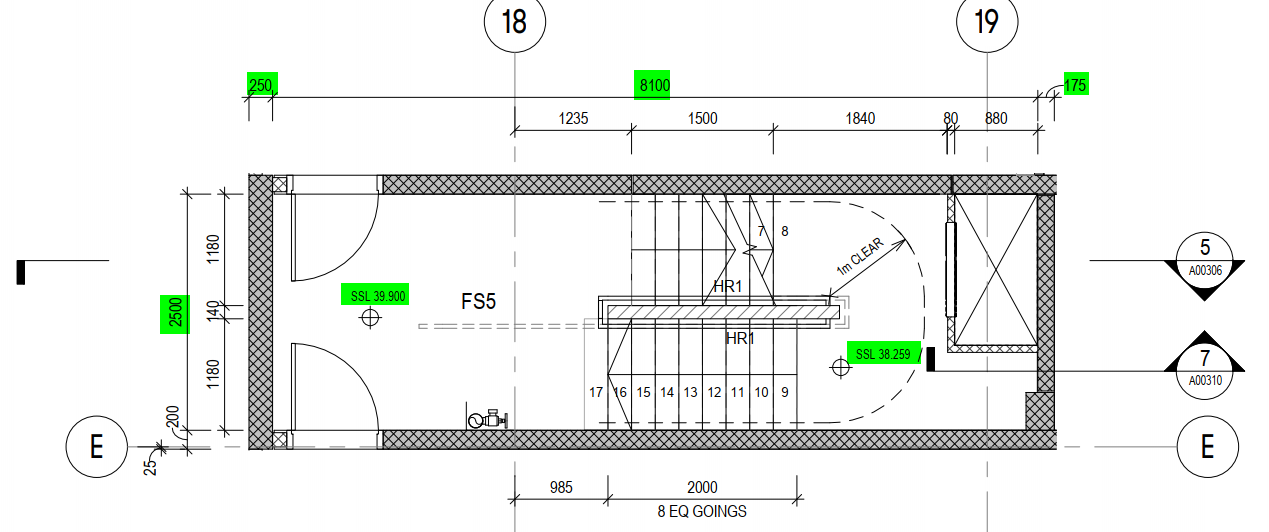
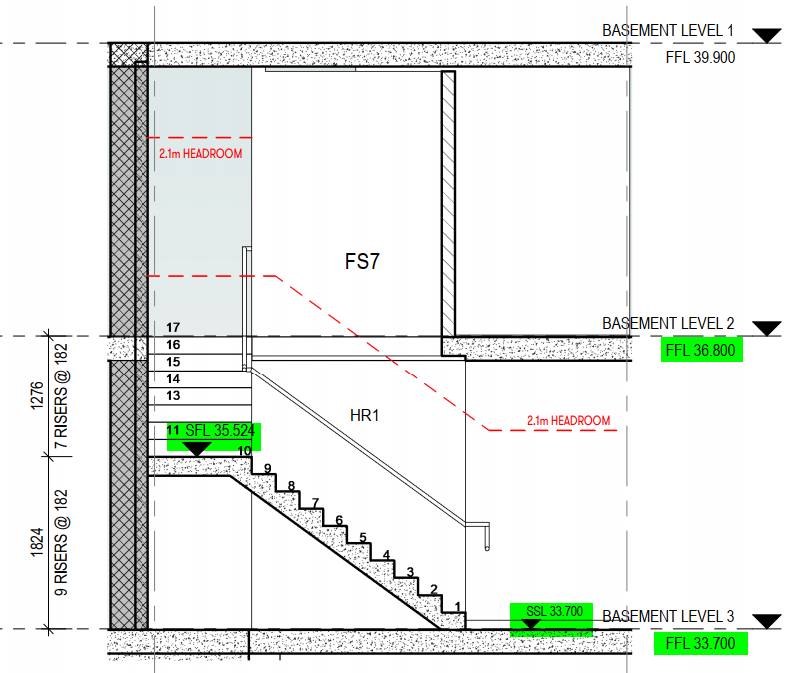
    1. Stair or fire stair drawings are used to find the stair landing RL, landing slab set-out (X-axis distance), fire penetrations and stair pressurization riser details.
      (Refer Fig .01 & 02)
    2. This drawing package are provided by architect separately in arch consultant drawings.
    3. The main things for this drawing are to take the value of stair landing RL’s, Door and opening sizes.
    4. If any mismatch with consultant arch drawing, we have to raise RFI (Request for information) and confirm it. (Most of the cases we need to follow as per stair drawing package only. If we need to raise RFI (Request for information), make sure and cross check issuing date & other references from drawings).
    5. Stair Landing & its mid landing RL’s will be taken from Architect Stair section drawings. If they not provided, then we have to check those RL’s in arch concrete plans.

    ARCHITECTURAL STAIR PLAN (Fig .01)

    ARCHITECTURAL STAIR ELEVATION SECTION (Fig .02)

  • ARCH ELEVATION DETAILS AND DRAWING STUDY

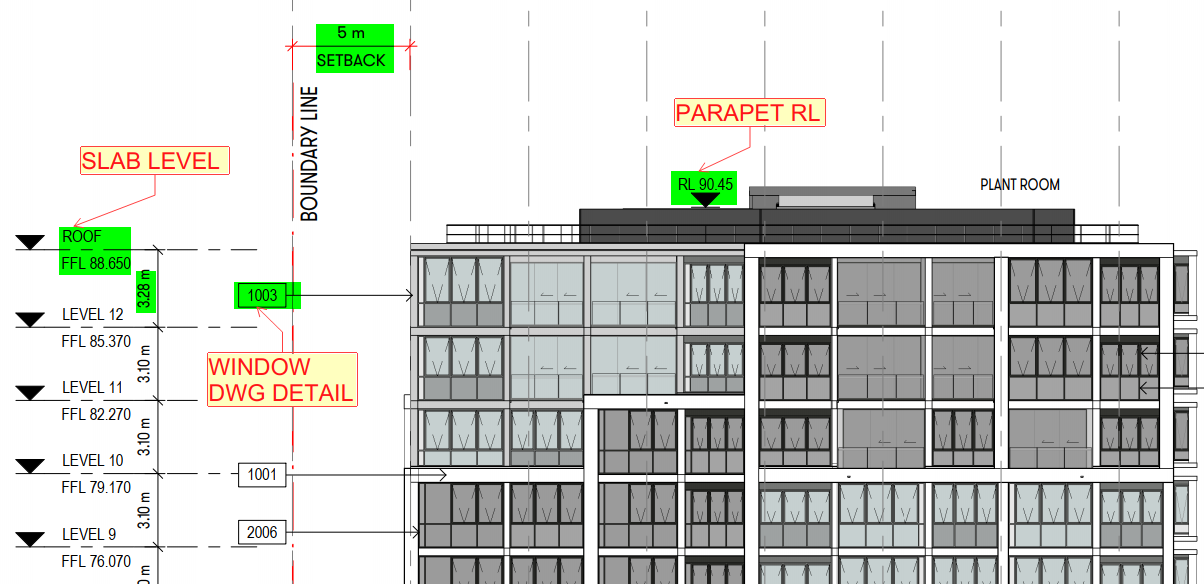
    1. For Architecture elevation, mainly we used for door/window openings height and its location details. (If any other service drawings available means we have to consider that too).
    2. This elevation helps to take the FFL/SSL value of each level.
    3. It’s showing also the RL of parapet and roof level walls.
    4. For patterns, grooves and other elevation design details will be shown on architectural elevation.
    5. The different types of panels finish also shown on elevation where it’s required.
    6. They given all the side of elevation and section views for overall building profile appearance.
    7. It also shows the slab profile appearance and it’s RL’s. (Like floor slab, ramp, stair landing, and etc.,)
    8. Some cases, the arch core elevations also provided separately for stair and lift. It’s shown the details like door and window set-out, fire penetration set-out, landing slab RL and etc.

    Sample Arch core elevation (Fig.01)

    Sample Arch elevation (Fig.02)

  • TABLE PRECAST FINISHES

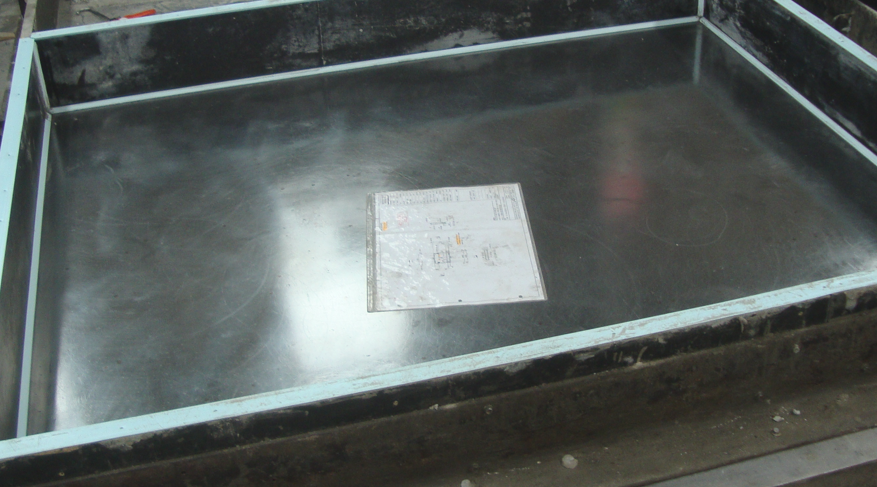
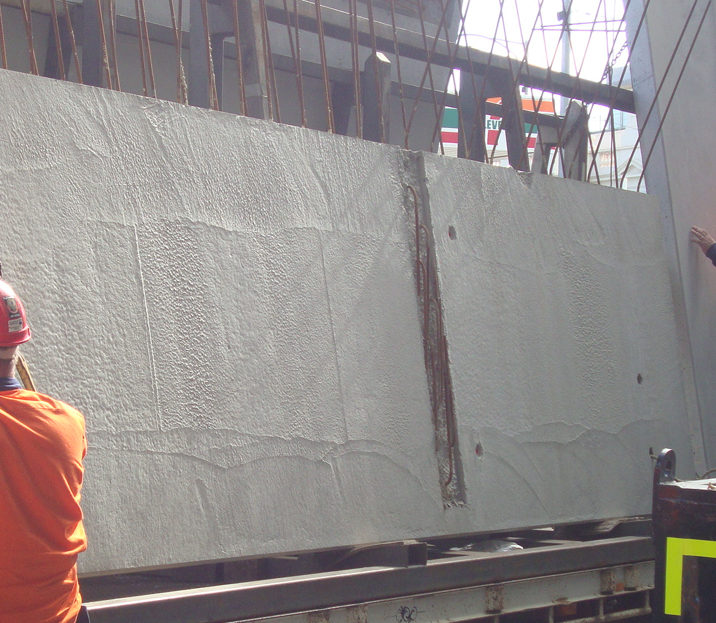
    Table precast finishes is the replication process. The surface of the manufacturing table affecting the precast surface. Sometimes the table is covered by form liners, bricks, signage letters & pattern to make the finishes.

    a) Normal table finish:

    Non-exposed surface of the precast is made by this type of table. Same table is used for multiple time for casting the precast. Surface of the table is drilled and nailed for component fixing. Components fixing damages not fixed at every time of repetition, which result poor surface finish.

    b) Good table finish:

    The damaged table surface is being fixed by welding and grinding before every time of casting. Which means each and every time the surface of the precast panel surface will be made well & good.

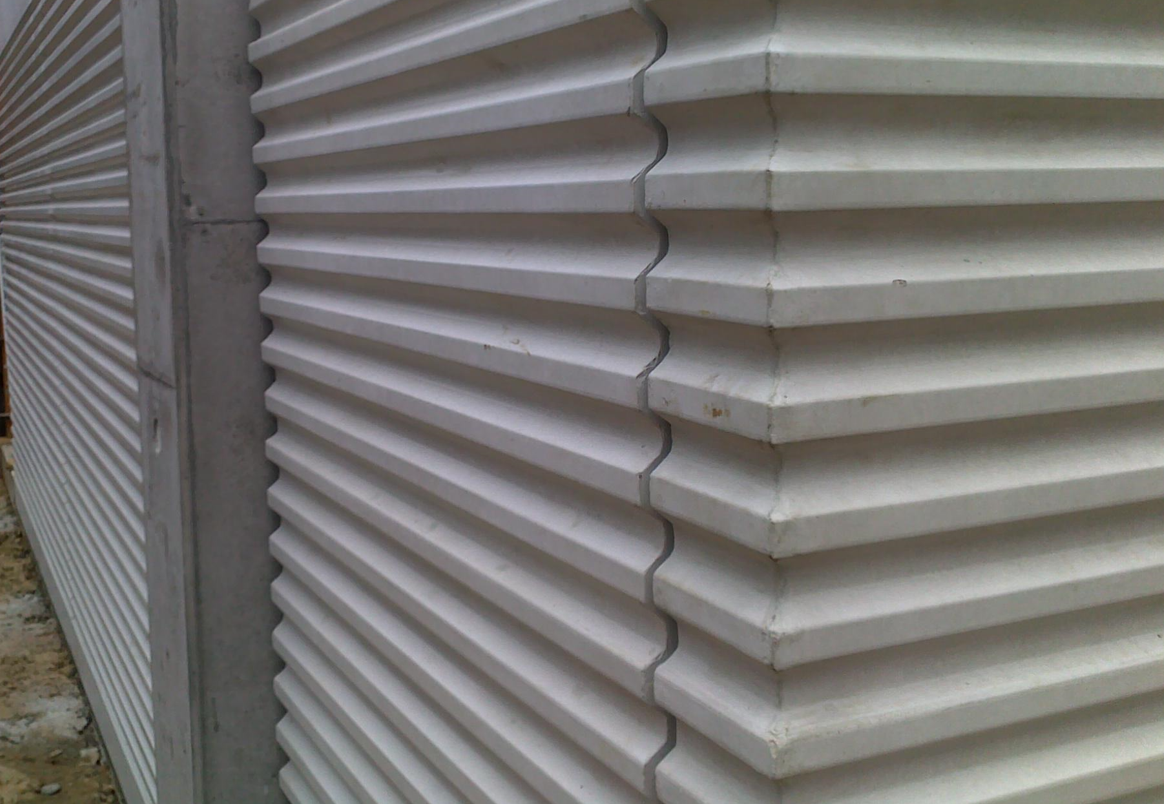
    c) Form Liner finish:

    custom façade design with architectural concrete, elastic form liners are used to form the finish by placing it on the table before pouring the concreate for the particular design of concrete facades.

    d) Retarder finish:

    It is a type of acid wash, spraying a retarding agent on the surface of the fresh concrete and leaved long time and washed to make aggregate exposed.

    e) Patterned finish:

    As per the Architecture or client requirement various shape of profile needs to make on precast surface by placing the readymade patterns on the table to form.

    f) Brick snap finish:

    Bricks are arranged on the table for required shape before pouring the concrete and demold the panel which has the bricks attached surface of the precast panel.

  • NON-TABLE PRECAST FINISHES

    The finishes are performed without help of table faces. These type of finishes are listed as below…

    a) Float finish:

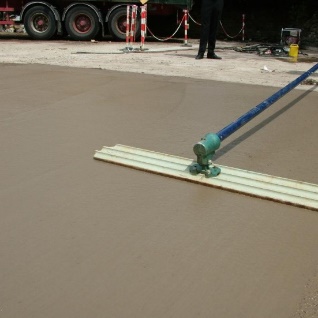
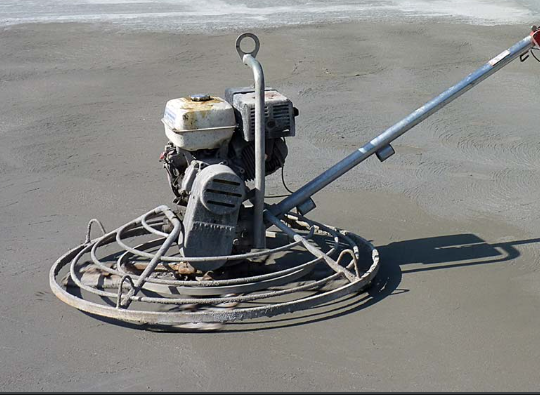
    Float is a tool used to finish a concrete surface by floating on it. After the concrete is poured on the table is levelled by using screed, then float tool is used. Float may be the small or large handle tool sometimes its powered by engine.

    b) Trowel finish:

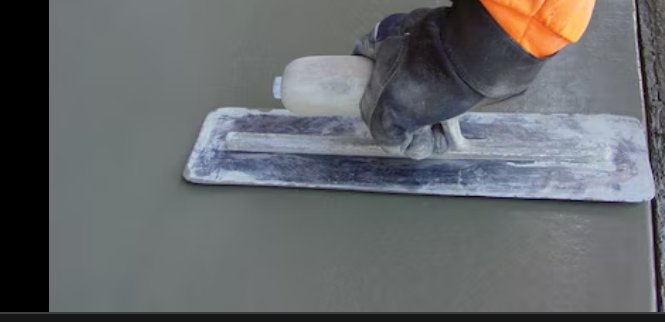
    Trowel also a tool used to finish a concrete surface by pushed and pulled across the concrete surface. Trowels are performed in both manual and mechanical types.

    A manual trowel consists of a flat steel blade with an attached handle on top. A Mechanical trowel is used for large commercial projects which have rotational of large fans with the blades directly against the concrete surface.

    c) Polished finish:

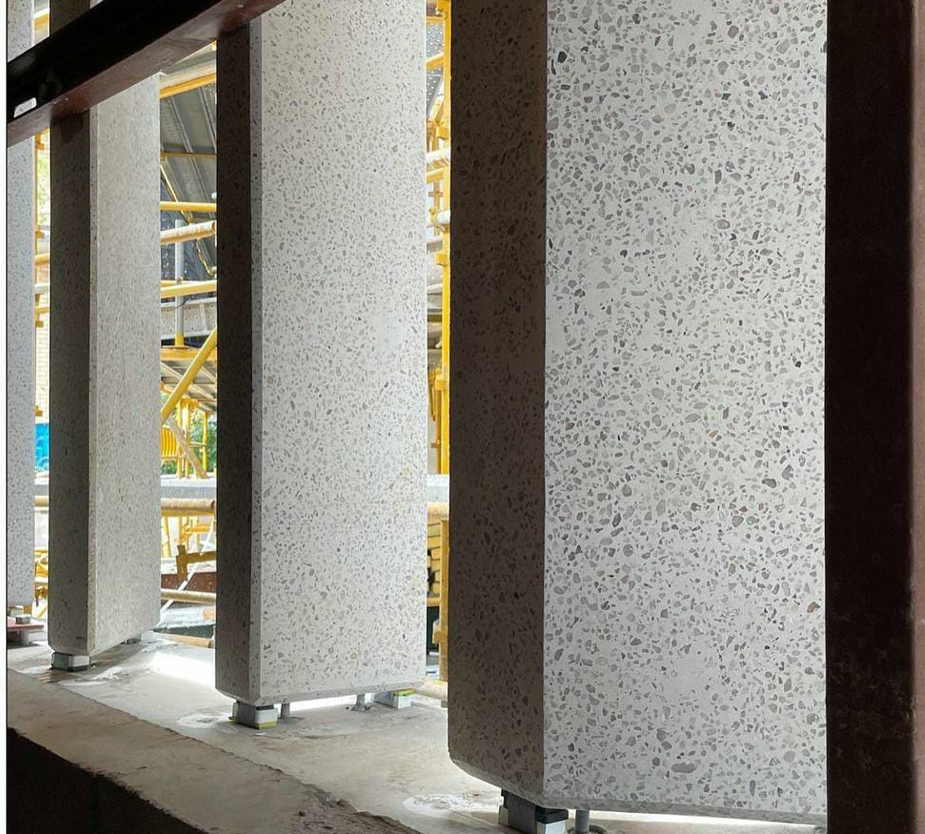
    Polished Finish is a multi-step process where a Precast concrete is polished with bonded abrasives or chemicals in order to grind a precast concrete surface. It is then refined with each grind in order to achieve a specified level of appearance.

    d) Broom finish:

    Broom finish of the concrete is rough surface finished made by forcing or dragging a broom on the troweled surface while the concrete is still fresh.

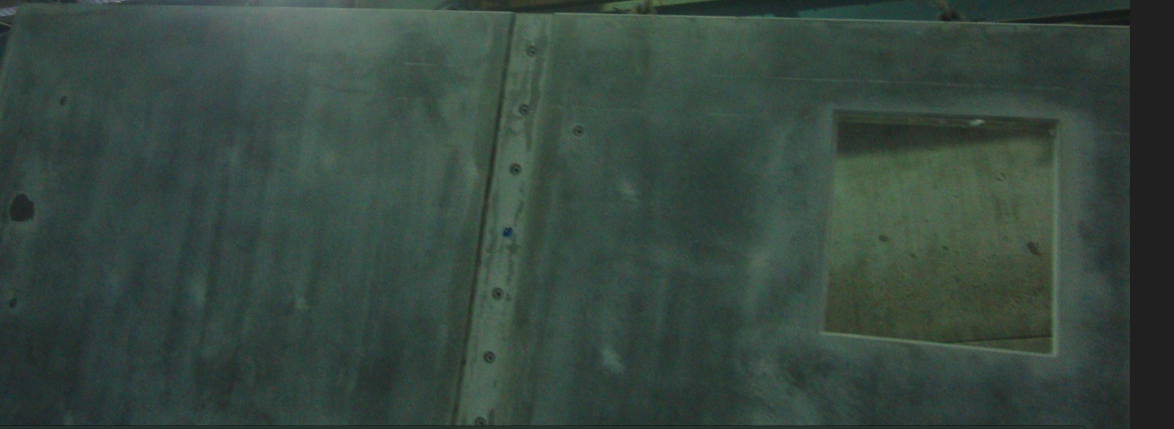
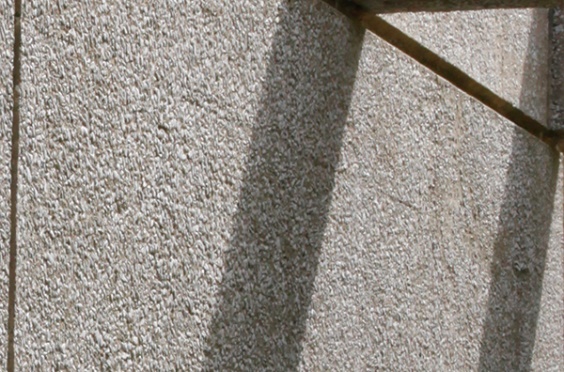
    e) Sand Blast Finish:

    A sandblasted precast panel has a rough finish which is achieved when a precast panel surface is subjected to a high-pressure blast of siliceous sand through an air gun.