Category: Steel Detailing Projects

Steel Detailing projects Show case projects details by Tek1 pty ltd

  • Rosella Bridge Successful Lift

    These cladding and frames were detailed by Tek1 Pty Ltd, fabricated and installed by JS Metal. We are proud to be part of this project.

    The successful lift was done on 26/9/2020

    Metal-works by Tek1 Pty Ltd

  • Internal Processes

    Please find below the processes we expect all staff to follow:

    • Document all instructions in writing.
      • Why? Clients may call on the telephone. Communication may be confused. People say the wrong lengths, the wrong drawing numbers, and they might be working of the wrong revisions, and people hear the wrong things. If you receive instructions via the phone: put it in writing with any applicable mark ups to make sure that everyone is on the same page. Later on, if there is some miscommunication, it becomes a “he said – she said” blame game. We want to solve our clients problems not add to them.
      • Insist that communication is sent to the right people. If important communication is sent to the wrong person: perhaps a mark up or an RFI etc. then there is a chance that it could be missed.
    • Do not issue IFC drawings without IFA approvals.
      • Why? Clients will scream that they don’t care about approvals: but approvals are very important from a safety point of view. Be firm and clear: no IFC without IFA approvals. If a client wants to take a risk and build off an IFA drawing that that will be their prerogative. We do not want to risk someone’s safety in order to expedite a construction schedule.
    • Clear all outstanding RFIs before issuing drawings:
      • Why? If you don’t have the answers to the questions you need: then you can’t draw something on assumptions. What if those assumptions are not correct? Seek the answers you need before issues drawings.
    • DO NOT RUSH a job. Do it properly rather than do a rushed, or half-complete job.
      • Why? Because you will be likely to make mistakes and cost everyone even more down the line. If a client wants a ferrule moved on a mark up immediately, when there are 10 other items that need to be moved and verified, tell the client to wait. Because if those drawings are sent through, then you’ll need to send them again with those secondary revisions, and that will likely confuse people and cause huge problems down the line. Finish the job, do it properly and move on. Don’t be pressured to deliver a shoddy work due to time pressures. Yes we are all pressured by time, but there’s no point doing it badly and then costing everyone going forward.

  • CHECK TRANSPORTATION FEASIBILITY WHILE WORKING IN AN EXISTING STRUCTURE

    The conventional maximum transportation size for an assembly is 12m x 2.5m x 2.5m. This value is not applicable for all the conditions.

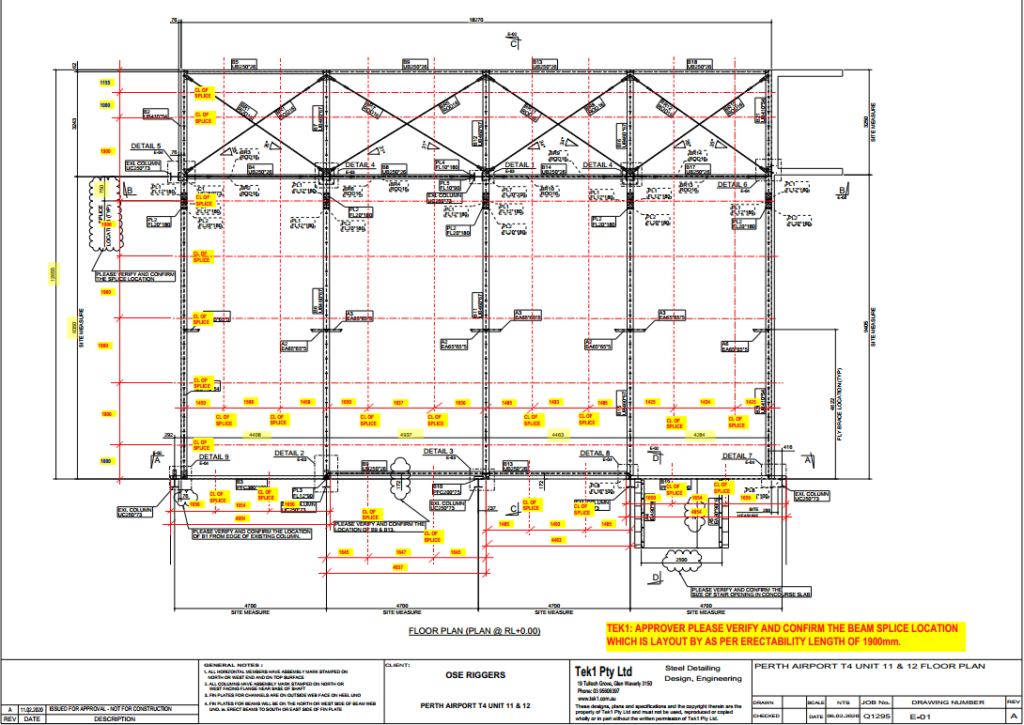
    TEK1 executed an alteration work inside Canberra airport. Everything that enters an airport must go through the checking / screening area. As per design, the size of assemblies were more than 9m & we were not sure whether these assemblies could be transported into the Airport. So, TEK1 raised a query regarding this. The client agreed to reduce the size of transported assemblies.

    Lesson: Whenever a work is carried out inside an existing building, consideration must be given for taking in the assemblies i.e. door/entrance size is mandatory. Since a completed airport terminal is a closed roof structure, cranes cannot be used for erection. Here the erection is done with the help of genie lifts. Weight carrying capacity of the erection machinery must also be taken into consideration.

    See below design snap & TEK1 proposal markup for splice location.
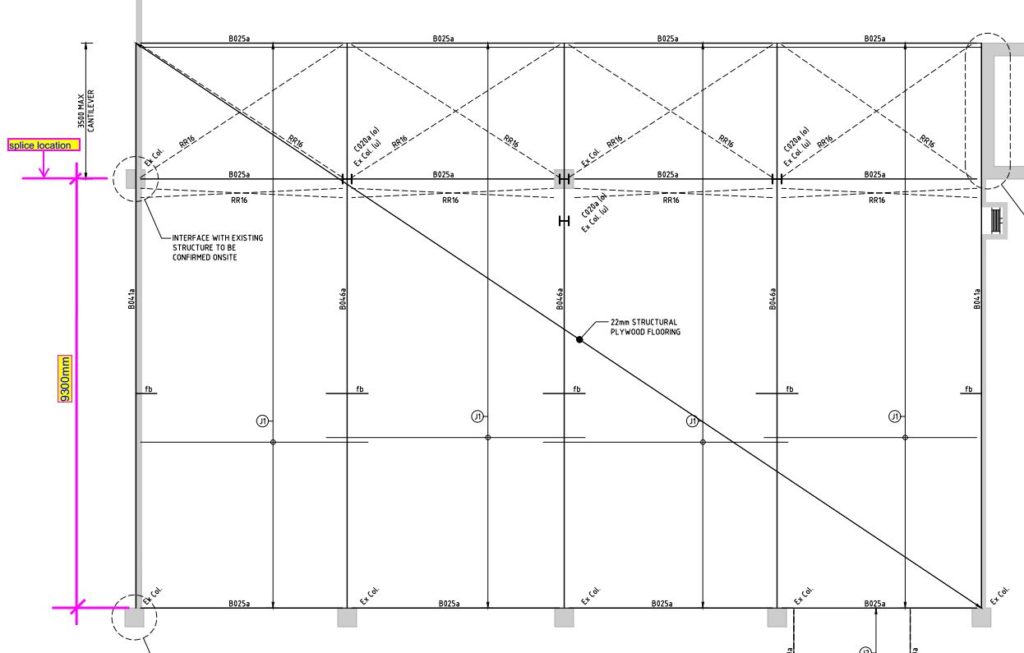
    ABOVE SNAP TAKEN FROM STRUCT DESIGN. SHOWN ASSEMBLY SPLICE LOCATION AS 9300 mm.

    PLEASE REFER BELOW SNAP WHICH SHOWS PROPOSAL MADE FROM TEK1 & THAT WAS APPROVED BY STRUCT ENGINEER.