Tag: stairs

  • Addressing Stair Landing Slopes with Steel Modifications

    Addressing Stair Landing Slopes with Steel Modifications

    In our previous blogs, we discussed common mistakes that can occur while detailing a stair landing with slopes. You can find the link to the previous blog here: https://www.tek1.com.au/australian-standards/designing-a-multi-level-staircase-common-mistakes-and-key-considerations/


    Now, the designers have replaced precast slabs with pavers. Since pavers cannot have varying thicknesses, we were instructed to do something with the steel structure to achieve the required falls.
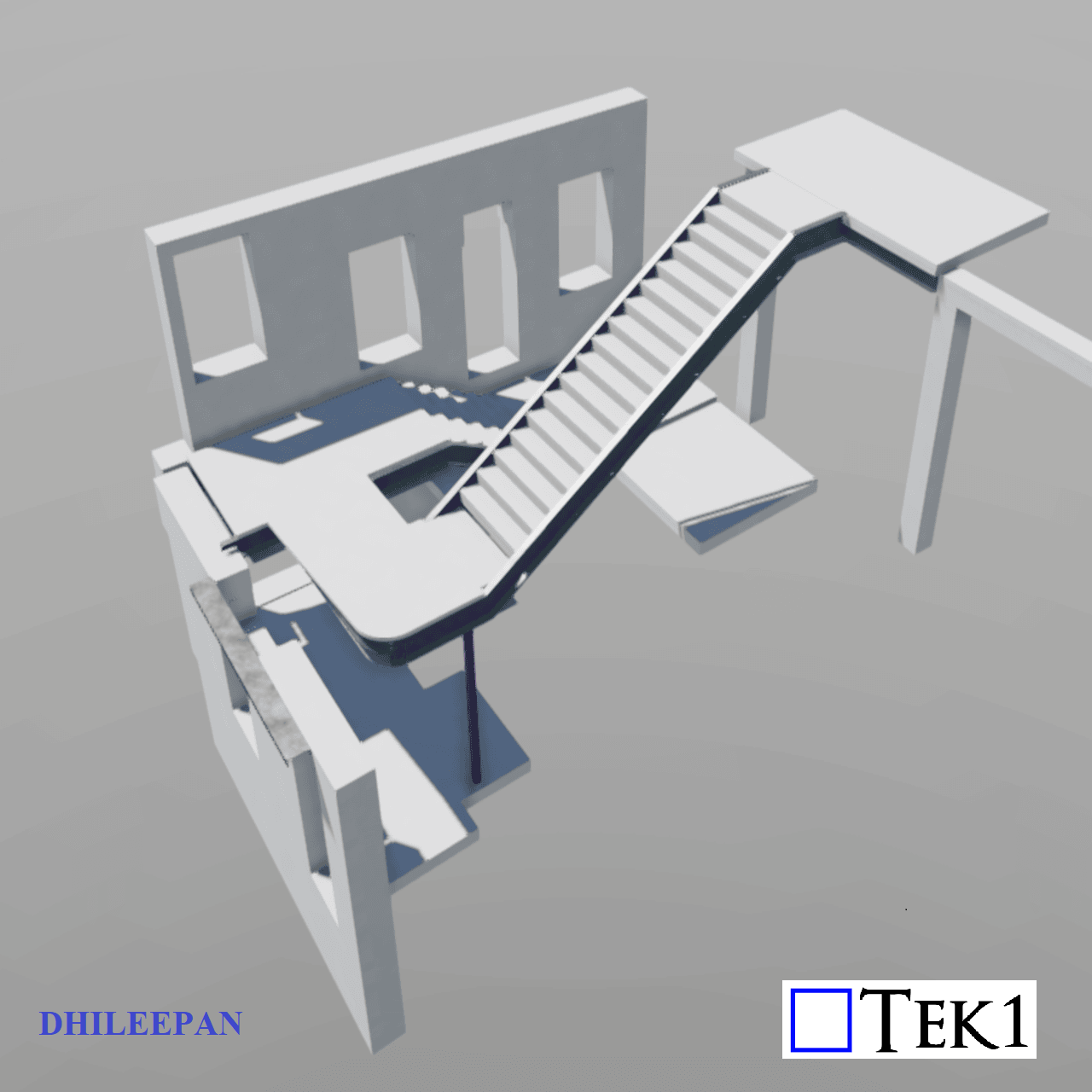
    The stair landing system has steel frames, 10mm plates on their top & EA support members to bolt them. The 50mm pavers are placed on top of the 10mm plates.


    TEK1 played a key role in designing the modifications, adjusting the steel supports and slopes to achieve the necessary fall. If the required slope were unidirectional, achieving it would be straightforward. However, in this case, the stair turns 180°, and the mid-landing’s fall transitions in three directions.

    Handling Slope Transitions
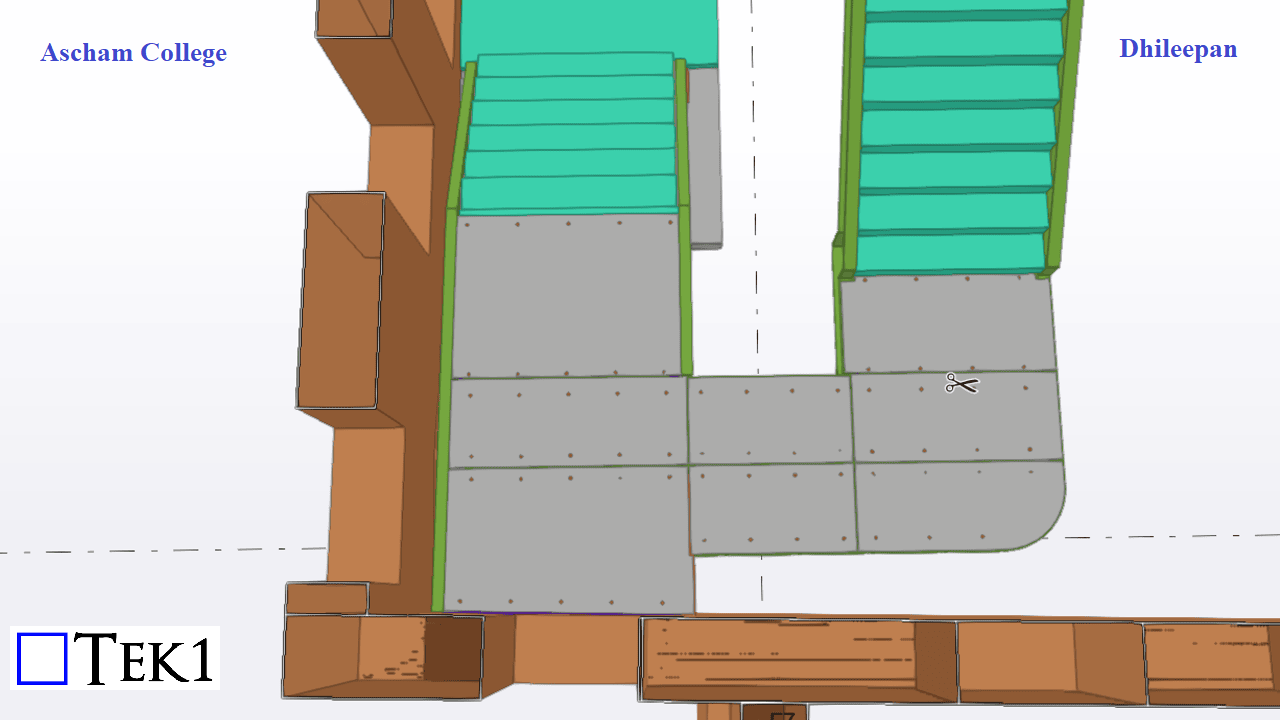
    The landing below Flight-02 and the top of Flight-01 are in opposite 180° directions.
    A single rectangular plate cannot connect these two slopes seamlessly.
    To address this, we introduced two triangular plates in the middle to enable a smooth transition between the slope directions.
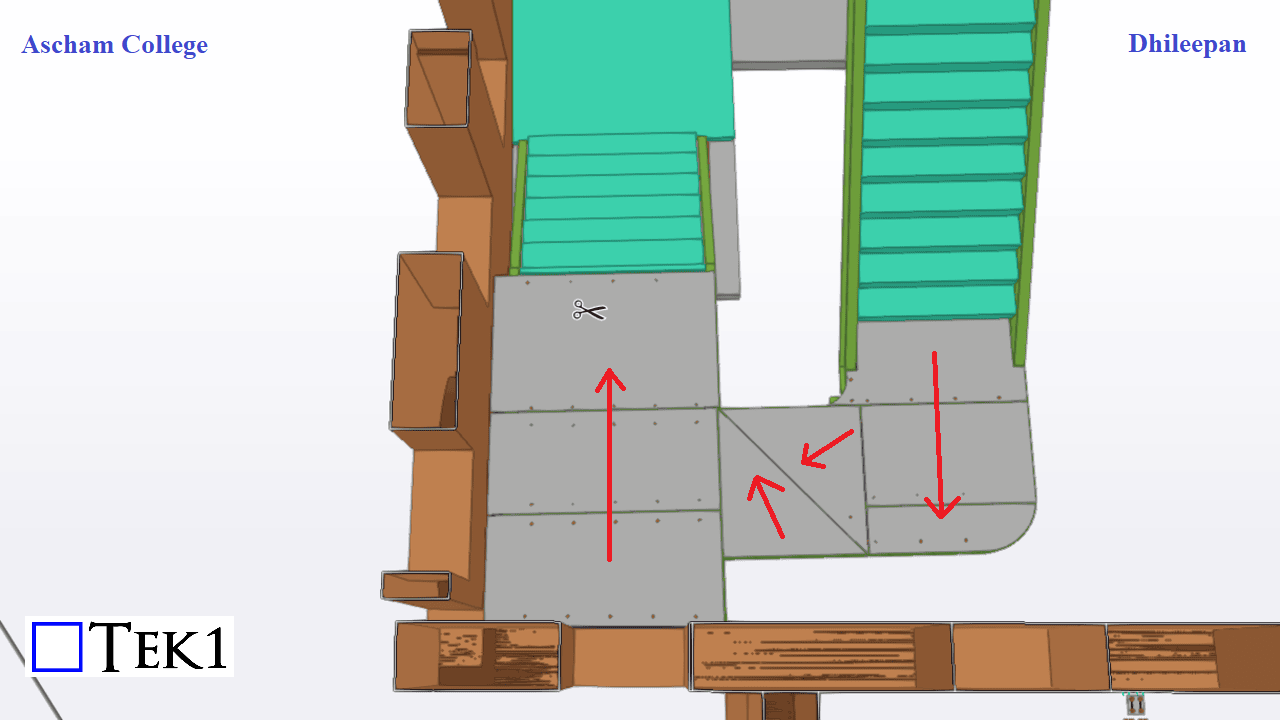

    Structural Adjustments

    The main steel structural members remain consistent throughout the mid-landing.
    We adjusted the RL (Reduced Level) and slopes of the EA support members to match the required slope of the 10mm plates that support the pavers.
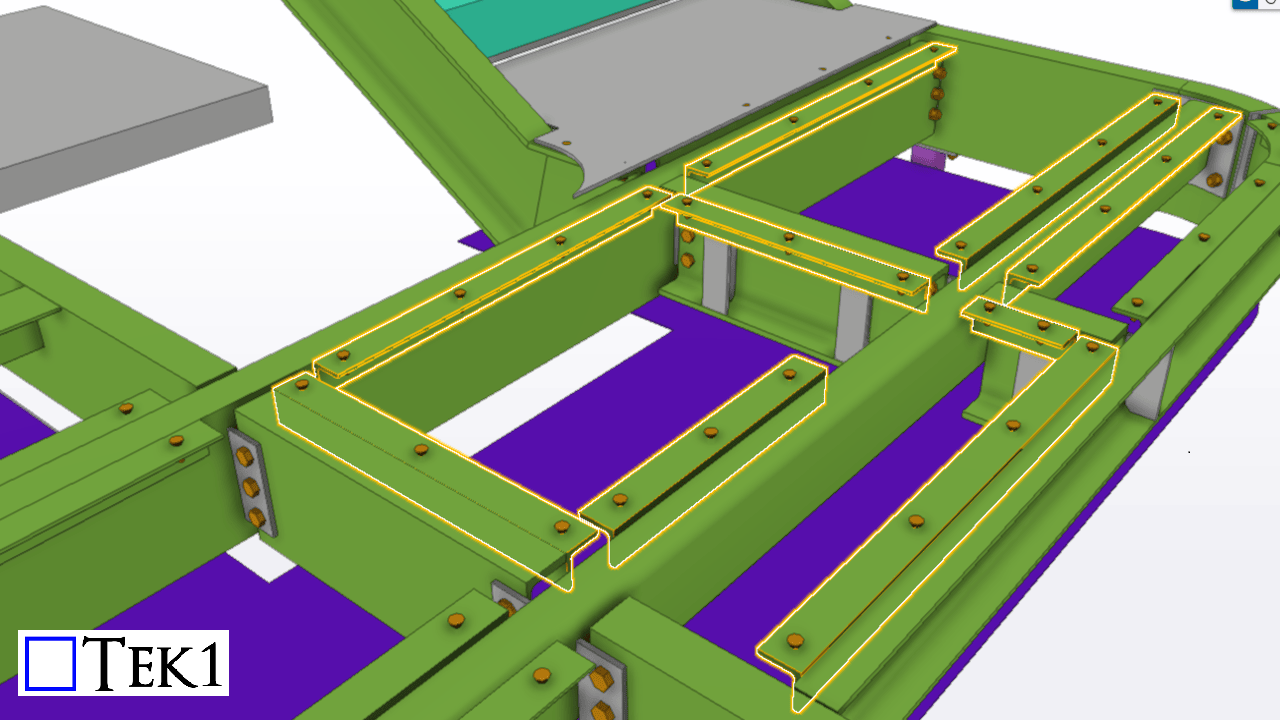

    By implementing these changes, we successfully accommodated the required falls while ensuring structural integrity and proper drainage. This approach maintains a practical and efficient solution when using pavers instead of precast slabs in stair landings.
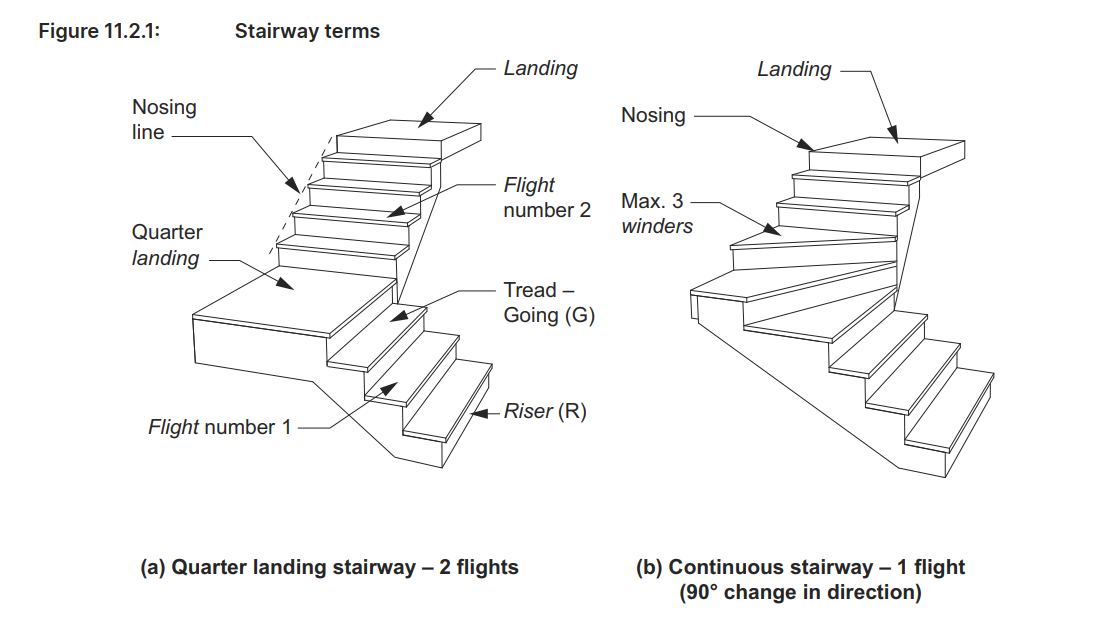
  • Step-by-Step Guide to Commercial Stair Detailing (According to AS1428.1 and ABCB Housing Provisions Standard 2022)

    Step-by-Step Guide to Commercial Stair Detailing (According to AS1428.1 and ABCB Housing Provisions Standard 2022)

    If you would like me to assist with your project, please send an email to koshy@tek1.com.au with your project specifications. Kindly use ‘Raj’ as the subject header.

    Overview
    This guide provides instructions for designing and detailing commercial stairs per the Australian Standards AS1428.1 and ABCB Housing Provisions Standard 2022. These standards ensure safe and accessible stairways in commercial buildings, with specific provisions related to the National Construction Code (NCC) and the Disability (Access to Premises-Buildings) Standards.

    1. General Stair Requirements (Non-Spiral Stairs)

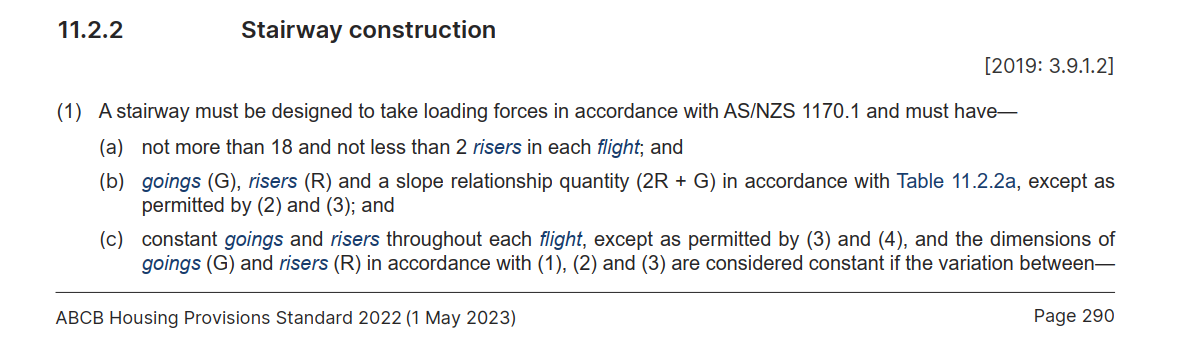
    • Riser Quantity: Each flight should have at least 2 risers but no more than 18 risers.
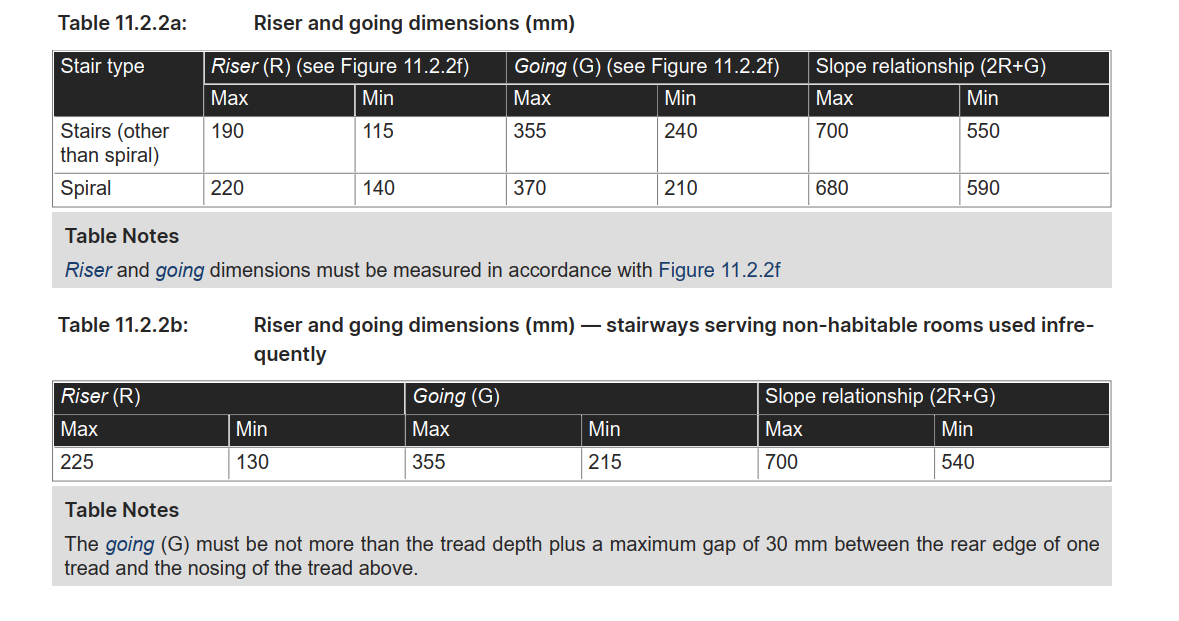
    • Riser Height: Must be between 115mm and 190mm.
    • Going Width (Tread Depth): Must be between 240mm and 355mm.
    • Stair Slope Rule: Follow the formula 2R+G, where:
      • Minimum Slope: 550mm
      • Maximum Slope: 700mm
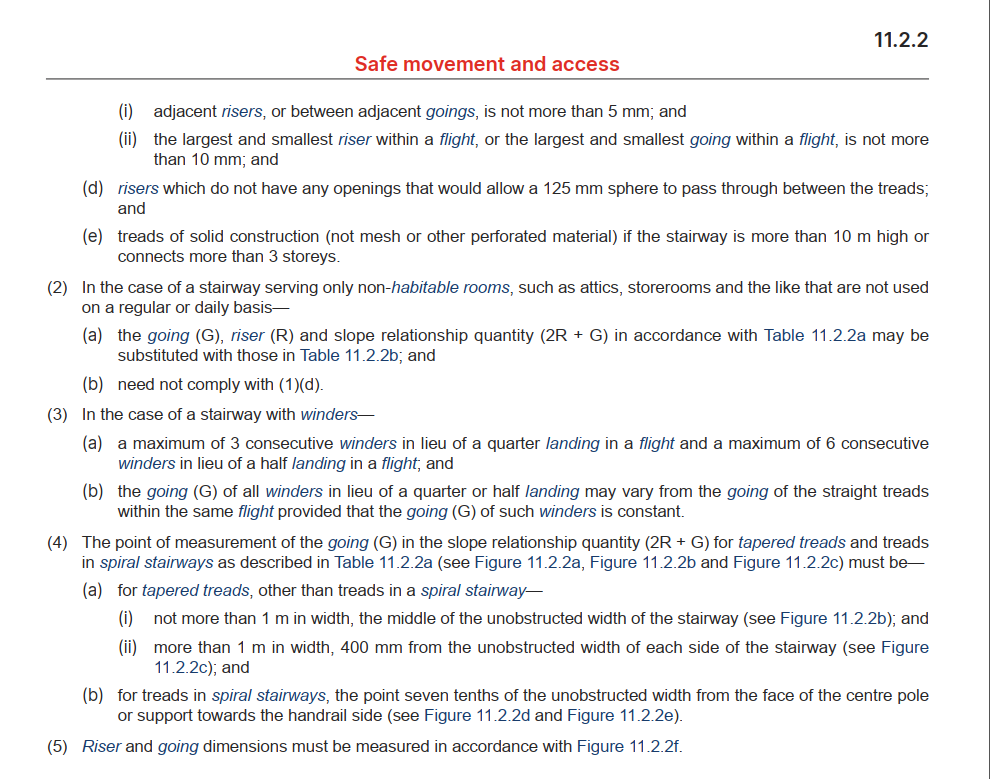
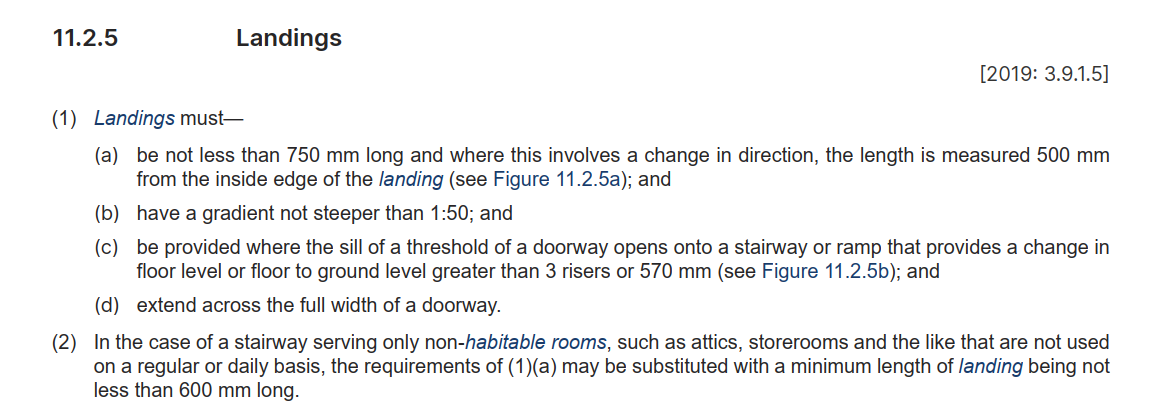
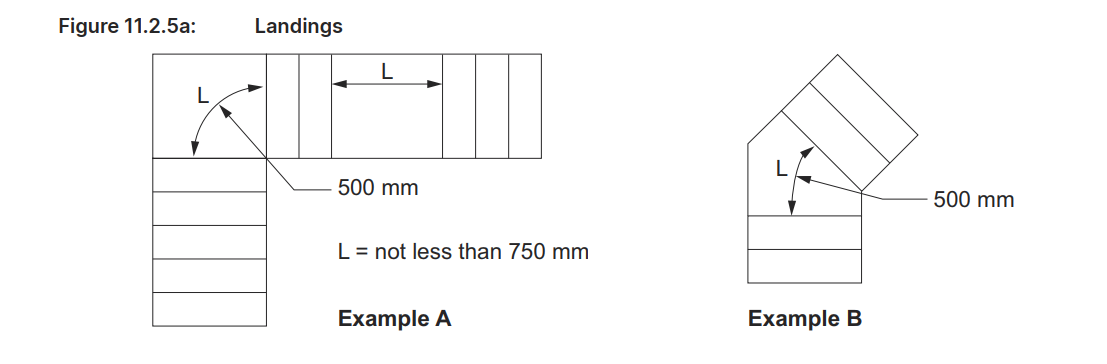
    • Landing Requirement: Landings must be at least 750mm in length. If the landing changes direction, measure at least 500mm from the inside edge of the landing​(abcb-housing-provisions…).

    2. Spiral Stairs Specifics

    • Riser Quantity: Similar to regular stairs, spiral stairs must have at least 2 risers and no more than 18 in each flight.
    • Riser Height: Must be between 140mm and 220mm.
    • Going Width: Must be between 210mm and 370mm.
    • Stair Slope Rule: Use the formula 2R+G with the following limits:

    3. Landings Specifications

    • Minimum Length: Landings must be at least 750mm in length.
    • Directional Change: For landings with a change in direction, measure at least 500mm from the inside edge.
    • Gradient: The landing slope must not exceed 1:50 to ensure levelness while allowing for slight drainage.
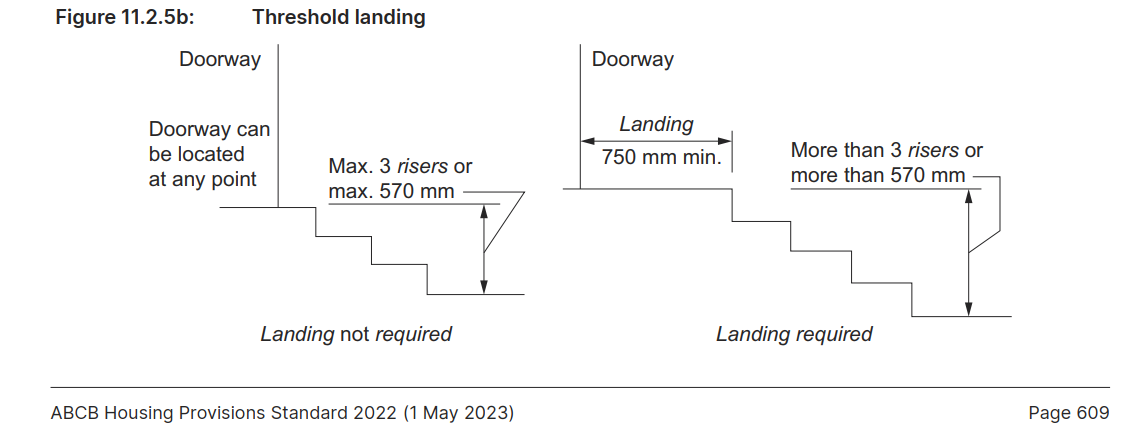
    • Threshold Requirement: A threshold landing is required where there is a floor level change of more than 570mm or three risers​(abcb-housing-provisions…).

    4. Slope and Safety Measures

    • The 2R + G formula is essential for the slope and safety of both standard and spiral stairways, ensuring each stairway is easy to ascend and descend.
    • Open Risers: Risers must not have openings wide enough to allow a 125mm sphere to pass through, minimizing the risk of small children or objects falling through.
    • Tread Solidness: Stairs that are taller than 10m or connect more than three floors must have solid, non-perforated treads for additional safety​(abcb-housing-provisions…).

    5. Consistency in Dimensions

    • Uniformity Across Flights: All risers and goings within each flight should be consistent.
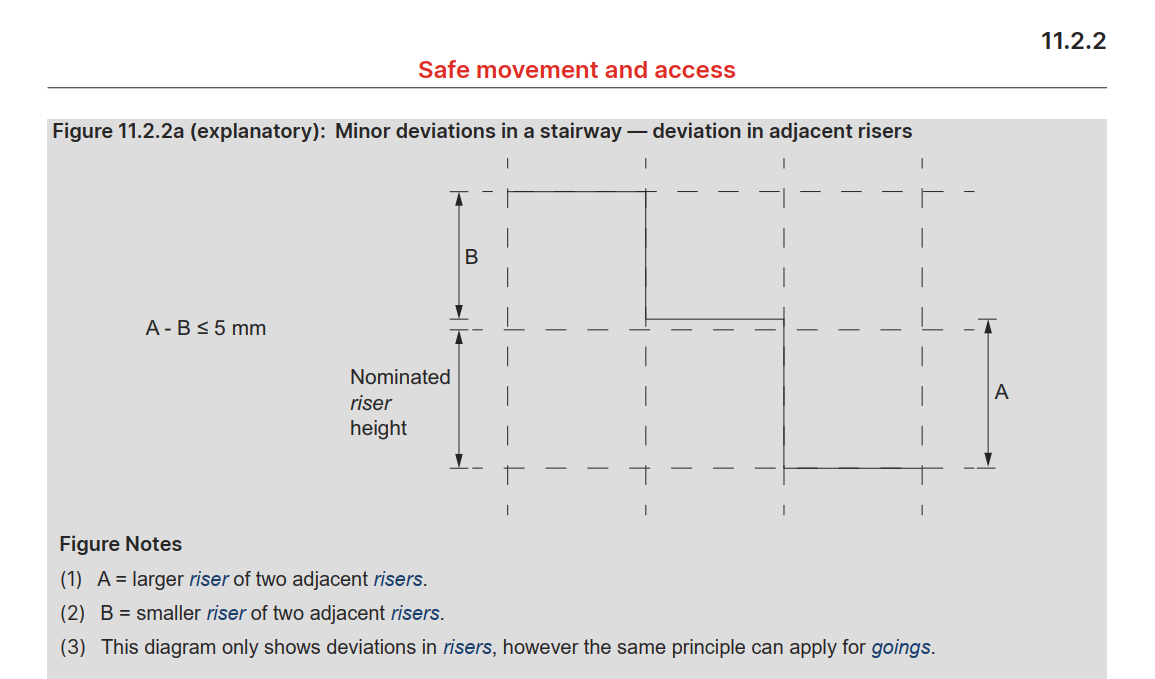
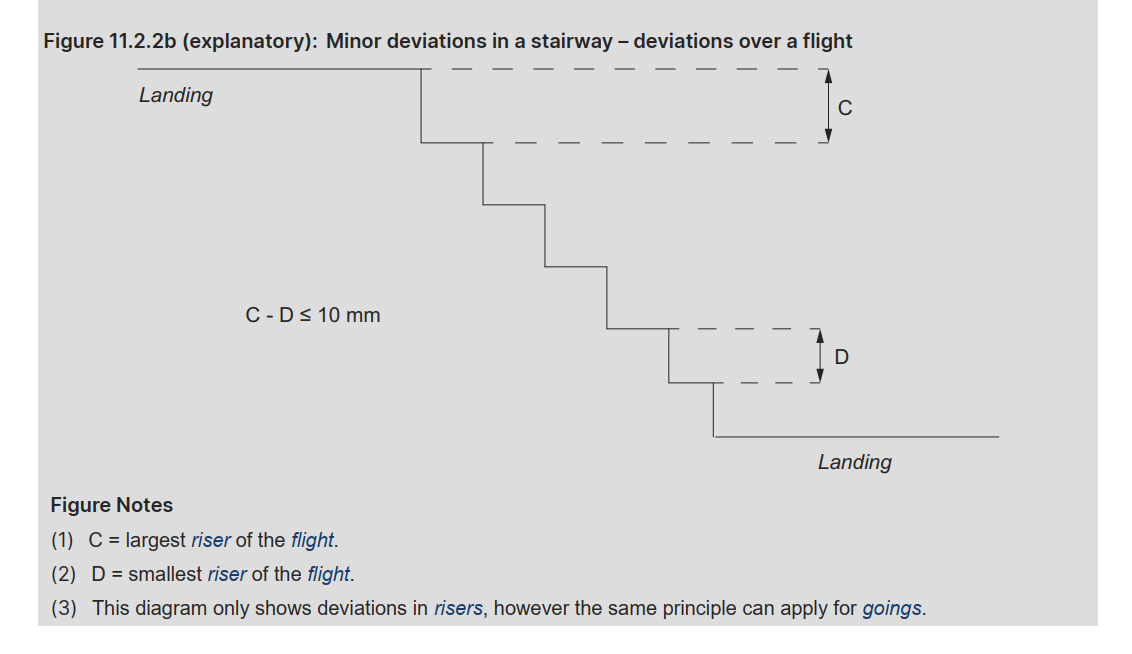
    • Permitted Variations: Adjacent risers and goings may vary up to 5mm, but the difference between the largest and smallest within a flight should not exceed 10mm​(abcb-housing-provisions…).

    6. Slip Resistance Requirements

    • Slip Resistance Testing: All treads, landings, and ramps should meet slip resistance classifications as per AS 4586. This includes:
      • Dry Conditions: Minimum P3 or R10 for treads; P3 for nosing or landing edge strips.
      • Wet Conditions: Minimum P4 or R11 for treads; P4 for nosing or landing edge strips​(abcb-housing-provisions…).

    7. Barriers and Handrails

    • Barrier Height: Barriers should be at least 865mm above the nosing of stair treads, and 1m above landings and other access surfaces.
    • Handrails: Must be placed on at least one side of the stairway, running the full length of each flight and at a height of no less than 865mm.
    • Opening Limitations: No opening in the barrier should allow a 125mm sphere to pass through​(abcb-housing-provisions…).

    By following these steps, builders and architects can ensure that commercial stairs meet the safety and accessibility requirements established in AS1428.1 and the ABCB Housing Provisions Standard 2022.

  • Using Moodle to train your staff on Stair Standards

    Tek1 has set up an online training course to train our detailers on stair standards.

    We have found this as an effective way of testing

    Here is the URL. Please register your interest so that we can make it available to you. If there are enough interest, we could make this course self registering

  • An Example of a Non-compliant Stair-case: A Case Study (Australian Standards)

    What happens if you don’t get it right?

    Have you ever fallen down a flight of stairs? I hope not! But from experience I can tell you that it’s not a very pleasant one. I slipped as I was walking down – I fell supine, hard, like a hammer on a nail, bang into the corner of the steps. The pain was absolutely numbing – I could walk for about three days, nor could I even roll over in bed for about that same period. Falling down stairs is a dangerous business – and if you’re in the business of designing or fabricating stairs – especially public access stairs, then you absolutely have to get it right. Because if you don’t, then it’s only a matter of time till someone falls. Luckily I was a young man, so I recovered pretty quickly. But if I was an invalid, a fall like that could be potentially life threatening!

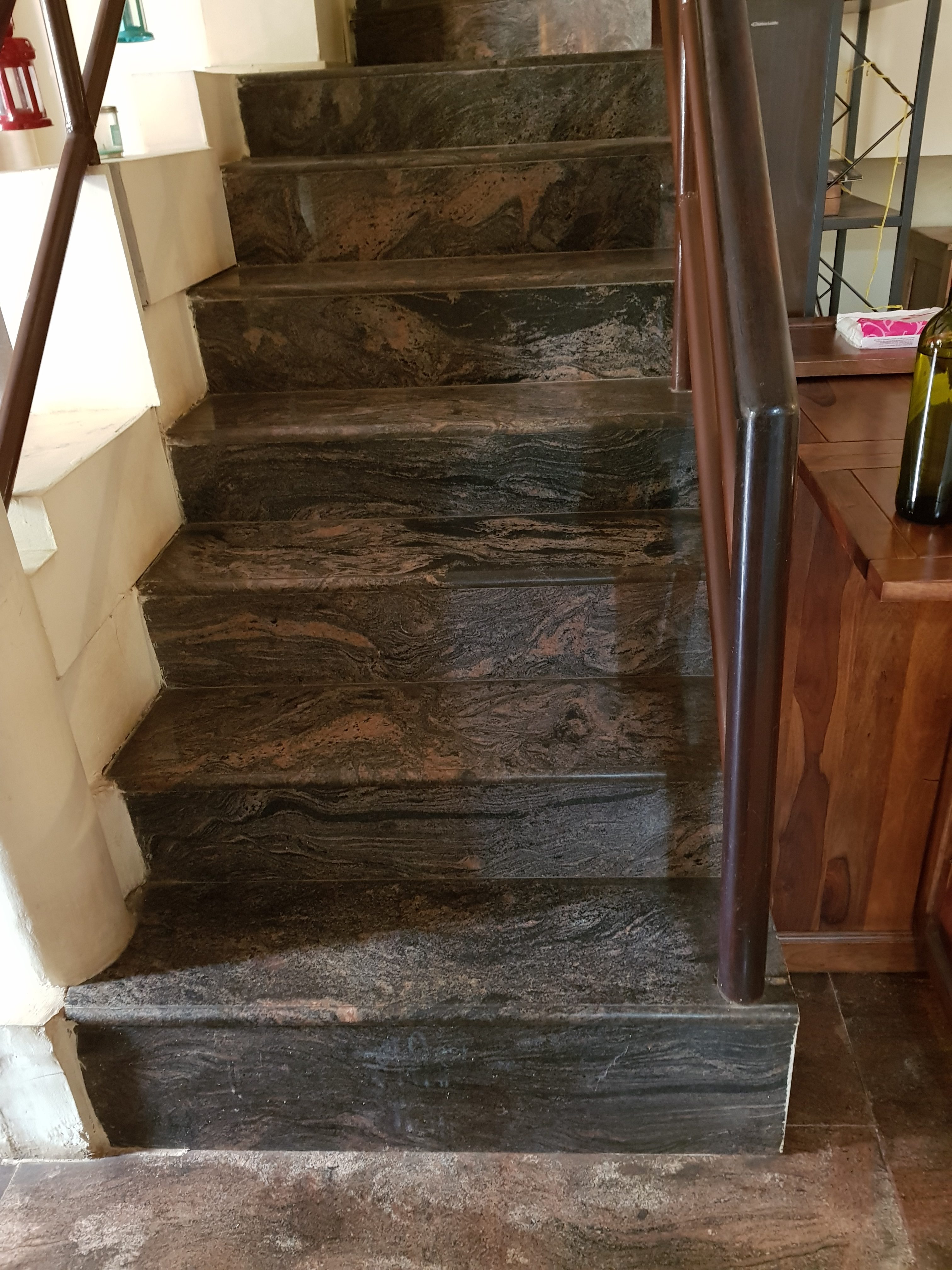
    Here is an example of a badly designed stair:

    An example of a staircase which was not made according to AS specifications or perhaps any sort of specifications apart from the builder's convenience I suppose. This type of shoddy workmanship will be the cause of many injuries and accidents. Designing structures according to the specifications mandated is absolutely essential.
    An example of a staircase which was not made according to AS specifications or perhaps any sort of specifications apart from the builder’s convenience I suppose. This type of shoddy workmanship will be the cause of many injuries and accidents. Designing structures according to the specifications mandated is absolutely essential.

    The steps are not uniform – they vary in height and length. This is not safe if you are traversing it. It’s easy to misjudge. That’s why when we do the shop drawings for a flight of stairs we check that it’s uniform, that you don’t have too many stairs in a flight, that there’s adequate room, that a child cannot squeeze his/her head in between the treads, etc. I have ascended and descended these steps – and were it not for the handrails, it would be very dangerous. Don’t do steps like this. Here were the measurement from the bottom riser going up:

    1. 29 cm
    2. 20 cm
    3. 20 cm
    4. 18 cm
    5. 17.5 cm
    6. 15.5 cm


    The risers vary too much!

    Our staff are trained to ensure that their stairs comply with Australian Standards. We’re definitely not the cheapest, but we’ll know if we see a bad design – and knowing that information could save you a bundle.