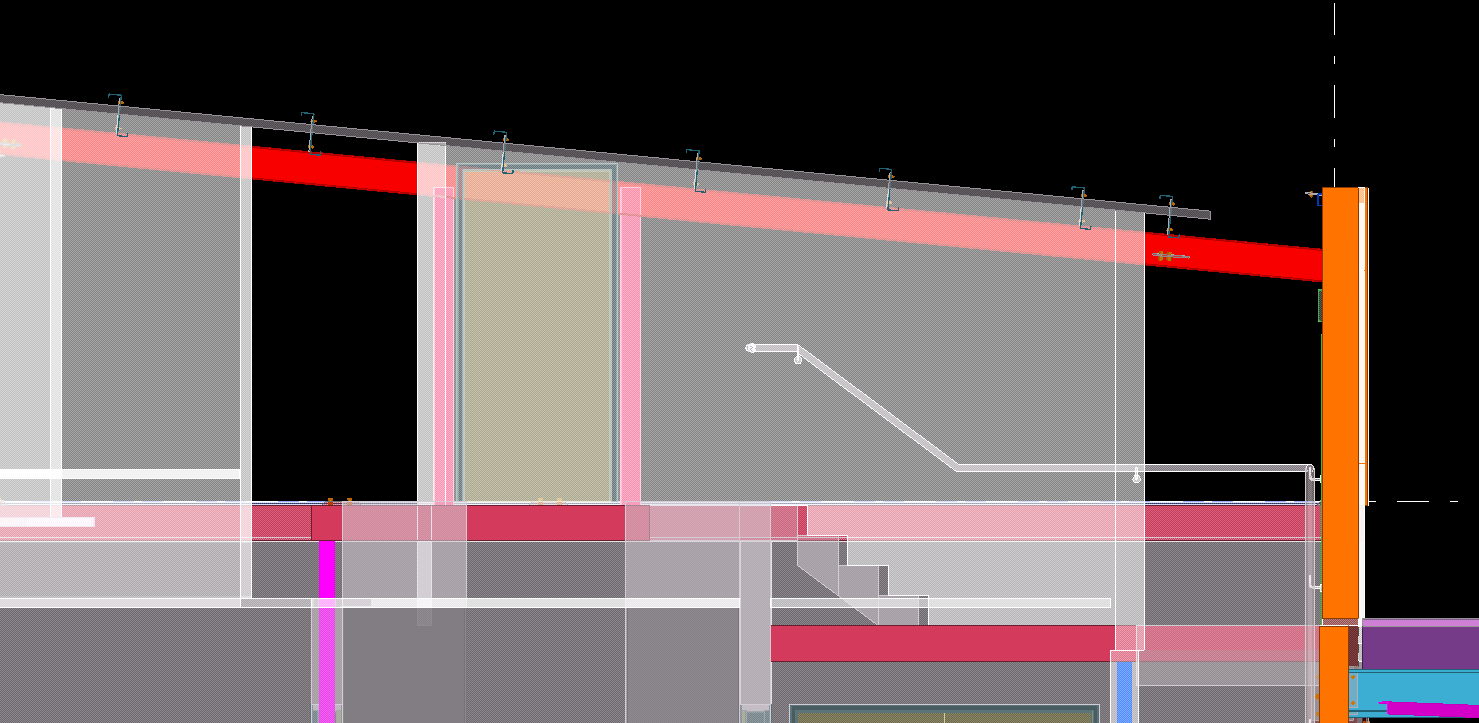
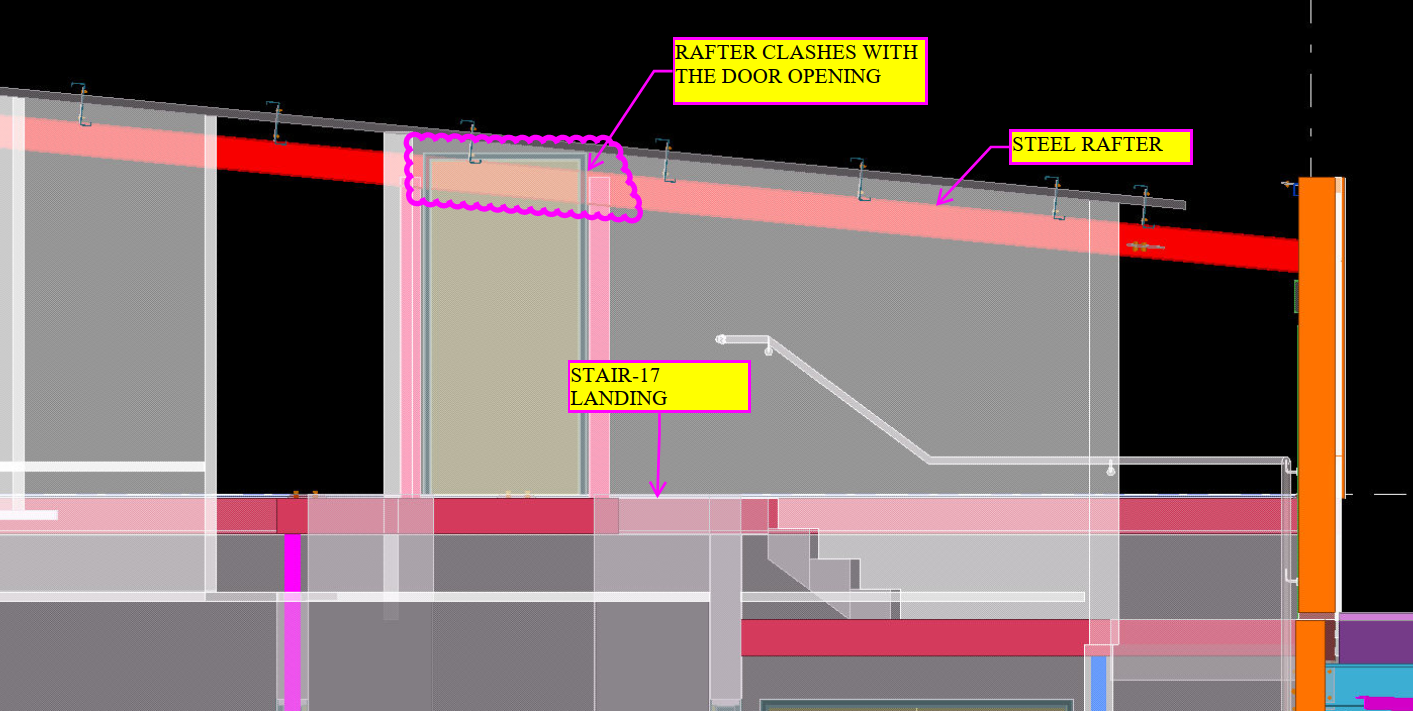
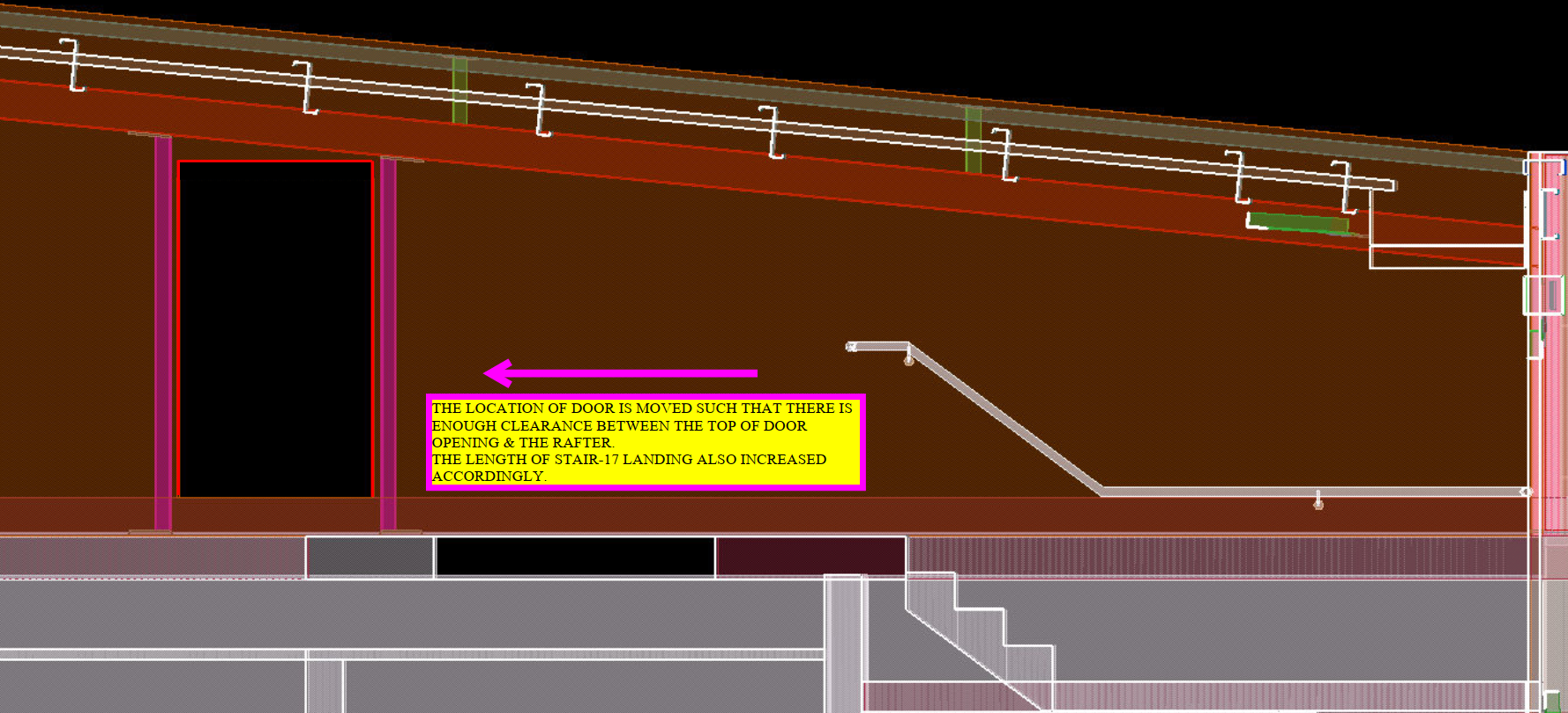
Our detailers identified & noticed that the roof rafter falls at the door opening which runs at 5.5° slope.
The Roof rafter is concealed inside the stud wall, also the Stud wall runs above the Rafter up to the top of parapet RL. The height of parapet wall is the same throughout, hence the top of the wall runs at the same 5.5° slope as the roof.
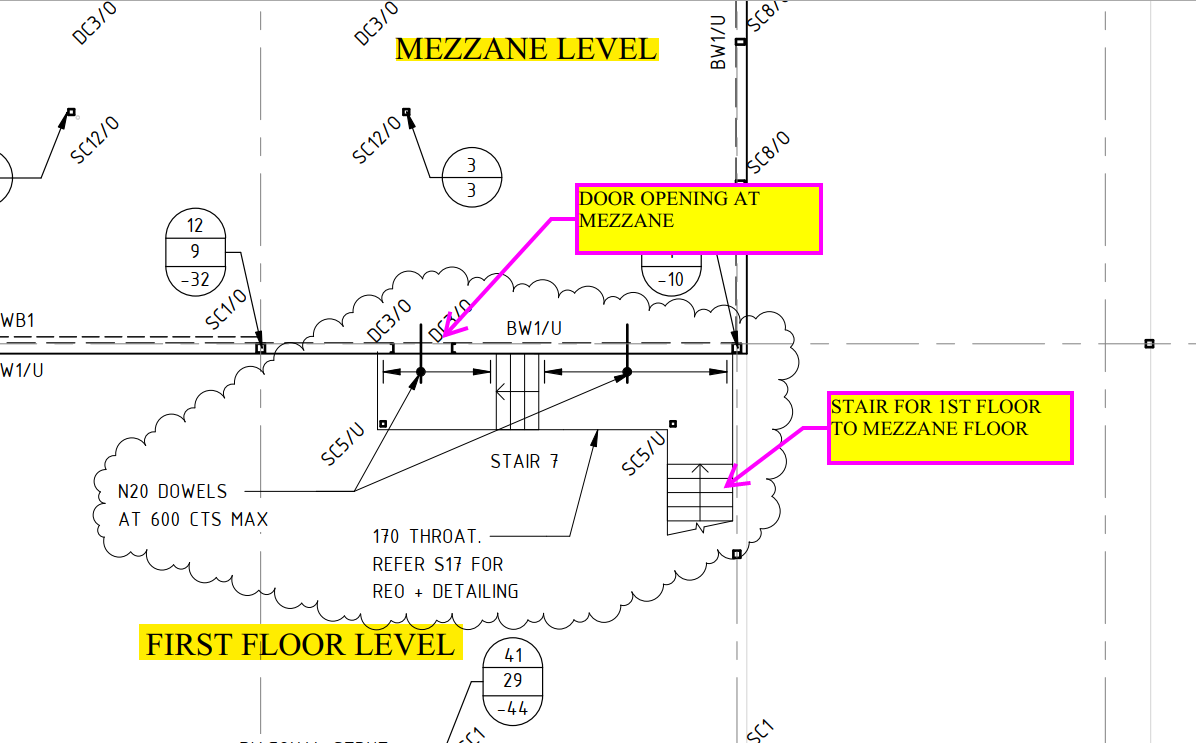
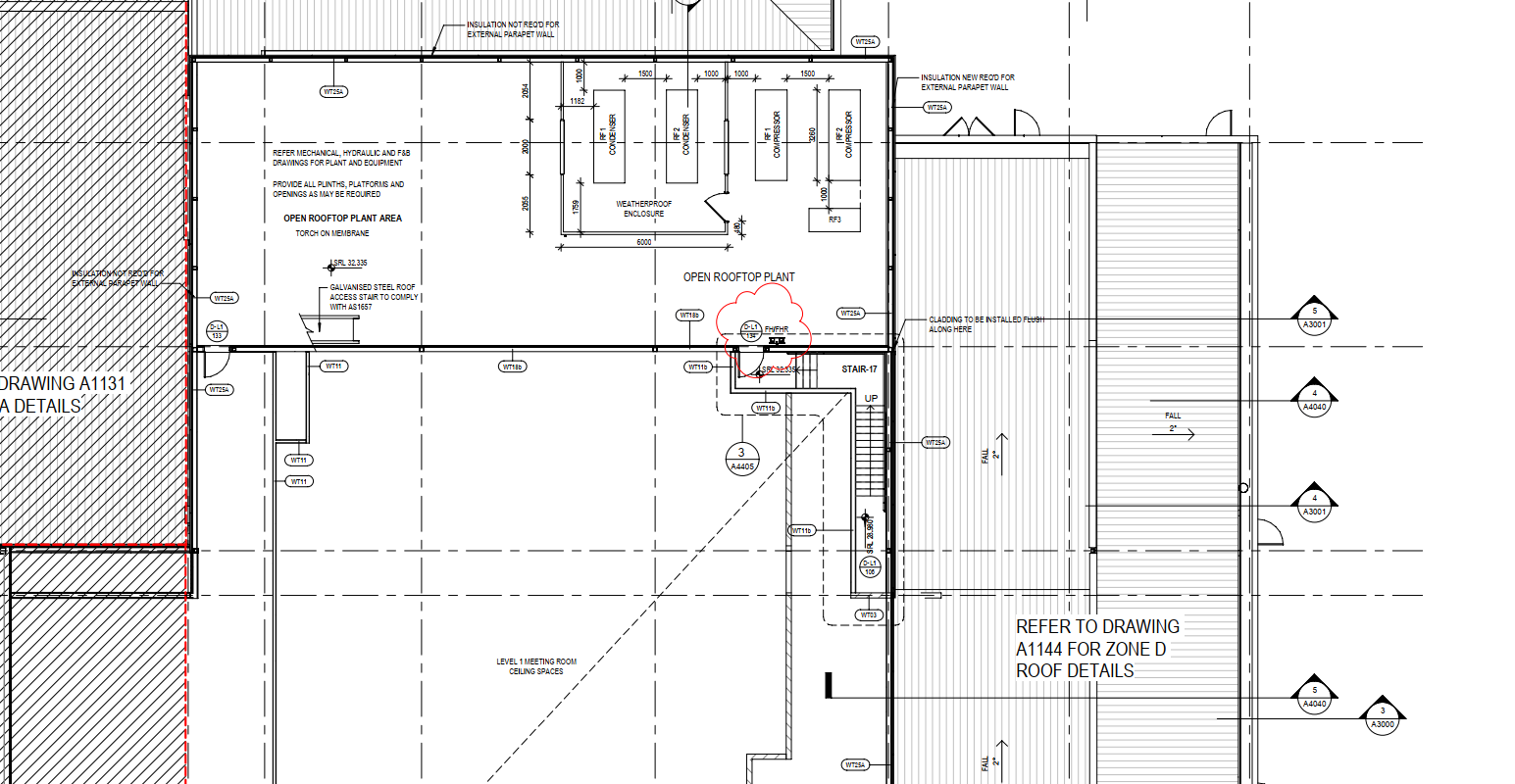
There is an access door near the lower end of the stud wall/Roof. We noticed that the rafter falls inside the door opening and suggested the client to move the door & increase the Stair landing length accordingly.
The suggestion is accepted and the door is moved in such a way that there is enough clearance between the top of door opening and the rafter soffit.
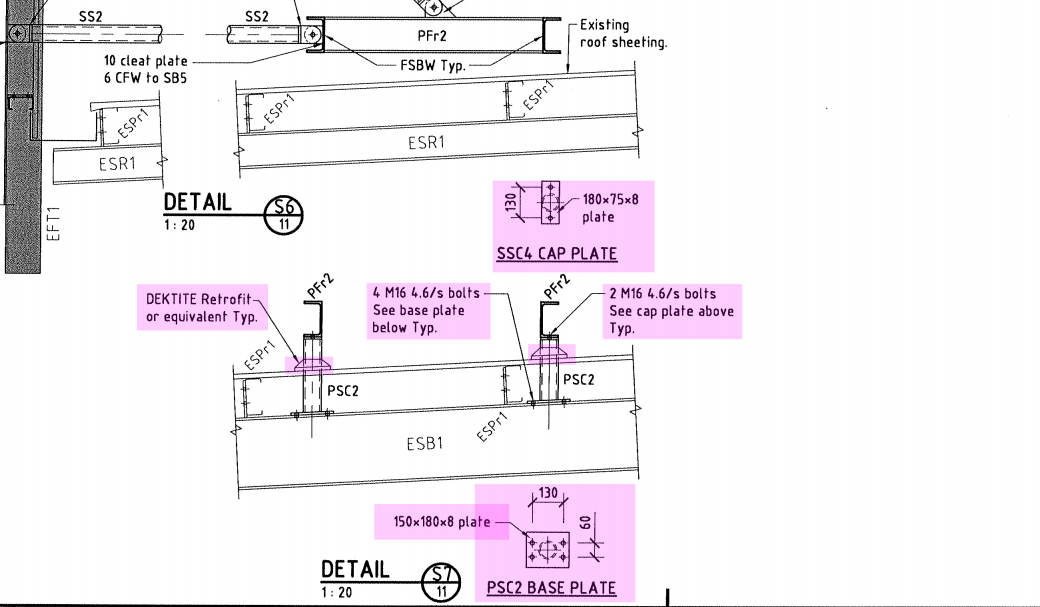
Please study the following drawing. The engineer has called for these details. But as detailers, can you see any issues which may come up? Consider the problem carefully and let us review the issues below. (Given information: the below is a drawing of a corrugated roof. There is a deck to be placed on top of the roof. Hint: waterproofing is the primary concern).
Can you spot any issues with the above drawing?
What is going on here?
The issue lies with water proofing. Corrugated roofing is not flat. It is bent and curved. In this case we have a beam that is penetrating through the roof. In these circumstances, water proofing is critical, and we need some type of Decktite (or equivalent) to be placed on the roof to ensure that water does not seep through. But then, what is the problem here?
To understand this issue, you would do well to watch these two videos first:
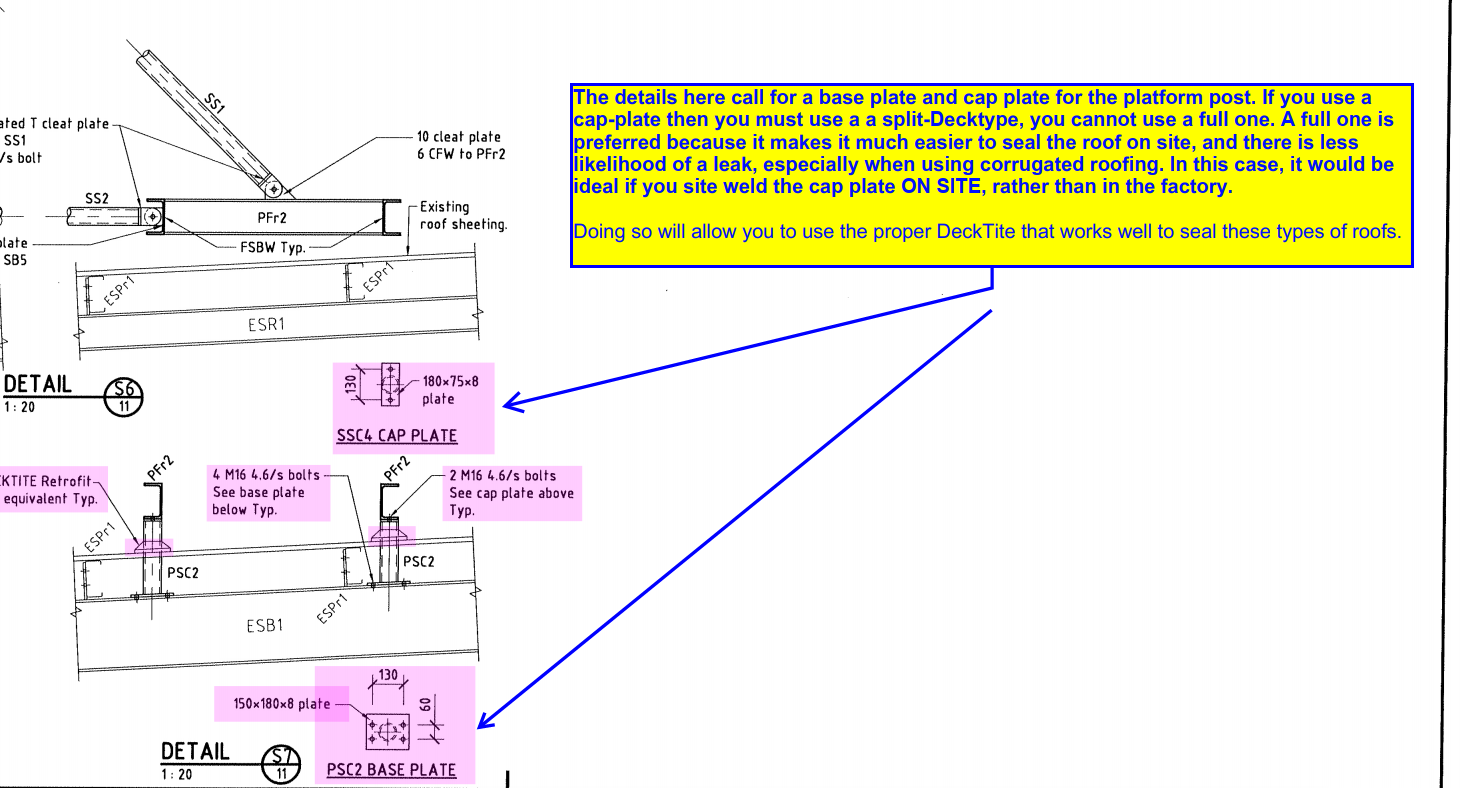
The problem lies in the fact that the drawing calls for a cap plate. That is extremely problematic when you are using Decktite. The usual and preferred practice is to pull some Decktite over a pole and slide it down – much like pulling a T-shirt over your head. You can think of the DeckTite as the T-shirt, and your head as a pole. The hole in the T-shirt fits snugly around your neck. But if you have a cap plate, the situation becomes different. In effect, to continue the analogy, having a cap plate is like expanding your head so that it is impossible large to be able to pull a T-shirt over it. You simply cannot put on a t-shirt if your head is too large! The only way to wear the garment is to use a jacket, which can be split and wrapped around – which in this case means using a split Decktite. The problem with using split Decktite on corrugated roofing is that it doesn’t seal as well, and is cumbersome to install.
In this case, you ought to confirm with the client how they want to handle this issue. If you bolt a cap plate on top of the column, then you are forced to use a split-Decktite. But if you want to weld on site, then you can use Decktite that is not split, and can largely avoid the complications of leaks occurring on the roof.
Shows the issues which may crop up if the drawings is followed. You need to confirm these types of issues with the client.