Month: October 2024

  • Compliance with AS 1428.1 and BCA: Limiting Riser Openings to 125 mm in Commercial Staircases

    Compliance with AS 1428.1 and BCA: Limiting Riser Openings to 125 mm in Commercial Staircases

    If you would like me to assist with your project, please send an email to koshy@tek1.com.au with your project specifications. Kindly use ‘Raj’ as the subject header.

    When performing detailed engineering for commercial staircases and balustrades, it’s essential to ensure that all aspects comply with AS 1428.1 and the relevant provisions from the Building Code of Australia (BCA), particularly those regarding accessibility and safety. Here’s a breakdown of the critical points you must address:

    Compliance with AS 1428.1:
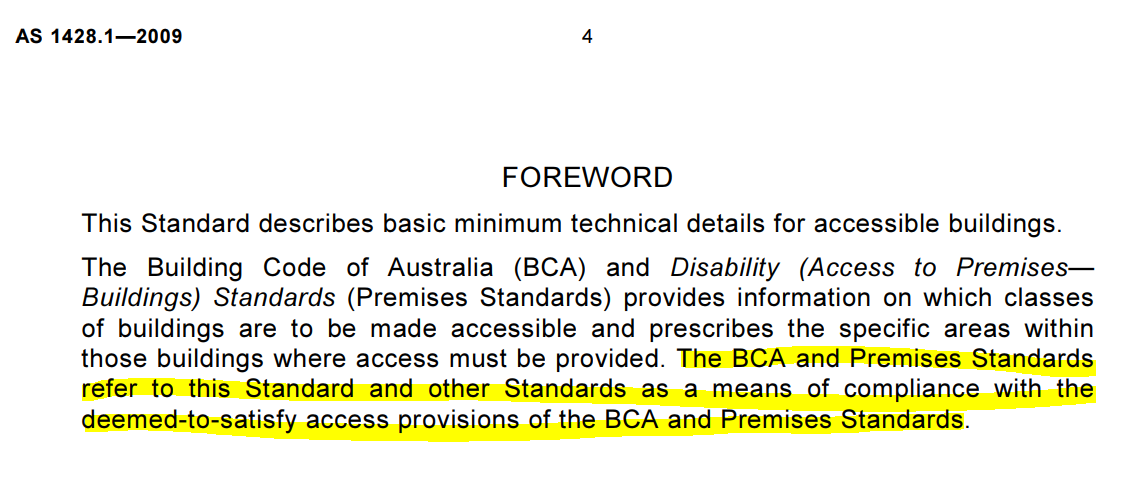
    1. This standard outlines the minimum technical requirements for accessible buildings. Engineers must reference the BCA to align with safety and access provisions. AS 1428.1 directs engineers to follow BCA for detailed requirements related to stair and balustrade design, ensuring all safety standards are met, particularly for disabled access.
    2. BCA 3.9.1.3 – Riser Opening Requirement:
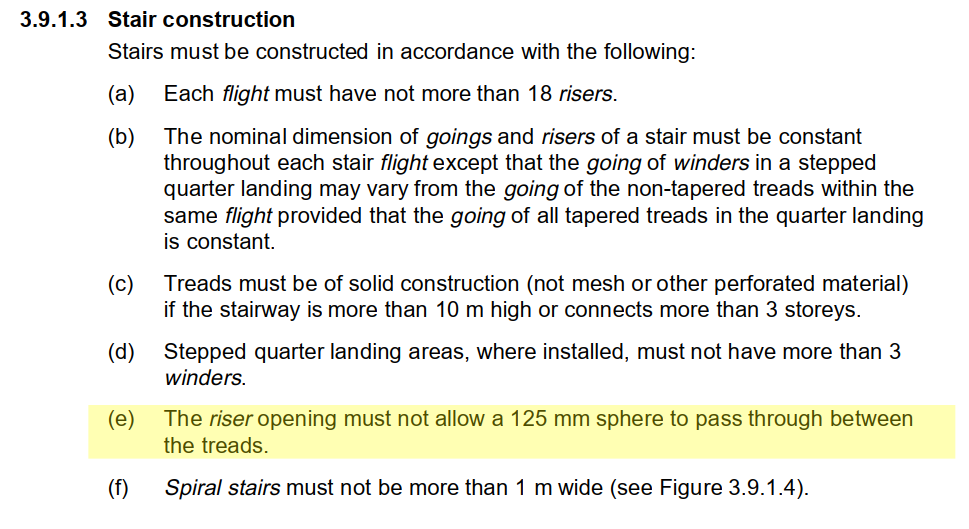
    One of the key safety provisions under BCA 3.9.1.3 is ensuring that the riser openings on stairways are restricted. Specifically, the gap between treads must not allow a 125 mm sphere to pass through. This rule is vital for preventing accidents, such as children slipping through open risers. As a detailed engineer, you must ensure that this riser opening specification is incorporated into the technical drawings and calculations to meet safety compliance.
    3. BCA 3.9.1.4 – Riser and Going Dimensions:
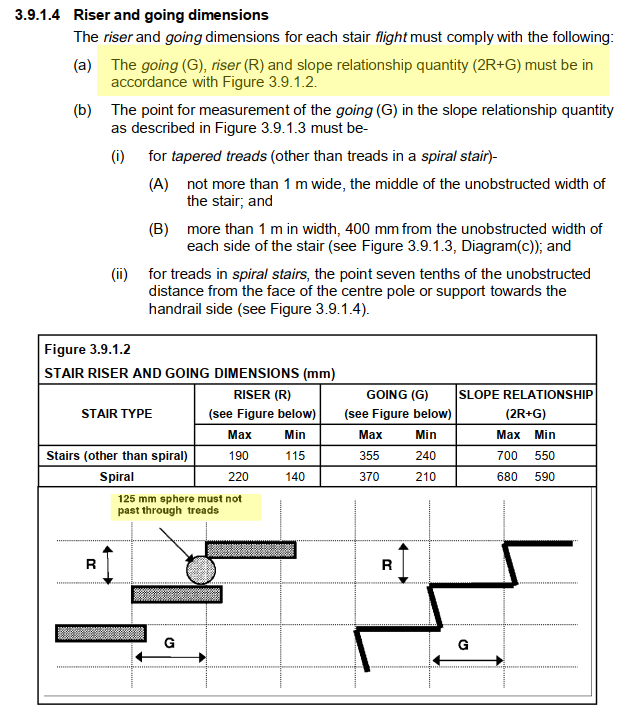
    Further, BCA 3.9.1.4 provides specific dimensional requirements for stair risers and goings, as illustrated in Figure 3.9.1.2. This figure shows the maximum and minimum values for risers (R) and goings (G), as well as the slope relationship (2R + G). Engineers must adhere to these dimensions for both spiral and non-spiral staircases to ensure that the stairs are not only safe but also ergonomically comfortable for users.
    4. Critical Figures:

    Riser (R): Must be within the maximum and minimum values—115 mm to 190 mm for standard stairs and 140 mm to 220 mm for spiral stairs.

    Going (G): Must be within the maximum and minimum values—240 mm to 355 mm for standard stairs and 210 mm to 370 mm for spiral stairs.

    Slope Relationship (2R + G): Must fall between 550 mm and 700 mm for standard stairs and 590 mm to 680 mm for spiral stairs. These values ensure that stairs provide both safety and comfort.

    5. Ensuring Compliance:
    As part of the detailed engineering process, it’s your responsibility to ensure that all specifications, such as the 125 mm riser opening limit and the exact riser and going dimensions, are strictly followed in the drawings, materials, and construction processes. This involves validating these measurements on-site and ensuring they are reflected accurately in both the design and construction stages.

    In conclusion, the detailed engineering process must ensure compliance with AS 1428.1 and the BCA, particularly regarding the requirement that the riser opening must not exceed 125 mm, as outlined in BCA 3.9.1.3. Additionally, the riser and going dimensions must conform to the standards specified in BCA 3.9.1.4. By adhering to these standards, you will ensure that commercial stairs and balustrades are safe, accessible, and compliant with Australian building regulations.

  • Gratings in Steel Detailing

    Gratings in Steel Detailing

    Platforms, walkways with FRP Grating

    For your job to go smoothly the steel detailer must have experience in detailing platforms, ladders. They must understand the grating catalogue, load bar directions, cross bar spacing pattern.

    Experience in detailing platforms, walkways essential.

    Tek1 has detailed a fair number of projects in Melbourne and Sydney involving Platforms and ladders with FRP grating

    • FRP Grating has no dominant load bar direction.
    • FRP Grating requires support on all edges
    • The span in both direction cannot exceed span specified in the catalogue.
  • How to get a pay-rise?

    How can I get a increment / pay-rise?

    Learn! The more you learn, the more you will earn.

    How does it work?

    I would love to pay you millions for sitting on your chair, however, I do not have pot of gold under my desk.

    Everything you earn must come from customers…..and they will only pay top dollar IF YOU MAKE THEM MONEY or help them in some way.

    In other words, you need to have skills – good skills, in order for THEM to make money. And as they make money, you will make money.

    That’s how the world works.

    Frustration over increments

    You may not be pleased with your increments.

    Again, we’d love to pay you a big increment, but can only do so if you learn quickly and can prove it. If your work needs to be constantly checked, or if you make the same mistakes, again, and again, and again, then the cost of your project increases dramatically, because it will take longer, and more resources in order to deliver it to the client. i.e. instead of you being a COST on a project (juniors, at the moment you are COSTING, not benefiting – but we are hoping you will become sufficiently productive in the future so that you become a benefit) – we want you to become a BENEFIT.

    The faster you become a benefit, the better. And the more you will get paid.

    If you are frustrated over this issue, and you wish to leave – that is fine – but why leave for a small increment? You may as well leave for a large one.

    Secondly, people seem to think they can “get ahead” by jumping ship every 12 months. This will likely work in the short run. New employers will be pleased to hire someone who is already trained, and they can pay for it since they did not incur the costs of training you have benefited from. However jumping ship may not work as well in the long term. i.e. in 5 years, you will have accrued 4-5 different employers, and you become “risky” in terms of anyone investing time and money into you. Some past employees have sought to get around this issue by lying on their resume.

    What do I need to learn?

    Some examples:

    • Learn, how to use your tools. AutoCAD, Tekla, Revit.
    • Learn how to write essays.
    • Learn how to speak good English. Clients VALUE THIS.
    • Learn how to market yourself.
    • Learn Australian / American standards. By yourself. Everyone wants to claim that they know the standards, but very few actually sit down to properly learn them.
    • Make something better, or faster, or cheaper. Ingenuity is valued highly.
    • Videos are highly regarded.

    All of the above is hard-work, and will require self-directed learning.

    If you want big increments but can speak broken Tamil-glish, and don’t know how the standards, cannot use the tools properly, cannot manage RFIs – where will the money come from?

    How can I prove I have learned?

    A great way to prove your expertise on a subject matter is to write about what you learned. Why should you bother?

    1. You will benefit. By writing, you will crystalize the concepts you have learned.
    2. Writing is a super power:

    The ability to write concisely is a super power – it will open doors for you: with clients, and all manner of business. A simple proposal, well thought out, is all that is required to procure millions in funding.

    Generally speaking a well thought out plan will trump none at all.

    Writing has the following benefits:

    1. Primarily: it refines your own thinking.
    2. The process of writing forces you to validate your own logic.
    3. It effectively communicates your logic to others – who can improve it, or invalidate it. In other words, it aids in better truth-seeking.
    4. It allows for groups to better coordinate, in order to produce an outcome.

    Prove your knowledge to others

    Why should another firm hire you for a large increment, when you don’t know anything, or can’t prove you know something?

    An easy way to prove your knowledge is to point to a portfolio of articles.

    When you go to interviews you can say:

    • “Here are my articles on Tekla” or “steel detailing” on https://www.tek1.com.au/category/steel-detailing/
    • Here are my portfolio of projects.

    Recruiters will immediately see your value. And you’ll be hired for a big increment rather than a small one.

    Tek1 Affords you the opportunity to self-promote

    I do not know any other firm who does this.

    Most other firms will try to limit you. But we do not. Why not take advantage of it?

    Promote your portfolio to the world, on social media etc.

  • Changes in Consultant drawings between Quotation stage to the Project stage? You must check: here’s why…

           It is essential to cross-check the revised consultant drawings we receive against the original drawings from the Quotation stage before commencing the project because this may affect prices.

    For example, the panel break up, or the panel specs might have changed. If they have changed, this might have a material impact on price such as concrete and reinforcement cost.

    What should we do when they make changes?

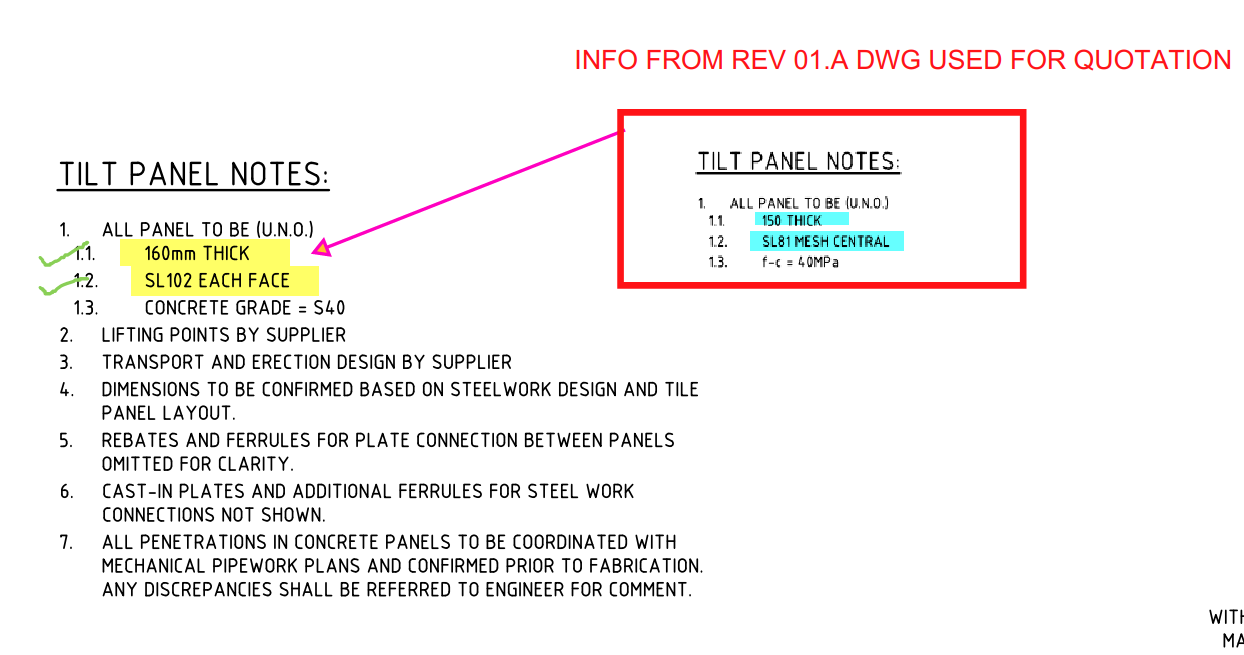
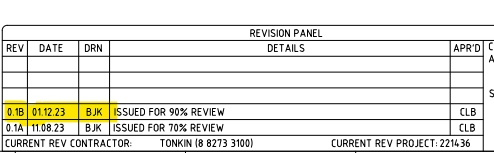
    1. Check the consultant drawing revisions and their date (between the quotation and the current stage).

    For example:

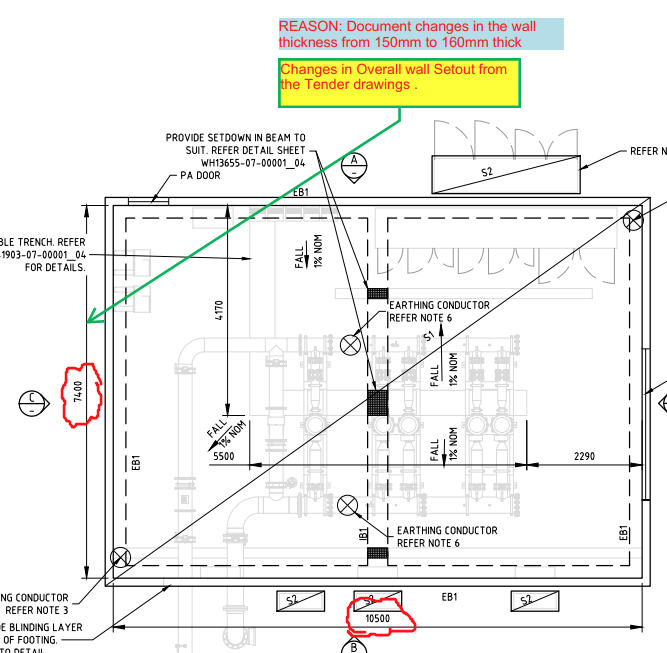
    2. Highlight the changes that occurred and mark them down in the latest structural PDF.

    For Example:

    3. Prepare a summary document report outlining the modifications.

    For Example:

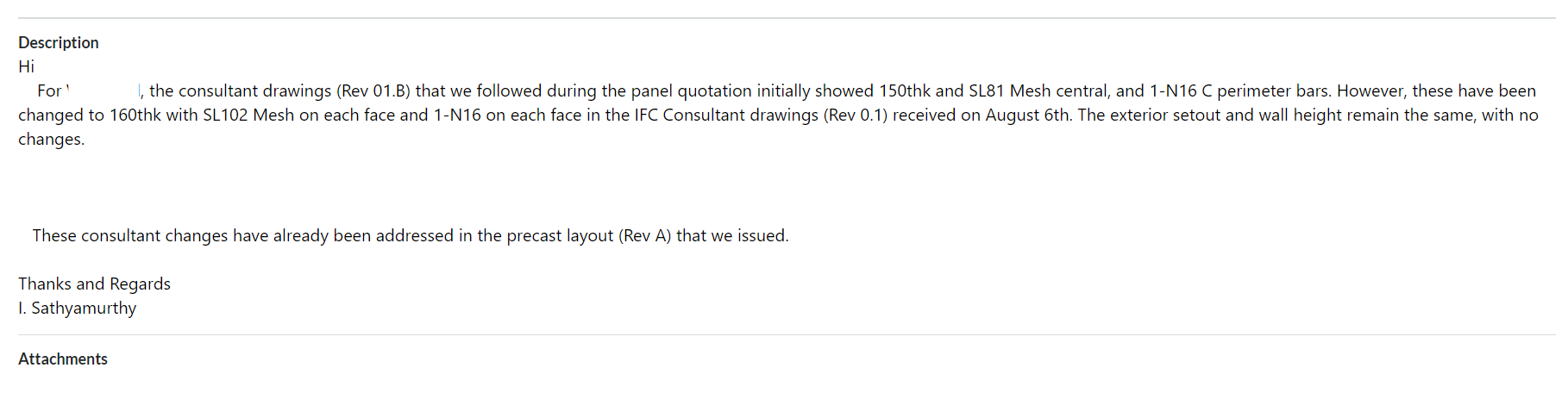
    4. Inform the precast manufacturer and builder about these changes by sending the relevant information via email.

    For Example:

    Why do we need to check the consultant drawings?

         This verification process will enable the precast manufacturer and builder to re-evaluate the timeline based on the information that was previously quoted. This allows potential Cost issues that could cause confusion or delays in the project timeline to be identified and resolved early on such as

    • Cost estimation of individual precast panels, including their respective panel areas and concrete volumes, for manufacture.
    • Cost estimation of approximate reinforcement and mesh weight requirements.
    • List of cast-in items and loose items required, approximate quantities.

    What are the key factors that need to be verified in the consultant drawings from a precast perspective?

    1. Panel Thickness and Types: Verify the panel thickness and types used, as specified in the Structural Drawings.

    2. Panel Count: Confirm the panel count based on the panel split, as detailed in the Structural Drawings.

    3. Panel Transportability and Tonnage: Conduct a transportability check and verify the tonnage of the panels from our end.

    4. Panel Reinforcement:

    • Perimeter bar diameter
    • Mesh type used and its placement
    • Additional reinforcement provided in the panel typical detail
    • Reinforcement on central or either side ( specify location)
      (Refer to Structural Drawings for details)

    5. Precast Wall Pattern and Special Moulds: Verify the precast wall pattern and special moulds required, as specified in the Architectural Drawings.

    6. Panel Finish: Confirm the panel finish, as specified in the Architectural Drawings.

    7. Panel Connection Details: Verify the panel connection details, if applicable, as specified in the Structural Drawings