Author: Ramakrishnan L

  • STEEL MODELER ATTENTION – DEALING WITH CAMBER

    TEK1 worked in a railway foot over bridge with 2 lifts, 2 ramps, 2 stairs connecting platform and overpass, a canopy and 7 platform stairs. The main challenge is the over pass. As per design, the steel truss after erection must be cambered to different millimeters at different intervals. There were two terms “Residual camber” and “Reference Profile” in the structural drawing. Many do not that what these mean. Any misunderstanding about these terms would result in redoing the entire overpass. But TEK1 had good understanding of these terms and avoided heavy rework.

    This blog is to educate the modelers regarding residual camber and reference profile. Kindly refer the camber diagram below.


    The residual camber at the south end is 67mm and reference profile at the same end is 62mm. Residual camber is the camber value which must be given in the steel assembly drawings which the steel detailer supply. Whereas reference profile is the camber value which the structure attains after applying all the dead loads. Here the dead loads are concrete load and self weight of the steel.

    Hope this helps you. Thanks for reading.
    Ramakrishnan.L
    TEK1.
  • CHECK TRANSPORTATION FEASIBILITY WHILE WORKING IN AN EXISTING STRUCTURE

    The conventional maximum transportation size for an assembly is 12m x 2.5m x 2.5m. This value is not applicable for all the conditions.

    TEK1 executed an alteration work inside Canberra airport. Everything that enters an airport must go through the checking / screening area. As per design, the size of assemblies were more than 9m & we were not sure whether these assemblies could be transported into the Airport. So, TEK1 raised a query regarding this. The client agreed to reduce the size of transported assemblies.

    Lesson: Whenever a work is carried out inside an existing building, consideration must be given for taking in the assemblies i.e. door/entrance size is mandatory. Since a completed airport terminal is a closed roof structure, cranes cannot be used for erection. Here the erection is done with the help of genie lifts. Weight carrying capacity of the erection machinery must also be taken into consideration.

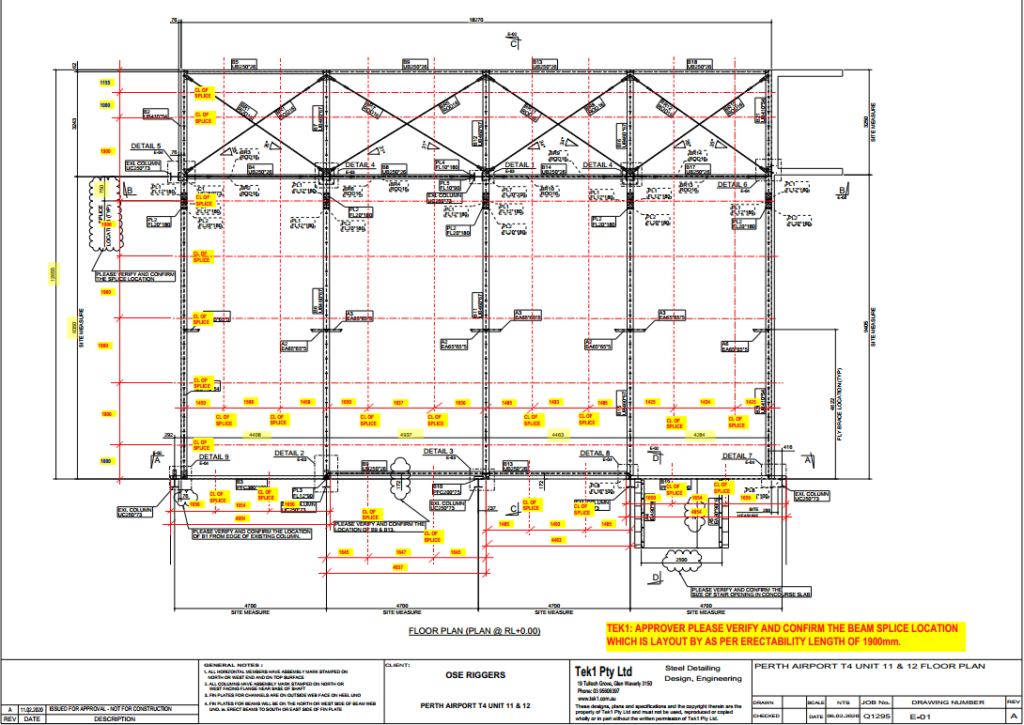
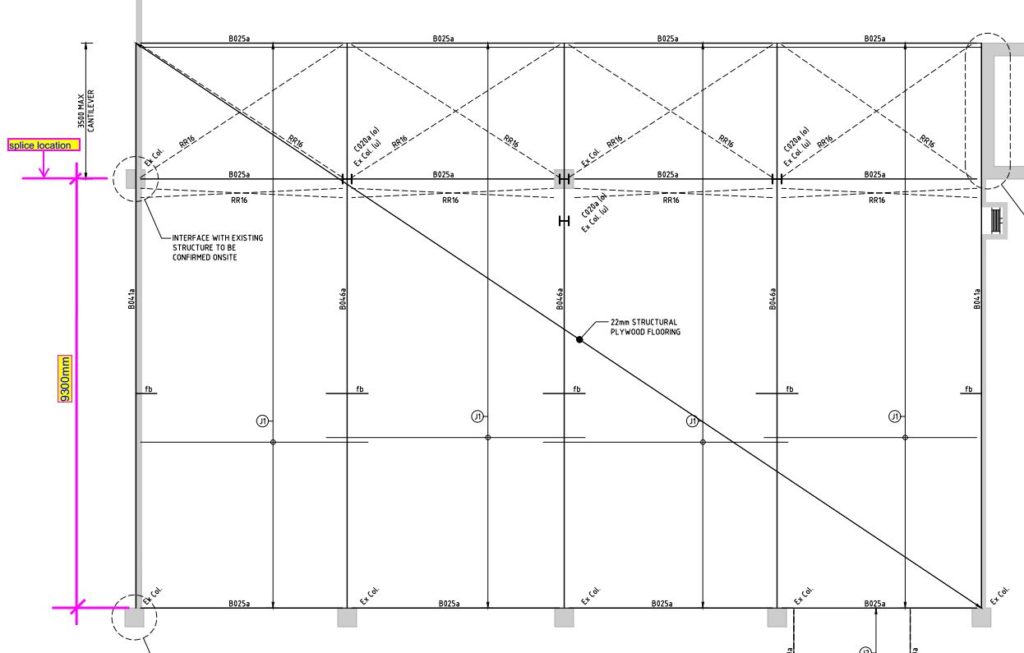
    See below design snap & TEK1 proposal markup for splice location.

    ABOVE SNAP TAKEN FROM STRUCT DESIGN. SHOWN ASSEMBLY SPLICE LOCATION AS 9300 mm.

    PLEASE REFER BELOW SNAP WHICH SHOWS PROPOSAL MADE FROM TEK1 & THAT WAS APPROVED BY STRUCT ENGINEER.

  • ISSUES OF EXPORTING DSTV TO DXF WITH CSK BOLTS IN TEKLA MODEL

    Wherever Countersunk bolts are provided in a model, it is advised not to send NC DXF files to the client for the corresponding plate/shaft. This is because the hole dia in the generated NC & DXF file is not the actual bolt dia but it is the dia of the countersunk head. Therefore, the hole dia in the plate/shaft is much higher than the actual value. Hence, it is advised not to send NC DXF files for plates/shafts which has countersunk holes.

    But, when the client demands for NC DXF files even for plate/shaft with CSK bolts, the generated NC DXF files must be manually edited such that the CSK hole dia in the NC DXF files is bolt dia + 2mm(Tolerance).

    Also the tolerance for CSK bolts must be 2mm everywhere irrespective of the members the bolt is connecting i.e, whether it is steel to steel connection or steel to concrete connection the tolerance for CSK bolts must be 2mm.


    By Ramakrishnan.L

    TEK1