
Analyze load transfer before blindly applying connections.
Here is a markup from the engineer, which is right. The load from the UB350 beam is not transferred to SC7. Hence 4 bolts not required.
Analyze load transfer before blindly applying connections.
Here is a markup from the engineer, which is right. The load from the UB350 beam is not transferred to SC7. Hence 4 bolts not required.
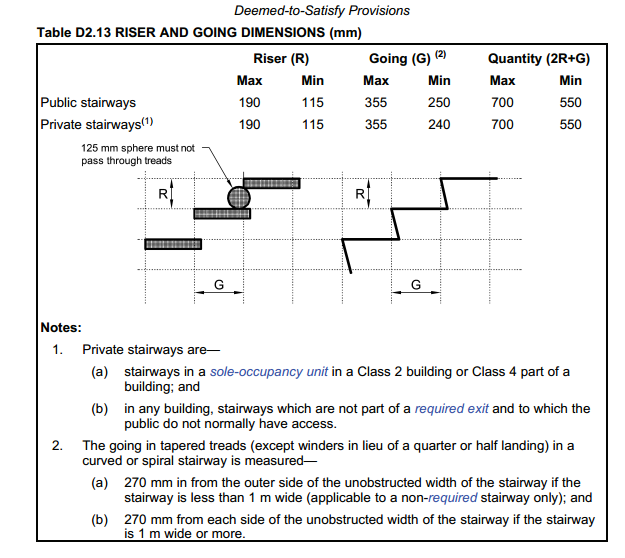
As per NCC 2016 D2.13 (Page 183) following requirements have to be met for public and private stairs
Public Stair ways, Riser – Max 190, Min 115 Going Max 355 Min 250 Quantity (2R+G) – Max 700 Min 550
Private Stairways Riser – Max 190, Min 115 Going Max 355 Min 240 Quantity (2R+G) – Max 700 Min 550
Have you ever fallen down a flight of stairs? I hope not! But from experience I can tell you that it’s not a very pleasant one. I slipped as I was walking down – I fell supine, hard, like a hammer on a nail, bang into the corner of the steps. The pain was absolutely numbing – I could walk for about three days, nor could I even roll over in bed for about that same period. Falling down stairs is a dangerous business – and if you’re in the business of designing or fabricating stairs – especially public access stairs, then you absolutely have to get it right. Because if you don’t, then it’s only a matter of time till someone falls. Luckily I was a young man, so I recovered pretty quickly. But if I was an invalid, a fall like that could be potentially life threatening!
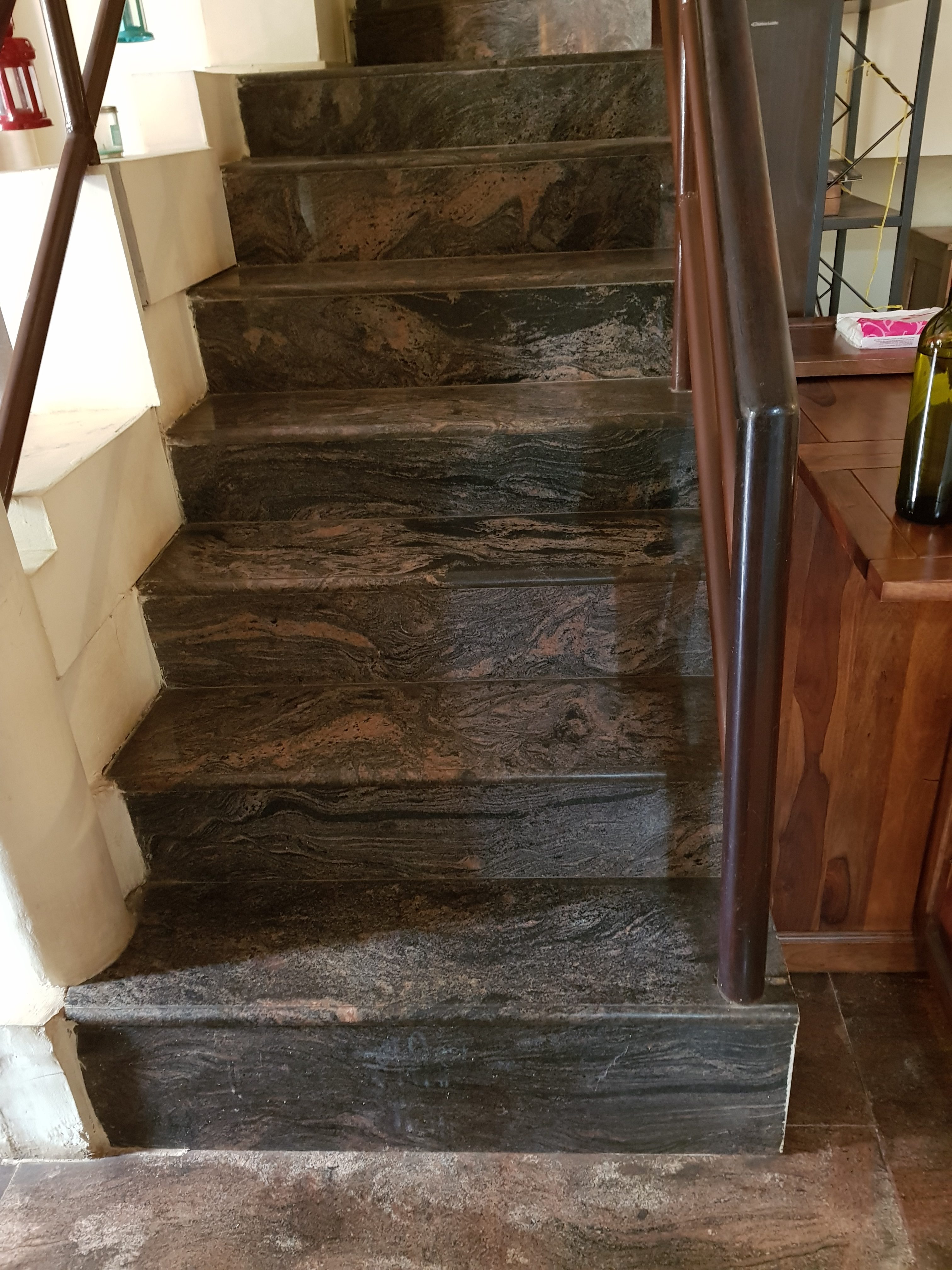
The steps are not uniform – they vary in height and length. This is not safe if you are traversing it. It’s easy to misjudge. That’s why when we do the shop drawings for a flight of stairs we check that it’s uniform, that you don’t have too many stairs in a flight, that there’s adequate room, that a child cannot squeeze his/her head in between the treads, etc. I have ascended and descended these steps – and were it not for the handrails, it would be very dangerous. Don’t do steps like this. Here were the measurement from the bottom riser going up:
The risers vary too much!
Our staff are trained to ensure that their stairs comply with Australian Standards. We’re definitely not the cheapest, but we’ll know if we see a bad design – and knowing that information could save you a bundle.
Experts in AS in Stairs/Handrails/Ladders
We’ve done a lot of work on Australian Standards – both public and private access. We specialise in Steel Detailing – and have a special focus on stairs and ladders. Since we deal extensively in this area, we require all our staff to be thoroughly versed in the Standards. Consequently, we have developed testing frameworks to ensure that all staff are well trained and accountable.
Our Testing Infrastructure Now Freely Released to the General Public
We are now releasing our testing framework to the public at no charge. These tests should help you learn and reinforce your knowledge of Australian Standards – namely, AS 1657 and AS 1428.
We hope and trust you will find it of immense benefit.
Keep people safe – design and build according to the safety standards prescribed by law.
https://training.tek1.com.au
We continue to release our in-house precis on Stair way construction. Reading the standards is terribly tedious so we have developed a way to easily cross check the requirements and to make sure that stairs are built according to standards.
Unfortunately it’s too common for us to see designers produce drawings which simply do not comply to the required standards. So it is of the utmost importance that fabricators are able to: (i) know and understand the standards and to independently verify that their drawings do comply. Only a fool would 100% trust in an architect to draw to standards – we’ve seen it way too often. You, the fabricator have to check everything yourself. Here are some of the in-house memos that we use to ensure that our stairs always comply:
We wish to share it with the world – and we hope it helps you immensely:
TEK1 AS 1428 11.1 Standards for Stairs
I hope you find it of benefit and great use.
We do a lot of work on handrails – both public access (AS 1428) and also private access (AS 1657).
Anybody can draw a staircase – and if you’ve ever fallen down some stairs, or if you’ve ever walked up some stairs which do not comply to any standards – then you’ll immediately realise the importance of having stairs that actually comply. It’s paramount for safety.
Designs of non-complying staircases is something that we see all too often. All the time. The costs of fabricating non-compliant staircases is monumental. We’ve invested a lot in training staff to ensure they follow the standards. And for the benefit of the industry, here is a cliff notes version that our guys use to remind them of the requirements needed for public access stair handrails.
It is a first class precise that allows detailers to quickly check compliance without wading through reams and reams of legislative like prose within the AS 1428. This precise will be the norm in the industry and is worth its gold. It was made right here by Tek1.
Please see the attached pdfs and drawings below.
2013 Australian Standards have changed for AS1657-2013
Here are some of the changes most pertinent to the work we do:
No Overlap required.
There is no overlap required. A gap of 30 mm between treads from the trailing edge of a tread to the nosing point of the next tread is allowed.
Changed Calculations:
Also the calculations on whether stair complies have changed.
See below for further details:
Uniform Dimensions
Section 7.2.3.2: All Risers and goings in the same flight of stairs shall be of uniform dimensions within a tolerance of 5 mm. The previous version of AS1657 was not explicit about this. I wonder how many inspectors were rejecting stairs or, giving the client a hard time because of some insignificant variation.
Online Training Resources
Tek1 have opened up its internal AS 1567 and AS 1428 training documentation and testing to the world. Anyone is free to enroll and learn from our online training packages, gratis. A special thank you to our Managing Director for making this possible. You can check it out here.
And here: http://tek1engineeringservices.com/onlinetests/course/index.php?categoryid=5
My recommendation is to enroll as a new user rather than using the public account – that way you can track your own progress on quizzes etc without impediments.