Tag: AutoCAD .NET API

  • Checking the Transportability of Precast Panels – Using the AutoCAD .net API

    Checking the Transportability of Panels – Using the AutoCAD .net API

    It is one thing to build a panel. It is another to ensure that:

    1. It can be lifted, and
    2. It can be transported to the site.

    Here is a video demo explaining everything:

    Can a precast panel be safely transported? from Tek1 on Vimeo.

    A short primer on the importance of efficiency

    When you are dealing with 100s, and perhaps even up to a 1000 panels per building, this can become extremely cumbersome and time consuming. Why not automate the entire process? This allows you to do things faster, to get the drawings out faster, and (hopefully) to build the panels faster, and ultimately the building faster. Speed is absolutely paramount! The faster a builder can get on and off of a construction site, the faster they can get paid. This lowers their working capital needs, and accordingly, their financing costs (however that may arise). Speed is king!

    Considerations When Transporting Panels to Site

    Every truck has a:

    • Size limitation (both length and height), as well as a:
    • Weight limitation (there is a maximum capacity).

    Secondly, trucks have different limitations, depending on where they are transporting a panel. E.g.

    • Trucks passing through the CBD (central business district) have different: length/height and mass requirements compared to those that are not, furthermore, these requirements are different depending on whether the truck has a permit or not.

    Let’s suppose you have the following hypothetical situation – take out a sheet of paper and pen and try and solve this by hand:


    Truck A

    • Length limitation: 6 m
    • Height limitation: 3 m (but a height limit of 2.5 m in the CBD; and a height limit of 3.2 m with a permit)
    • Weight Limit: 12 tonnes.


    Truck B

    • Length limitation: 4 m
    • Height limitation: 4 m (but a height limit of 2.5 m in the CBD; and a height limit of 3.2 m with a permit)
    • Weight Limit: 18 tonnes.


    How on earth are you going to work out, quickly and efficiently, whether your fleet can transport the following panels:

    1. ABC1 – Mass: 13 tonnes, Length: 5 m, Height 3 m
    2. ABC2 – Mass: 10 tonnes, Length: 3 m, Height 2 m
    3. ABC3 – Mass: 12 tonnes, Length: 4 m, Height 2.5 m


    Problem

    • Are you able to transport your panels by any of the trucks in your fleet?
    • Which of your trucks can you use to safely transport a particular panel?

    How was this particular problem was solved using the AutoCAD .net API?

    • I created a data structure for each of the limitations imposed by a truck.
    • Similarly, I created a data structure for each of the limitations imposed by each panel.
    • And very simply asked whether a truck and lift a panel? The output was compiled and put into an Excel report. They key method tying this all together is the `CanLift` method on the Truck class.
    • I used ClosedXML to combine it all together to produce a report.

    Here is an example of the results:
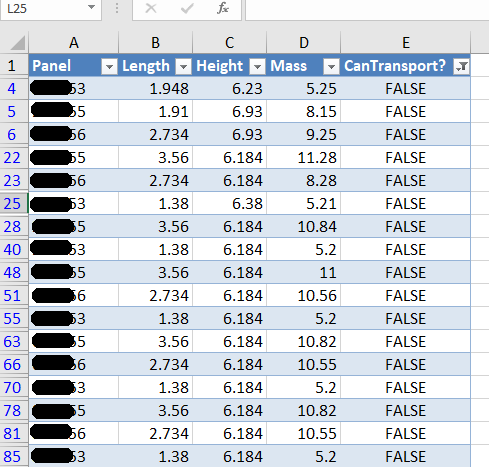
    panels that failed the transport check
    A sample of the report produced when running the command. This is showing all the panels that failed.

    Here are the key server classes:

    Summary

    • Tek1 has the resources and expertise in order to do Precast Panelling jobs fast and
    • Accurately

    These are just the tip of the ice burg in terms of the checks and processes we employ.

  • On Line Equality (AutoCAD .net API)

    Some lines may be more equal than other lines? The AutoCAD .net API's EqualTo method may disagree with your interpreation of equality. Here are the results;
    Some lines may be more equal than other lines? The AutoCAD .net API’s EqualTo method may disagree with your interpretation of equality. Here are the results;

  • A Poor Man’s Line Jig (well, there’s actually no jigging here) – (AutoCAD .net API)


    What are these guys doing, you ask? I suspect that they are jigging a line. They are probably doing it this way because they didn't read the ObjectARX documentation. Well actually, you don't need to. Just use the poor man's jig.
    What are these guys doing, you ask? I suspect that they are jigging a line. They are probably doing it this way because they didn’t read the ObjectARX documentation. Well actually, you don’t need to. Just use the poor man’s jig.


    I wanted to implement a jig for drawing a Line – but strictly speaking I didn’t want the line itself – I wanted its two points, yet I wanted all the features that come with jigging: snaps, polar tracking, and a nice line leading from the base point to the cursor, which shows you where you were, and where you are going. I was originally going to jig it all myself – and all of this to obtain two coordinates in a manner that would allow the user to see what was actually going on. Jiggig takes a lot of effort. It was only then that I realised I could get the same result, but with a massive short cut:

    Here is a poor man’s Line Jig – at the end of it, you’ll have the two points you are after, but without the effort. If required, you can encapsulate all the logic in it’s own class, so that the client doesn’t have to bother too much with the implementation details.

    Poor man’s line jig.


            [CommandMethod(“GetPoints”)]

    public static void GetPoints()

    {

    Document doc = Application.DocumentManager.MdiActiveDocument;

    Database db = doc.Database;

    Editor ed = doc.Editor;


    PromptPointResult pprOrigin = ed.GetPoint(“Click for point.”);


    if (pprOrigin.Status == PromptStatus.OK)

    {

    PromptPointOptions promptPointOptions = new PromptPointOptions(“Please get secondPoint”);

    promptPointOptions.UseBasePoint = true;

    promptPointOptions.BasePoint = pprOrigin.Value; ;


    PromptPointResult ppr = ed.GetPoint(promptPointOptions);


    if (ppr.Status == PromptStatus.OK)

    {

    ed.WriteMessage(“Congrats!”);

    }

    }

    }


  • Steps to Mastery of the API (AutoCAD .net API)

    These are steps. When you get to the top, you'll be an AutoCAD master programmer.
    These are steps. When you get to the top, you’ll be an AutoCAD master programmer.

    I’ve compiled a list. There’s actually quite a bit involved. I don’t think you can get away with simply not knowing anything about unamanged ObjectARX world. Here is the list below – which I will update. If you see any notable topics which I have missed, please feel free to add a note and I will update the list.

  • Finding the Point on a Curve Which is the Closest Point to Another Curve? (AutoCAD .net API)

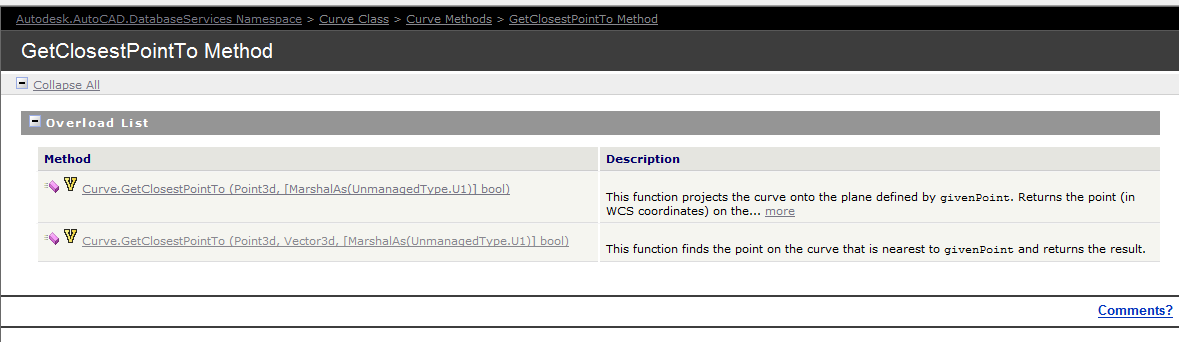
    Documentation of the GetClosestPointTo method of the curve object - the overloads are extremely limited. So we have to be somewhat creative in obtaining a solution.
    Documentation of the GetClosestPointTo method of the curve object – the overloads are extremely limited. So we have to be somewhat creative in obtaining a solution.

    The Genesis of this problem

    This is a tricky little problem and I could not find a solution on the forums. So I resolved, upon discovering the solution, to oblige posterity and the public, to publish my findings.

    Specific Notes about this problem

    Now the following code has been generalised to the specific case of Lines and a non-descript curve (which of course is an abstract base class), but the general principles can be applied to any type of curve.

    Notes on implementation

    Unfortunately, the curve object exposes a method: GetClosestPointTo, which is only overloaded to accept points and not other curves. In order to deal with this rigmarole we’ll have to first, convert the curve to a `Curve3d` object which is a member of the Autodesk.AutoCAD.Geometry namespace as distinct from the Autodesk.AutoCAD.DatabaseServices namespace.

  • Changing All Block Definitions (AutoCAD .net API)

    (Unfortunately it's not a block table record dictionary definition - but it kind of is :))

    (Unfortunately it’s not a block table record dictionary definition – but it kind of is :))

    Some how or other all the block definitions associated with a drawing were not defined on layer zero – this is less than ideal. I guess it goes right up there with another instance I heard about: (i) about drawing everything in paper space, or layer zero, for example.

    Accordingly, it feel to me to change all the block definitions. I could foresee that there might be some other requirement associated with changing all the block definitions, so I thought it apposite right now to employ the strategy pattern to solve the problem.

    Here is the code in its entirety. I like using LINQ, it’s concise and efficient, so I beg the patience of those whose views differ:

  • Checking for Panels with Nibs – Precast Detailing (+ Video Demo inside)

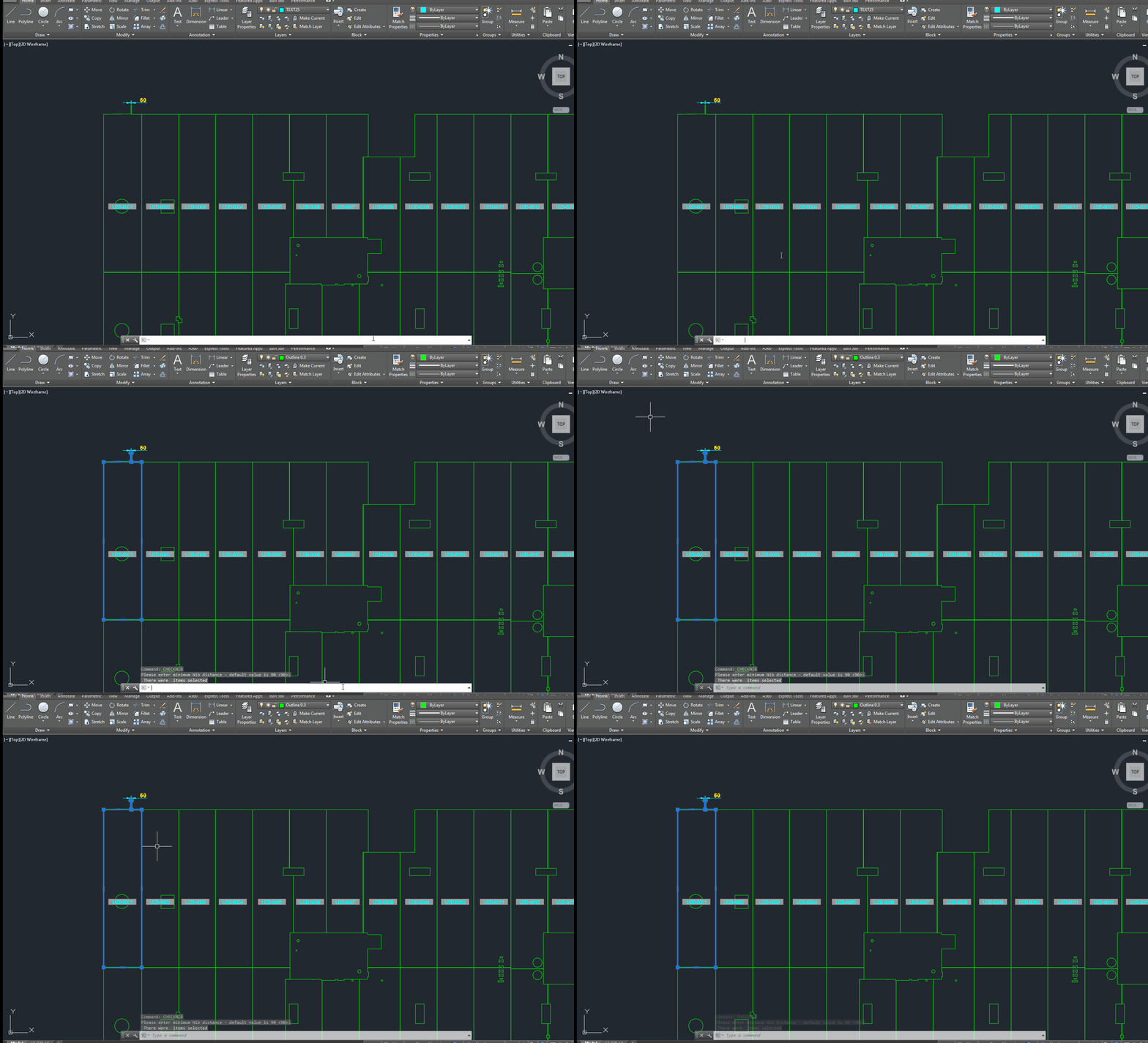
    A gif showing how easy it is to check for nibs on bubble deck slabs using my command.

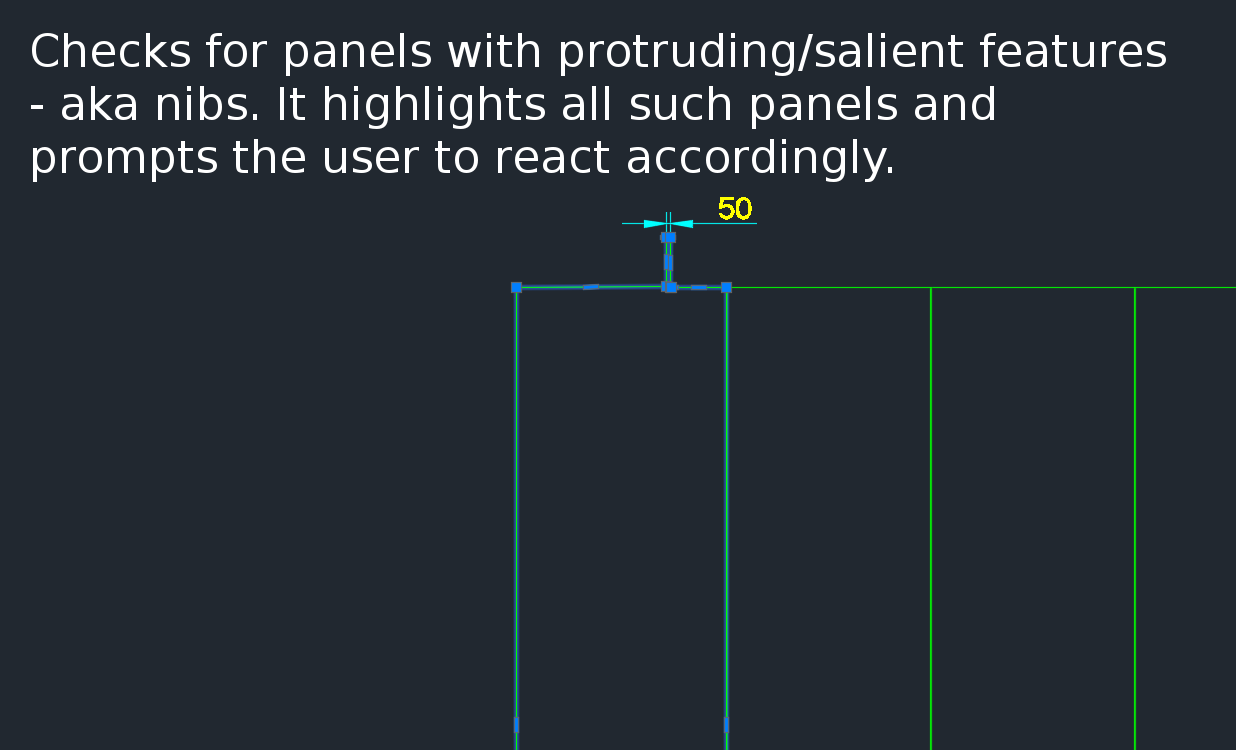
    A gif showing how easy it is to check for nibs on bubble deck slabs using my command. There are certain panels which we have that have protruding elements – salient features. These can be problematic if they go to production unnoticed. Given there are entire teams of people doing things, it can be hard to track – people forget that they cannot draw a panel with such a dimension.

    This is a plug in which enables one to easily identify all such panels with nibs like this:


    There is a need to identify panels with protruding features because they could be problematic if fabricated.
    There is a need to identify panels with protruding features because they could be problematic if fabricated.


    Here is a video demonstration:

    Bubble Deck Detailing – checking for panels with salient features from Tek1 on Vimeo.

    Summary:

    • This procedure and command saves us and the fabricator a lot of time and money.
  • Returning Inside Using Statements (AutoCAD .net API)

    WPF Databinding operations in the AutoCAD .NET API
    A demonstration of using a WPF User control to display information pertaining to missing and/or extra items within a panel, using the ComparePanels Command.


    While writing the above AutoCAD plug-in, I faced a small conundrum in the below code:

    • The question for you is: will the transaction be disposed of, and committed given I have returned the bool before it reaches the end of the using statement?

    Will it be disposed?

    The short answer is yes. The transaction object implements IDisposable. So, finally you can trust that the transaction will be disposed, and that any objects that it opens will also be similarly disposed.

    Will the transaction be committed?

    I had a peak into the Dispose methods using Reflector. I didn’t see any automatic committing of any transactions – so I am venturing to say that no, the transaction will not be committed. In other words, we’ll have to restructure the above code to ensure that the transaction is committed before we issue the returning statement. Perhaps the AutoDesk team should abort a transaction if it is not committed before a transaction is disposed?

    Summary

    So the lesson is: (i) always be sure your transaction is being committed, and (ii) a using statement obviates the need to ensure that your transaction is actually being disposed of.