This is the first project we have completed after an extended training period on the Scottsdale software.
Thanks to Rob, Lance, Derek from Scottsdale
Also thanks to Christy and Nick from Elite Homes.
This is the first project we have completed after an extended training period on the Scottsdale software.
Thanks to Rob, Lance, Derek from Scottsdale
Also thanks to Christy and Nick from Elite Homes.
If you have 20 hours worth of variations: do you think your client will rejoice? Typically, no!
Clients demand transparency! They have every right to know: (i) why you are charging them, and (ii) what they will get in return. It will not do to simply say: variation: 20 hours. Why not? Clients will assume you are pulling the wool over their eyes. If you wanna get paid, you need to justify your pricing and proposed scope of works to them.
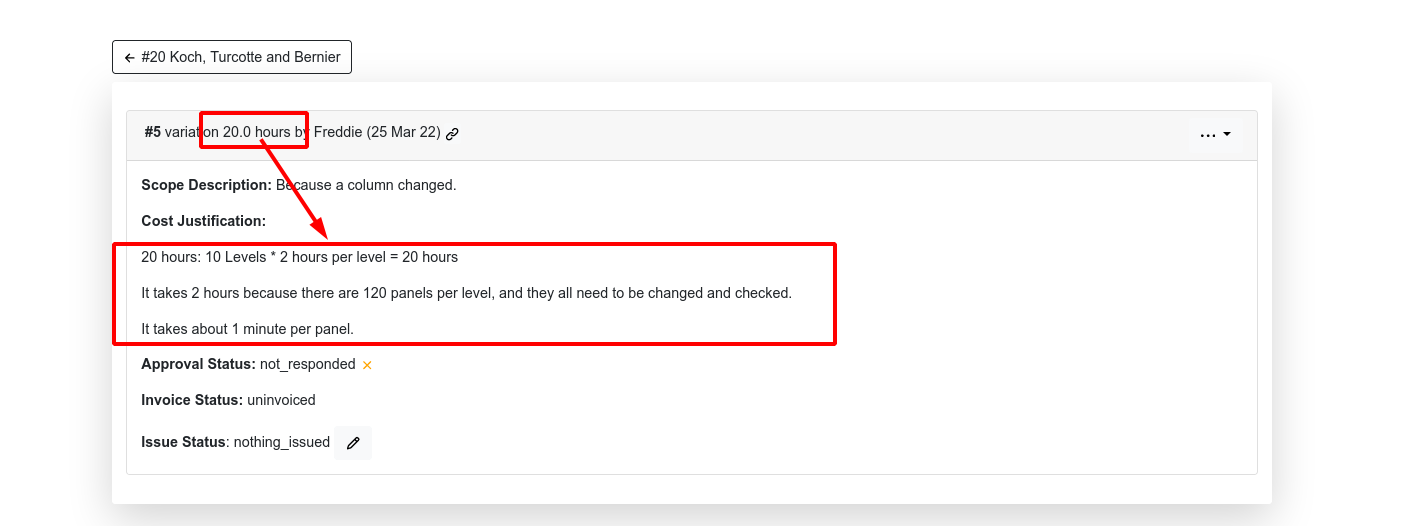
Break your costs / hours down!
Where are these 20 hours going? Well, that’s 2 hours per level. And there are 120 panels per level. Which equates to a change of about 1 minute a panel. That seems extraordinarily efficient, now that you state it in those terms.
Your clients will thank you. Remember, they’re going to use your justifications so they can in turn claim costs from their clients. And best of all, it means you’re more likely to get paid for your labour.

This will probably apply wherever you work: don’t send project and firm related correspondence on your private whatsapp chats, or on your private emails etc.
Why not? It’s very hard to track. We have no record. Nothing can be verified.
Protect yourself, your careers, your firm, and your clients: it’s pretty simple: avoid using private channels for firm correspondence.
When traveling overseas, especially India, I often hear the following:
“Where are you?
“I’m almost there”
“When will you arrive?”
“Five minutes!”
They always say: “five minutes”.
Once, I remember waiting, for at least 45 minutes.
Not sure if this is a cultural thing. I’ve heard Indians say:
“Oh, that’s IST – Indian Standard Timing”.
Friends – Indian Standard Timing might work very well for your own personal arrangements, but it will not work well in the USA / UK / Europe / Australia / NZ, on construction projects, where tight deadlines are involved, and where “Liquidated Damages” are at stake.
Why are ETAs important?
Because clients need to order material, organise labour, and equipment. It will not do to organise a crane, and hire labour, only for them to sit idle for a couple of weeks because you were overly optimistic with your delivery times. Cranes alone might cost $5000 – $15,000 per day. What about site crews? If you give the wrong ETA, then it could cost your client a lot of money. Which means it’s gonna cost you a lot of money.
Give real ETA. Not the typical: “5 minutes later” ETA. Update your clients constantly on your Tek1 status reports.
Summary: Give the correct ETA, and make sure you meet it.

ETA – This means Estimated Time of Arrival. Just put the ETA and then the date, the time and the time zone:
e.g. We will issue the Takeoff reports by the end of 02.04.2025
Don’t do that.
ETA: COB 2025-04-02 (AEST)
Clients care about their time zone, not yours.
Why is a client asking for an ETA? Because they need to:
Let’s take this job for example: https://tek1-quotes.herokuapp.com/organisations/2/quotes/12046
It was filled with issues: some from our side, the other from the client, and the other just due to coordination issues.
We need to ensure that our communication on the hold-up points is clear.
I’m not here to lay blame: but to make people understand the cost.
Do me a favour: add buffer time, and communicate your hold-ups effectively. Perhaps this might require a technological solution.
Here is a memo we received from one of our clients. Such memos are not infrequent:
I am pushing for stamped drawings, however from the IFAs issued there should be no changes made. I need to begin the steel ordering process tomorrow. There is a lead time on the ordering of the steel, and by that stage we should have the finalised drawings. Anything that gets altered can be held at the processing of steel stage.
Can you please issue the full pack for the Spiral tonight.
Thanks
Question: what should you do?
To answer this question, you need to first understand the approval work-flow in building and construction projects:
Process in Building and Construction
Please follow this process. It is very important from an insurance and legal liability point of view.
Why is the process important?
In every building and construction job, there is risk. If something goes wrong, then fabricators and builders are likely to start blaming people – lawyers will blame anyone who is not insolvent so they can recover the loss. If people fabricate from IFC drawings without a stamped approval, then we will not be covered by insurance: the entire firm could go under.
When things aren’t approved: the things are likely to be in a rush, and things are likely to be poorly planned and coordinated. When the builder starts blaming you for releasing IFC without stamped approval, even though he demanded it: what are you going to say in response? We want to avoid problems and disputes at all hazards. To keep it simple:
DO NOT MARK AS IFC WITHOUT STAMPED APPROVAL
So what should I do?
1. Release the drawings as IFA with the following annotation:
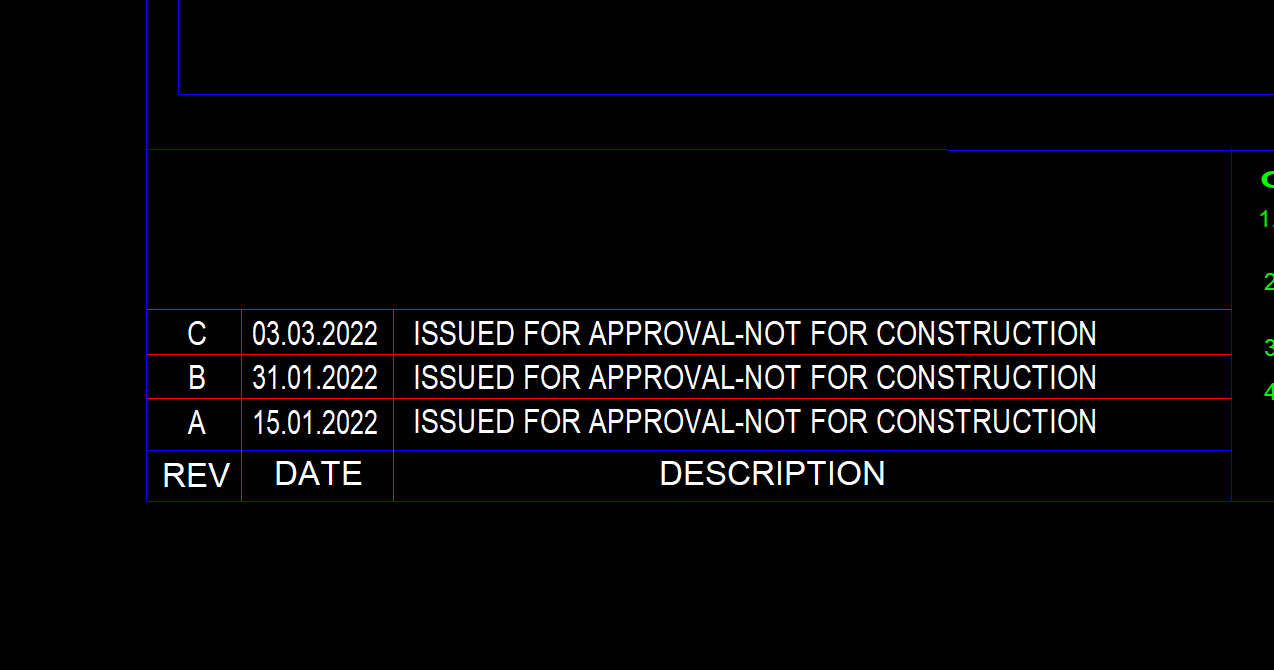
2. Add in the following disclaimer ON THE DRAWING:
Fabricate at own risk. No stamped approvals? Then no insurance. If anything goes wrong, for whatever reason, you’re carrying the can, not Tek1.
Summary:
DO NOT MARK AS IFC WITHOUT STAMPED APPROVAL
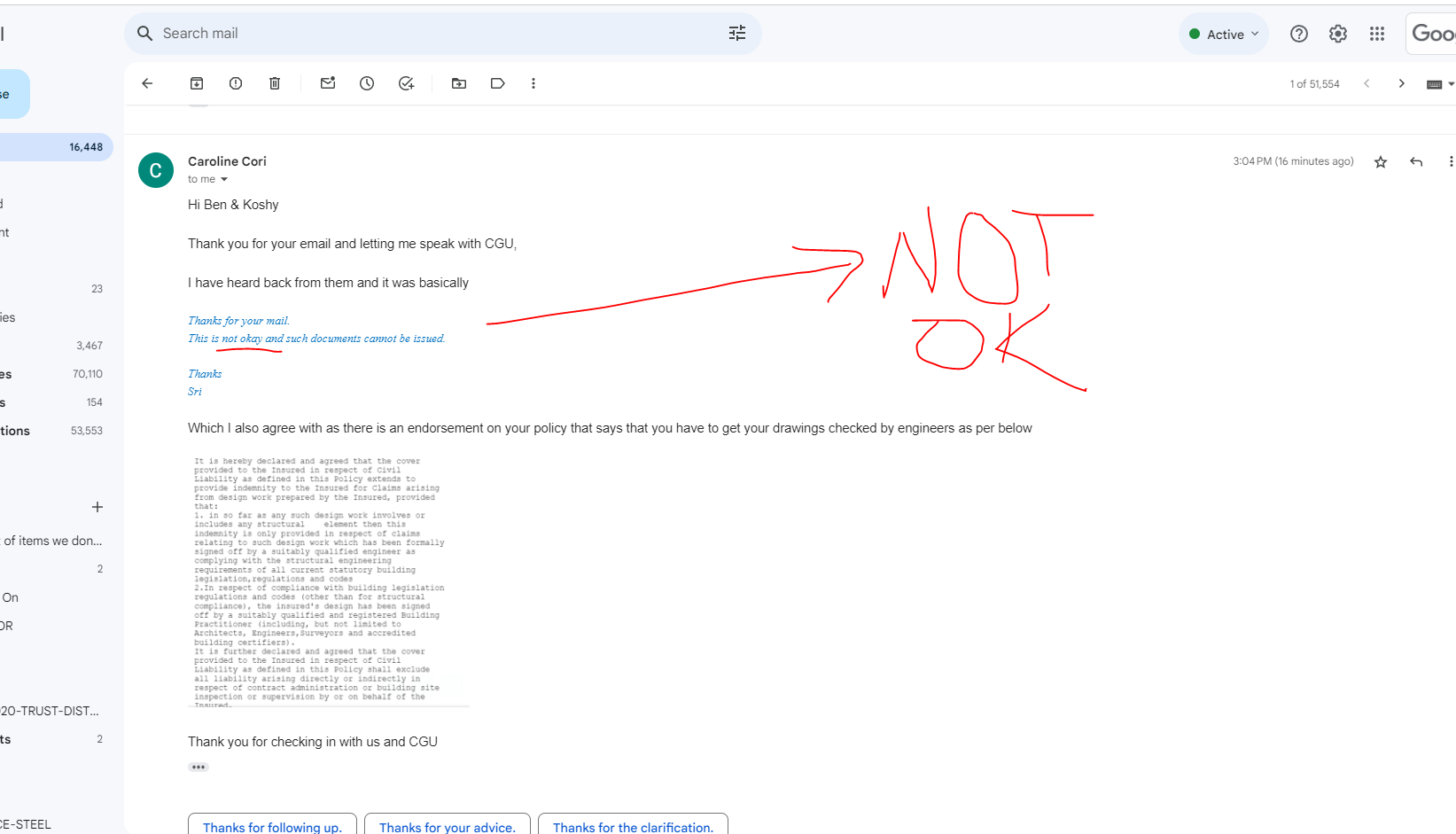
Why? Check the insurance documentation here (internal link):
We have a few positions available to young Engineering graduates at the Koyembedu office in Chennai
To be successful – You have to be a recent graduate in Civil, Mechanical or structural engineering.
Must have a good command of English and Tamil.
1-2 years of Tekla skills is appreciated. Else you have to demonstrate the ability to learn quickly via our online tutorials.
There will be an appropriate task to complete whether you have no experience or have some experience.
The position involved shift work (We work 2 shifts).
Please send your applications to hr@tek1.com.au
Here is a quiz that Bharath has written. Very relevant.
Engineers Architects are trying to wriggle out of their responsibilities by stamping “VIEWED” or “No COMMENT”. They do not want to stamp approved for fear of any error in the document could come back and bite.
Insurance companies on the other hand are trying to minimize their risk when they provide insurance to detailers by explicitly stating, they will not cover the detailer unless the drawings are stamped for approval by the engineer and architect, and anyone else.
To cut the discussion short, if the detailer issues without approval then the detailer will put everyone at risk because there will be no insurance cover. Detailers are the smallest in the chain. Try to litigate against the detailer is unlikely to get any good result. They could simply windup.
Now here is the quiz
https://docs.google.com/forms/d/e/1FAIpQLScspZzCdNBlwVb4FJcB3rUebNuaZHBk28goPcUBHGFXz-aQiA/viewform
Tek1 has extended their tool kit by adding Revit Structural and Tekla Precast to detail precast concrete.
We were trialing precast for a few months now. We have developed some internal tools to handle precast panel shop drawing efficiently.
Tekla for Precast
We are experts in using Teka for steel detailing. Now are embarking on using Tekla for detailing precast. As first step, we have upgraded our 2 steel detailing Licenses in Melbourne to Global License and upgraded to enterprise. We are running parallel trials with Revit and Tekla to test whether Tekla will make the grade.
