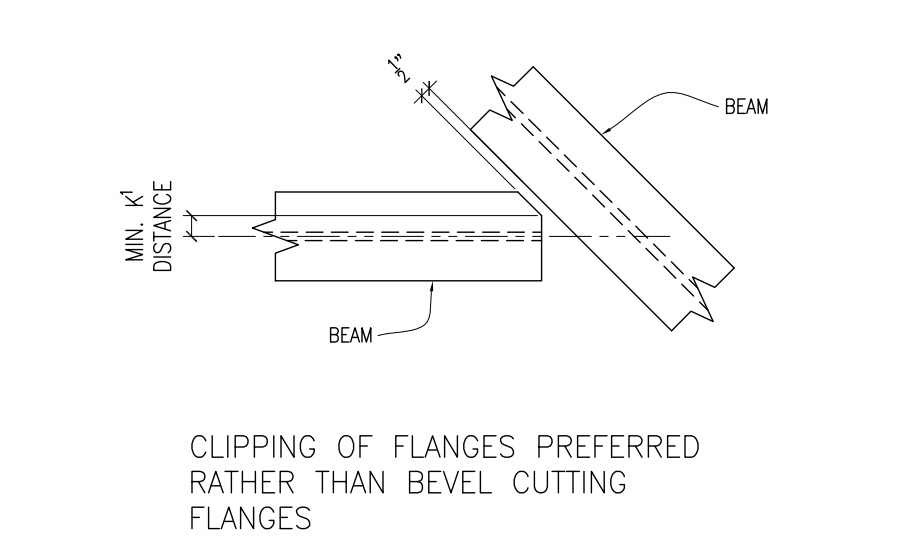
Given here is an image of how do the bevel cut in a beam to beam shear plate connection where the beam does not connect perpendicular. There is no benefit in creating full width bevel cut since it will only add material. All you have to do is remove the clashing bit
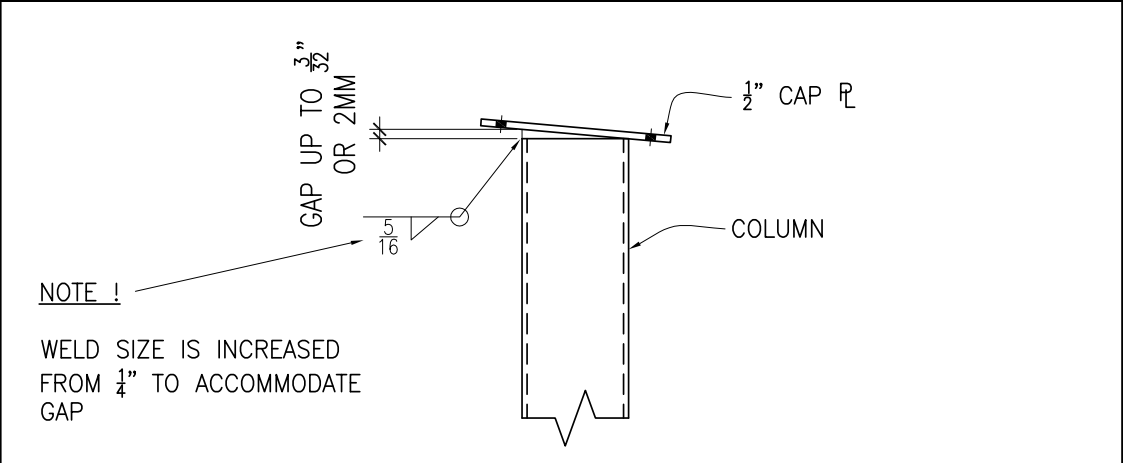
How to detail Column end when end plates are skewed
Here is a picture of an included end plate. Fabricators and easily weld and fill up upto 2mm. Hence there is no need to skew cut end plate. Will save a heap of time and cost in the fabrication shop.
We’ve been detailing Bubble Deck for around 5 years now.
We’ve learned the Bubble Deck standards and we’ve developed some very efficient tooling and processes that allow us to get our drawings out to clients quickly and without errors.
As in everything we do, the primary focus is error trapping and productivity.
Our Resources:
1 lead Bubble Deck detailer.
3 supporting drafts persons.
1 full time software developer.
Our capacity:
As of now, we have the capacity to shop draw about 1500 bubble deck panels per month.
If you have a requirement to shop draw bubble deck panels, please contact us on [email protected] or give us a call +61 3 9560 6397.
Please checkout our tooling and video samples on our Bubble Deck blog!
Our Tools – Here are demos of the tools we have available at our disposal:
Tekla BIMSight is a free tool provided by Tekla to view and markup up Tekla model. We use this too extensively for highlighting and resolving model issues. It will be very convenient if you can download and install this software on your machine and have some basic skills on using the tool
What type of models can be viewed with Tekla BIM Sight?
You can view at least the following types of CAD formats using Tekla BIMSight
Tekla BIM exported models
IFC Models
Autocad 2d and 3d Models
How to view IFC and Autocad files with Tekla BIMSight.
Create a project and simply add the files to the project.
How to markup and send the marked up Tekla BIM model?
There are one or two things to know about this. Please watch the videos below to get a handle on this. The key thing is make your comment public, and also save as package so that others can view your markups.
User Input is critical. You gotta make the user experience amazing.
Any AutoCAD programmer knows that things which an algorithm may take a million years and infinite computational power to do can sometimes be easily done by a human being instantly. In the same way it is sometimes much easier to give a human being the ability to choose: then you can get an optimum result without complex algorithms.
This post is a code snipped of how you can utilise the CTRL + SHIFT + Mouse Wheel (up/down) mechanisms in order to produce different desired results when operating a custom jig.
Here is the code:
So when the appropriate user input happens, then the jig can respond accordingly. Yes it’s true – the OOP purists will say: “you’re passing a concrete type in there” – I can always change it later if I want.
The effective point of this blog is to demonstrate the use of a jig – not just any old jig – but a jig which accepts user inputs using the CTRL + SHIFT + MOUSE-WHEEL (up or down) to change the jig’s behaviour. When the jig is finished running, everything returns back to normal.
We use this jig and command as part of our Bubble Deck tools dll.
The reason we utilise tools like this:
This allows us to turn over shop drawings faster, more efficiently. This allows our precast fabricator to massively improve their working capital position:
Their factory staff is always utilised – they don’t have massive overheads of 50 guys sitting on the factory floor twiddling their thumbs,
They can get in and out of jobs quickly – minimising their liabilities and expenses and also collecting revenues faster,
Faster revenue has huge benefits in terms of interest saved vs interest earned – especially for the developer. If you can allow the developer to finish the job a couple of weeks earlier you save on: construction costs, and also, as before, their interest expenses and their liquidity also improves. That’s worth its weight in gold.
There is nothing worth more than: accurate drawings, done quickly. That’s what we strive for.
For those who want to read my philosophy of the benefits of improving productivity and how I approach detailing – see below. If that bores you, then you may safely skip it with no loss.
An Approach to Detailing: Make things Easier and make them faster
Productivity is what makes the world go round faster. It’s why you can fly from Melbourne to London in less than 24 hours. 500 years ago it might take you a few months – and that too at a break neck speed. Today, anything over 2 days is a painful delay.
Improving Shop Drawing Productivity
It’s the same with shop drawings. We found that our detailers were spending too much time ordering dimensions. That’s something that can be sped up. We want to smash something which had taken over an hour down to 5-10 minutes. And if possible, we want to reduce that time to zero. This allows our detailers to turn around shop drawings quickly to their Precaster – which will in turn massively improve the Precasters turn around time, and working capital situation, and will allow a continual throughput of panels being cast on the factory floor. In other words you will never have a situation where you have 30 guys on the shop floor twiddling their thumbs because their drawings weren’t brought to them quick enough. And if you can get out of a project earlier, that means you can get paid earlier. That in term will allow developers to quickly build and get out of a project ASAP, which would have monumental impacts to their working capital positions and overall profitability. In short, doing things quickly and accurately is worth a lot………………..Time is money.
Get your API working hard for you. Like worker bees.
I got thinking about the AutoCAD APIs (ObjectARX/.NET) – they’re virtually the same – the .NET API is basically a wrapper to the ObjectARX API (with some differences). If you want the full power of low level calls then you gotta go with ObjectARX. But then using .NET comes with a very powerful benefit – a host of libraries and code readily available to utilize. If you’re talking UI then WPF is waiting for you if you go down the .NET path, but not so with ObjectARX.
Anyways, when you think about the API there are a few issues that you gotta manage:
The opening and closing and disposing of Objects.
And the main operations that come to mind are the following:
Adding Items to the database.
Removing Items from the database.
Editing existing items from the database.
Getting Items from the database.
If this happens do that (Events) which ties into all of the above.
Is it just me or does smack of a RESTful API? Well not quite, because we can store state in variables, both within the drawing, and in variables within our classes (temporary).
These are the steps:
Identify a resource.
Operate on that resource.
We can go about this in a few ways:
Using extension methods. This means that we have already identified the relevant resource and we act on it.
Static Methods where then operate on those resource. (I use resource in the sense that Fielding uses it).
GetResource( parameters)
Action(parameters)
We shouldn’t have to worry about all the lower level stuff.
Perhaps a better wrapping API can be written incorporating this. I know Mr Wolfgang Tertinek has wrote about it extensively in his blog. It’s a good approach, but perhaps common tasks e.g. changing a layer of an object can be incorporated in this model. Ideally this should be written simply with core level logic without direct use of a particular dll.
.e.g something like this: SelectionFilter.Create(layer: “test”, types: [BlockReference, Mtext]) – without going into the specifics of setting type filters etc. A DSL much like Active Record for handling these types of queries.