Category: Estimation

  • How to Scope your project, and why?

    Why scope?

    • To define an outcome, and to define a problem.
    • To give clients certain on what they’re getting: price, quality and timeline.
    • To sell yourself as capable to do the job.
    • To fix resources. Everything costs time, money and skill. You will need to allocate resources to get the outcome.

    Scope must be white listed in.

    • If you don’t white list something IN, then new items will CREEP in. This is called “scope creep”. If this happens, and you are being constrained by resources, this means you haven’t accounted for it in the above step(s). Perhaps the entire job needs to be de-scoped.
    • Without a scope, you are handing over a blank cheque. DON”T DO THIS. Clients want people to make a good margin.
    • White-listing also forces everyone to be clear on what they want.

    Clear Unambiguous Objective:

    • If you can’t quantify it, then you have a problem.
    • Scoping will help the client to be satisfied, which is the ultimate objective.

    Summary:

    • Scoping allows you to make resourcing decisions to meet an outcome.
    • Gives you happy clients.
  • Claiming Variations Made Easy

    Navigating the Maze of Contract Variations: Documentation is Your Compass

    Estimating contract variations can feel like navigating a minefield – time-consuming, fraught with disputes, and often leading to costly litigation. Securing payment for variations hinges on one crucial element: impeccable documentation that leaves no room for argument.

    It’s no secret that estimators command significant salaries, largely dedicated to the intricate task of unraveling and quantifying these changes.

    So, how does Tek1 empower you to confidently claim contract variations when design drawings shift?

    We understand firsthand the frustration of pursuing variation claims without bulletproof evidence. That’s why we developed a proprietary app – a game-changer for our clients. This isn’t a publicly available tool; it’s an exclusive advantage for those who partner with us on their projects.

    Unlocking the Power of Real-Time Documentation

    Our app revolutionizes the variation claim process by putting the power directly in the hands of those closest to the changes: the detailers.

    Imagine this: As soon as a drawing change occurs, the detailer meticulously documents it within the app. This includes:

    • Precise markups of the alterations on the drawings.
    • Detailed reports of added or removed materials with quantities.
    • Specific notes on additional work required, both in detailing and fabrication.
    • A clear breakdown of the detailer’s associated costs.
    • All this information compiled into a single line item, complete with supporting attachments.

    Instantly, our clients gain access to this comprehensive documentation, alongside readily available Excel spreadsheets and PDF reports (with and without pricing).

    Effortless Claiming for Our Clients

    Claiming for variations becomes a streamlined process:

    • Instant Access: All the necessary data is available at the click of a button. No more time wasted chasing information or sifting through emails.
    • Transparent Costing: Our detailed breakdown provides a clear foundation for your claim.
    • Simplified Upstream Process: Your team can easily integrate our costs, add your own material and labor expenses, and confidently present a well-supported variation claim. (While the final upstream process involves your specific procedures, our app provides the bedrock of information you need.)

    The Undeniable Value of This Level of Reporting

    Consider the tangible benefits our app delivers:

    • Eliminate Time-Consuming Collation: No more hours spent gathering and organizing change-related information.
    • Strengthen Justification: The detailed documentation speaks for itself, significantly reducing the potential for disputes.
    • Instant Excel Reports: Generate comprehensive reports with a single click, ready for upstreaming with your added costs.

    By providing this level of clarity and detail, Tek1 empowers our clients to claim variations accurately, efficiently, and with the confidence that comes from having indisputable documentation at their fingertips.

  • Our process of Precast Estimation

    Our process of Precast Estimation

    Are you finding precast estimation a demanding task?

    Imagine offloading the time-consuming aspects of this process, freeing you to focus on more critical activities. At Tek1 Pty Ltd, we excel in providing fast and accurate takeoffs for precast projects, often at a fraction of the cost you might expect. You can rely on our expertise and extensive experience to deliver exceptional results.

    Our process begins with your structural and architectural PDFs. Utilizing the panel spliting details from the structural precast elevations, we proceed with a detailed analysis.

    We meticulously number all panels, assigning crucial data such as thickness, material, and panel type. This intelligent data within our takeoff model allows for comprehensive report generation later in the process.

    The panel type information also captures reinforcement details, including rebar weights, perimeter bars, and any additional mesh. For panels requiring patterned or special moulds, including brick snap panels, we identify and mark them accordingly, even specifying the number of special moulds needed.

    Our summary report provides a comprehensive overview, including:

    • Number of panels
    • Thickness summary
    • Gross and net area calculations
    • Concrete volume
    • Panel weight (concrete + reo)
    • Number of meshes and reo weight (excluding ligatures)
    • Perimeter bar weight
    • Caulking and grout lengths
    • Panel types and strengths
    • Concrete mix and any colored concrete specifications
    • Quantities of Bricsnap, Reckli, and Feature panels
    • Number of moulds required
    • Maximum panel size and its corresponding number
    • IFC model compatibility with Trimble or Autodesk
    • A QR code linking directly to the model for easy viewing
    • Thickness summary

    Furthermore, we proactively identify any potential for optimization or issues related to buildability and transportation, providing comments along with the relevant panel mark numbers.

    If you believe our services can bring significant value and allow you to concentrate on higher-priority tasks, please don’t hesitate to call or email us.

    You will be surprised how economically we can do the take off for you

  • Changes in Consultant drawings between Quotation stage to the Project stage? You must check: here’s why…

           It is essential to cross-check the revised consultant drawings we receive against the original drawings from the Quotation stage before commencing the project because this may affect prices.

    For example, the panel break up, or the panel specs might have changed. If they have changed, this might have a material impact on price such as concrete and reinforcement cost.

    What should we do when they make changes?

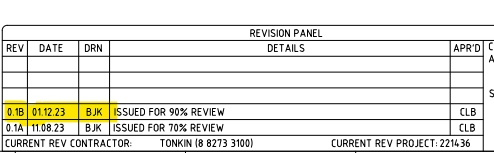
    1. Check the consultant drawing revisions and their date (between the quotation and the current stage).

    For example:

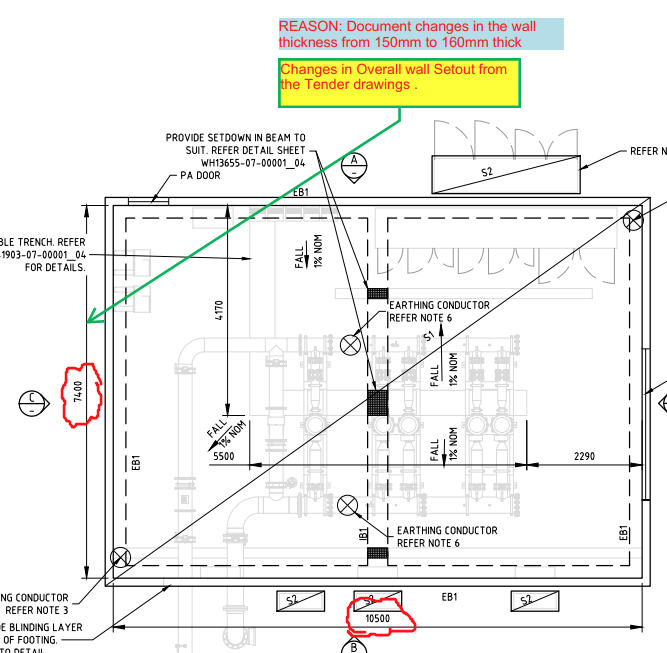
    2. Highlight the changes that occurred and mark them down in the latest structural PDF.

    For Example:
    3. Prepare a summary document report outlining the modifications.

    For Example:
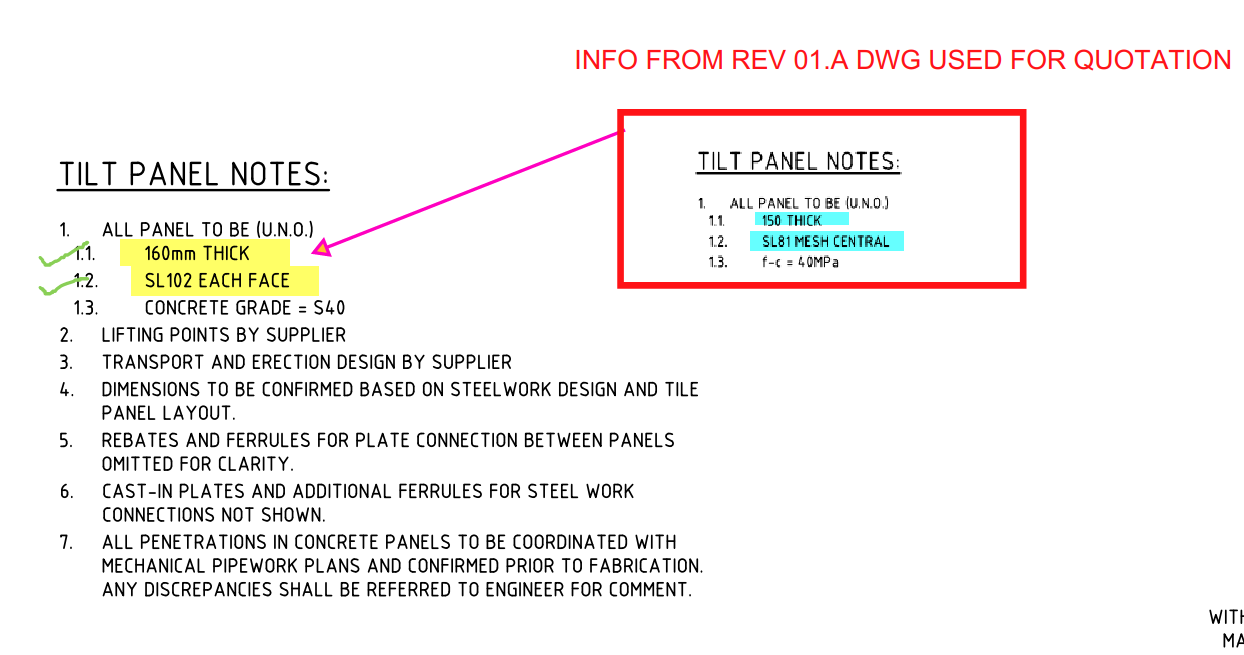
    4. Inform the precast manufacturer and builder about these changes by sending the relevant information via email.

    For Example:
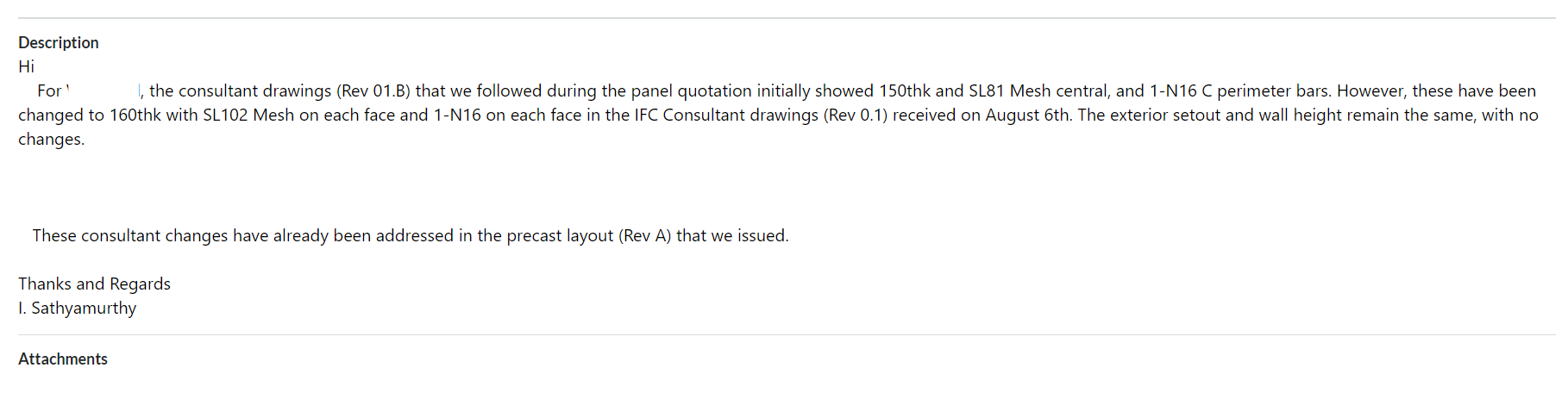
    Why do we need to check the consultant drawings?

         This verification process will enable the precast manufacturer and builder to re-evaluate the timeline based on the information that was previously quoted. This allows potential Cost issues that could cause confusion or delays in the project timeline to be identified and resolved early on such as

    • Cost estimation of individual precast panels, including their respective panel areas and concrete volumes, for manufacture.
    • Cost estimation of approximate reinforcement and mesh weight requirements.
    • List of cast-in items and loose items required, approximate quantities.

    What are the key factors that need to be verified in the consultant drawings from a precast perspective?

    1. Panel Thickness and Types: Verify the panel thickness and types used, as specified in the Structural Drawings.

    2. Panel Count: Confirm the panel count based on the panel split, as detailed in the Structural Drawings.

    3. Panel Transportability and Tonnage: Conduct a transportability check and verify the tonnage of the panels from our end.

    4. Panel Reinforcement:

    • Perimeter bar diameter
    • Mesh type used and its placement
    • Additional reinforcement provided in the panel typical detail
    • Reinforcement on central or either side ( specify location)
      (Refer to Structural Drawings for details)

    5. Precast Wall Pattern and Special Moulds: Verify the precast wall pattern and special moulds required, as specified in the Architectural Drawings.

    6. Panel Finish: Confirm the panel finish, as specified in the Architectural Drawings.

    7. Panel Connection Details: Verify the panel connection details, if applicable, as specified in the Structural Drawings

  • Managing Sticker-shock

    Managing Sticker-shock

    Author: RAJ (Arokiaraj Arputharaj)

    • The initial project was quoted at: $x
    • Changes were required on the project necessitating variations – at double the cost of the original quote!

    When this happens, it is ESSENTIAL that you call the client before you put in your variation documentation.

    Why?

    • The client will suffer from “sticker shock” after he sees your price.
    • “Sticker shock” means that the client will be so surprised, and shocked, that he will fall off his chair.
    • The client will lose trust in you.
    • The client will try to negotiate everything down.

    What should I do instead?

    • Call the client and say that the changes are huge.
    • Do not send variation documentation before addressing the “sticker shock issue”.
    • We cannot and do not negotiate on prices.
    • Going forward clients can choose between: (i) a fixed price quote – where we take on-board the risks of an infinite amount of variations, or (ii) where we charge variations but come in at a lower price.
    • Our variations are FIXED in price.
    • They are not negotiable.

  • How to choose a good detailer / draftsperson?

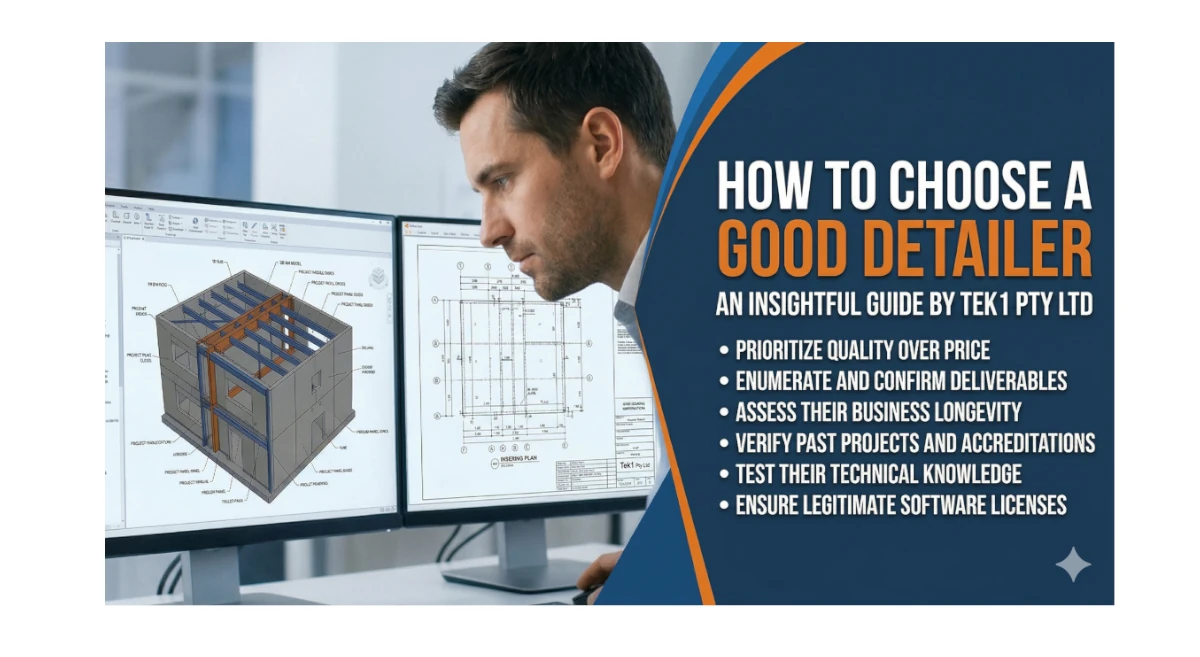
    How to choose a good detailer / draftsperson?

    You’ve got 2-3 quotes for a precast or steel detailer or draftsman / draftsperson. Different prices. Who do you pick?

    When comparing (prices), make sure you compare apples-to-apples:

    • are you also comparing quality and/or
    • other deliverables?

    Consider the following when assessing candidates:

    1. Assess on QUALITY, not price!
    2. Deliverables?
    3. How long have they been in business?
    4. Past Projects
    5. Past Reviews (this is a loose guide only)
    6. Documentation of Knowledge
    7. Documentation of Training
    8. Test Their Knowledge!
    9. Legitimacy of their operations
    10. Understand Internal Processes
    11. Understand Pricing: terms, supply vs demand for their services
    12. Staff: who are they? How long have they been there?
    13. Accreditation

    Warning: Assess on Quality, not on Price

    • A bad detailer will cost you your entire project: whether that’s $10,000 or $20,000,000 m, they will destroy your reputation, your cash flow, and your business. To me it makes no sense to assess on price alone – it is insanity to do so – you must assess on quality.
    • e.g. Story time: I went to meet a big fabricator in Melbourne – who wanted shop drawings for $6.00 / panel. That was an order of magnitude cheaper than what I was quoting. I said how is are you going to do that? He quoted an overseas firm whom we know (this firm is a client killer – they destroy clients but seem to churn enough to stay alive). Fabricator wanted me to price match at $6.00 / panel. I laughed and said: “I can’t do that. Impossible. Good luck with$6.00 / panel!” He was smug. I was astounded at how smug he was – because he did not know, and could not foresee the danger that lay in front of him – for himself, and his employer. This guy was awarded the precast project – it was a prison job – and he then flipped his project to $6.00 detailers, and that detailer basically killed him, and the job. The fabricator lost the contract, and it eventually landed in our lap. That manager essentially killed his employer and the last I heard of him – he was transferred out of his Melbourne position into a role interstate. I could have told him that he was heading for trouble, but this guy wouldn’t have listened to me. The point being: do not assess on price, assess on quality. We are dealing with high stakes outcomes, not a low stakes trinket where ersatz will suffice.

    Deliverables

    • Enumerate their deliverables. Different business have different deliverables and different mechanisms by which they deliver results to you.
    • Our deliverables are as follows:
      • IFA: Marking Plans, Assembly Drawings, Anchor Bolt Plans. No IFC model when we release IFA drawings.
      • IFC: Marking Plans, Assembly Drawings, Anchor bolt plans, drilling layout for Chemset/True Bolt, Part Drawings, NC1 files, DXF files for Plates, CAD exports of requested marking plans and elevations
      • And we don’t deliver db1 files until invoices are cleared. Why? Because fabricators can shop that model; and secondly, and more importantly: we want to control all aspects of the quality process: if a fabricator absconds with the model, and produces a set of drawings via a third party: and it fails – who is to be held liable? We do not want to be dragged into the fray.
    • Reports: Variations reports. How is a fabricator to keep track of all the documentation associated with changes on large jobs? We will do the work for you, we have systems + processes to ensure that you will get change reports.
    • Statuses / Delays: With Tek1, you will largely be informed of the status of your project. Rarely will you have to chase us.
    • Timeliness: We have tools to make us efficient. We write them and build them. This allows us to deliver drawings FAST! Which means you won’t have people sitting around in your factory doing nothing.
    • Further value added services. programming capabilities, tooling, surveying resources etc.

    How long have they been in business?

    If they’ve managed to: (i) establish themselves, and (ii) remain in business for a long time, then that, in and of itself is a semi-reliable indicator. It means:

    • they began, and sustained themselves through that beginning phase,
    • they have enough customers, and enough profits to survive.
    • they’ve had ample opportunity to make mistakes, yet have survived.

    The longer the better.

    We’ve been in business since 2008. That’s at least: 16 years (at the time of writing). You can check out our ASIC filing here, and you can also check out our start year of incorporation:

    We’ve been operating, successfully since 2008:
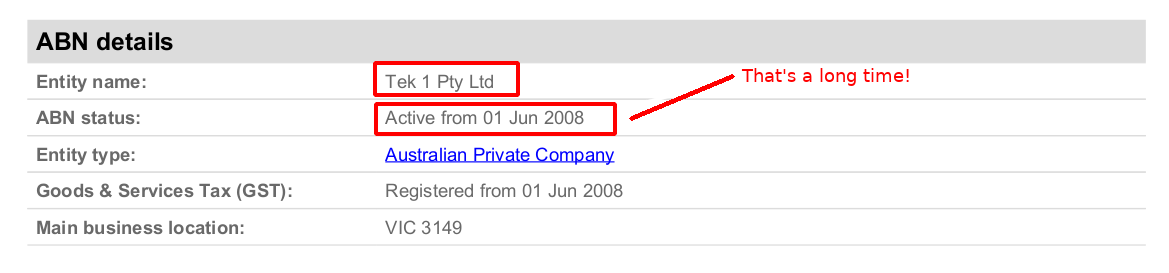
    Tek1 ASIC filing

    Past Projects

    • How many past projects have then done?
    • Have they documented them?

    This is easily assessable:
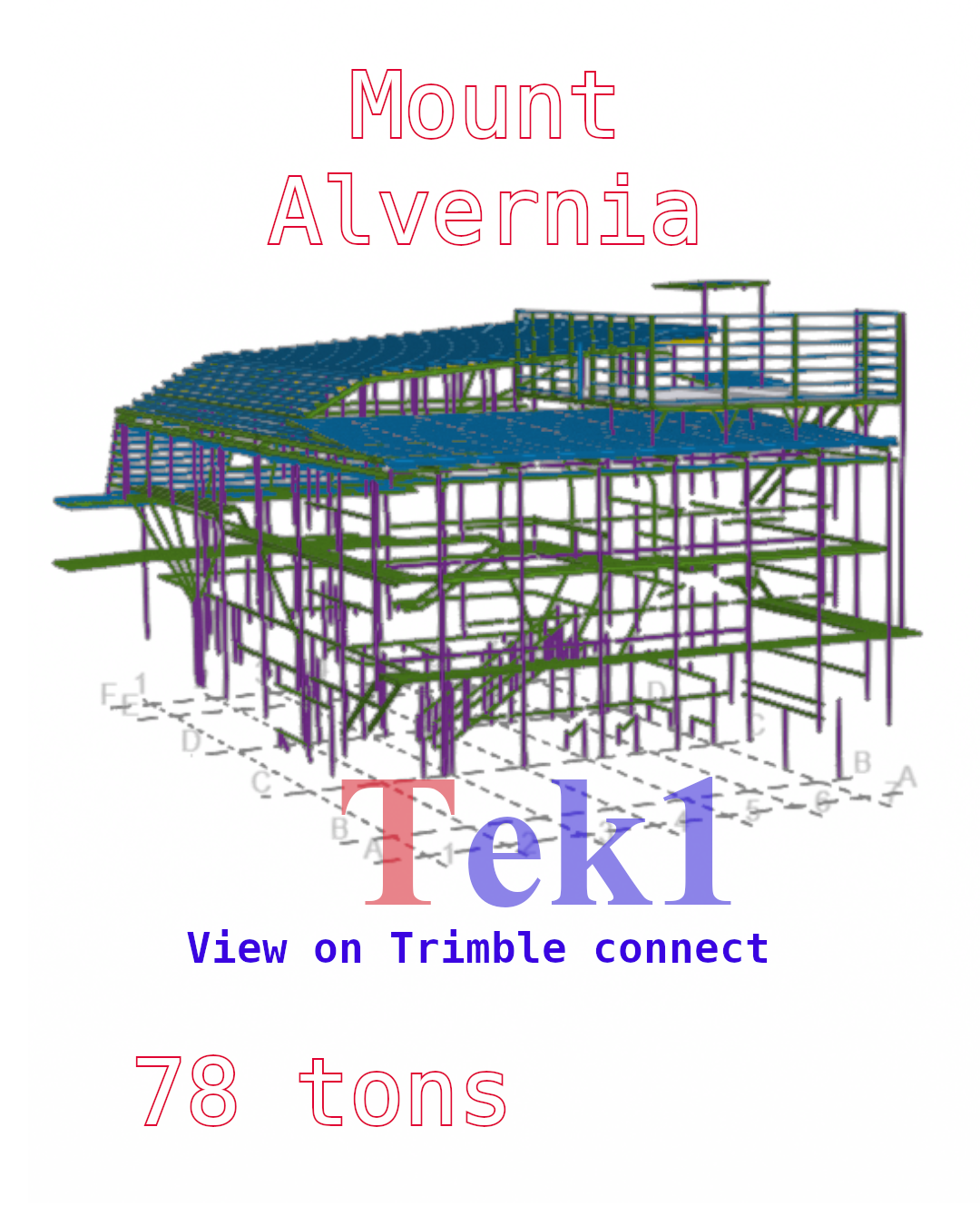
    Steel: We have done many, many 100s of projects – possibly nearing 1000 – check out our past Steel Projects blog.
    Precast: We have done over +130 precast panel projects for Meriton alone (indirect client and through another entity we managed). Checkout all our past precast projects blog.

    Documenting projects takes time. If a firm has documented it over a long period of time, it is more likely than not, that they have actually done the project. It also allows you to ask further questions about a particular project. Further it demonstrates that clients are trusting that particular detailing firm to conduct those (perhaps large, and risky) projects.

    If you don’t see any projects: ask your detailer if there is any reason? Perhaps there may be commercial reasons why they are not there. Perhaps they don’t have the time / resources to post their projects.

    Past Reviews

    They should only serve as a loose guide. Why?

    • Only over-joyed clients will make a comment, and many will only do so after prompting because:
    • Clients who are happy with their detailer: WILL NOT be incentivised to promote their detailer’s name via Google Reviews (or any other platform): because this would entail further competition for themselves, which would serve to push up their prices when asking us to quote for their work. We are not dealing with cafes and restaurants. Precast jobs are expensive, and there is zero incentive to promote “their” cornered resource, especially on jobs worth millions of dollars.
    • Clients who are disappointed will not bother to leave a review: they will leave and not return.

    You cannot trust the existence or non-existence of Google reviews, unless these clients are mums and dads (doing 1 off jobs), or you’ve gone above the call of duty for your client. Nevertheless, we do have some – If interested, check out Tek1’s Google reviews: Tek1’s Google Reviews:

    Documentation of Knowledge

    • Do they document knowledge? Do they know what they are talking about?
    • Do you learn something that you yourself did not know?

    At Tek1 we document our learnings for our staff. They serve a secondary function: that of marketing to prospective clients: clients can form a judgment of competence based on the quality and quantity of documentation they can see.

    Check out our technical blog posts:

    1. Steel
    2. Precast
    3. Tekla
    4. AutoCAD .net API (our programming capabilities)
    5. Tekla Open API (our programming capabilities)
    6. Staff Memos.

    As above: documenting knowledge and creating training courses takes time: it demonstrates that a firm has the resources, and commitment to do so.

    Can the cheaper detailing firms do the same?

    Documentation of Training

    The better firms will document their training. We do this through:

    Staff are also assessed for their knowledge on the job.

    Test Their Knowledge!

    If you know your domain, ask whoever claims to hold knowledge, some simple questions:

    • What is the difference between a UB and an SHS? Where would I use one over another?
    • What does a “grade” of material mean?
    • What are my transport limitations?
    • What Ausutralian standards are applicable for this staircase / balustrades?
    • What is the difference between a ferrule and a coupler? Where would I use one over another?
    • What does rebar mean?
    • How should you dimension a precast panel?

    Then you can gauge whether they know what they are talking about.

    Staff

    • Who is doing the work?
    • How long have they been with the firm?
    • Where are they located?
    • Do you own or control your detailers?
    • How much are they being paid? What is their incentive structure?

    At Tek1, we’re open about who are staff are. Many have been with us for a very long time: +8 years. This means they’ve seen a lot of issues. You can check out our team, and their blogs in the our team page.

    Staff churn is not a good thing, as a client or as a business.

    Our staff are located in our privately held back office in South India. We hire, we fire. We train, manage and steward. We have direct control of our staff: we do not hail-Mary your job to external contractors in Timbuktu and hope that it comes back perfect. It never does. And we pay our very staff well. When you compare our quote to cheaper detailers, consider: how much are they paying their staff? If you pay peanuts, you may get monkeys.

    Legitimacy of Our Operations

    • We use 100% genuine Tekla licenses. These are very expensive, and is why we cannot compete with cheaper pirate licenses. Do you really think a pirate, who steals software, will miraculous be straight in their dealings with you?
    • We’re above board: we pay tax. No cash.
    • We pay our suppliers well, and on time. This enables you job to be delivered well, and on time.
    • We’re tooled up and constantly innovating. Our AWS (Amazon Web Services) cost alone – at one stage: was around $500 / month. How many detailing firms do you know with AWS in their stack? Why do we have AWS? Tooling: it allows us to deliver a better, overall product to you.
    • Proprietary software: as alluded to above: we don’t steal. We write our own tools. Many in this industry are little better than thieves, both in software, and in taxes.
      • e.g. Why should you care if a detailing firms gives you shop drawings cheaply (via thievery)? You should care because it speaks volumes about the integrity of the people in your supply chain. If they lack integrity, how can you expect them to have integrity in performing their work when you are not watching them?
    • If they claim to have custom tooling, but cannot program, and have little ability to innovate: it doesn’t take a rocket scientist to figure out how they got their tools. The good old fashioned way: pilfering.

    Legitimacy serves to add additional costs, but with those costs come integrity in the work. Basically you get what you pay for.

    Will they throw you under the bus?

    • Client did not pay us, gave us obsolete drawings, and was a poor interface with their client i.e. the builder. The project was delayed, because the builder could not contact them directly – because they absconded and went to a destination wedding overseas. A frustrated builder called us directly, wanting a few cast-in-plates: “just give me the drawings, I”ll pay you direct”. What would you do? Cut your client loose (and get paid)? We knew our client would not pay us – he was already late in payment, and routinely paid late, and sometimes not at all.
    • But I never liked going direct: because it might completely screw over our client – who knows if they are using this job to extract payment on other jobs etc. Predictably: the builder fired our client. Our client reassured us that he would pay us regardless, but he reneged. We knew it. The point being: even when we knew we are going to lose, we did not screw over our client. For us, it’s not about the money, but some very basic ethics.

    Understand Internal Processes

    • Do you know HOW they operate? We publish our processes (where relevant).
    • What happens if the architect / engineer adds a few extra tonnes of steel in your job? What if the reo in your panel changes? Will your detailer notify you? How will they do so?
    • Will they update you on your jobs?
    • Do they have systems that other detailers do not have?

    Understand Pricing: terms, supply vs demand for their services

    • Is the job risky? The higher the risk, the higher the price.
    • Does it involve a bridge? Bridges add to the firm’s insurance premiums: these costs must be recouped.
    • What are the terms of the job? Are they taking a deposit?
    • Remember: good detailers are hard to find: they are always in demand. If you’re shopping for a cheap price, perhaps an established detailelr will not want to deal with you.
    • Are you a known brand? Do you pay on time? Good detailers will want to deal with well established and credit-worthy players. If you’re an unknown entity, detailers may decline by quoting you a high price. Perhaps you can negotiate with them by adjusting the terms.

    Further Benefits

    • Are they able to deliver a 3d model to you which you can interrogate? We offer a “live link” service to our clients, so they can see their model, live, and check out any problematic areas.
    • Will they give you documentation if things change for you (rather than for them)?
    • Are they contactable?
    • Will they update you on the status?
    • Will they save your files?
    • Do they have back ups?
    • Do they have insurance? How much cover? What about liquidated damages? Consequential damages? Retention?

    Accreditation

    • If required: are staff accredited?
    • Is the firm accredited? (Tek1 – as of 2024 is a registered member of the Concrete Institute of Australia)
    • Verify any accreditation.

    These are some ideas that will give you some insight into qualifying your detailer. There are many others which I have missed, or have avoided for the sake of brevity. Good luck!

  • How to get fast variation approvals (or denials) on your construction projects?

    How do you get fast variation approvals (or denials) on your construction projects?

    You need:

    (1) Clarity : Be clear of what change is needed.
    (2) Evidence : Evidence of client change request.
    (3) Brevity : Be brief, concise, to the point.

    Watch here for an example from a real life project (not a hypothetical) of the fantastic work done by @Ramakrishna L.

    If the approvals / denials are delayed, it is super easy to track and follow up – now that you have the records.

    Subscribe for more useful tips on Tek1’s Steel Detailing blog: https://www.tek1.com.au/category/steel-detailing/

  • Estimation / Take off Tools

    We’ve created many libraries that handle estimation. Here are some examples which you may view or use as the case may be.

    Apologies folks, this is documentation for our own staff. If you’re not on staff, I’m afraid your access will be limited. Videos are located in the documentation contained in the Drive Folders. Please carefully read the documentation and watch any videos if required.

    Advanced Steel Member Placement:

    Draw some lines in AutoCAD or Advanced Steel. Set up a CSV file that maps lines to Advanced Steel Beams. Run the command in Advanced Steel, and Advanced Steel beams are produced.

    Advance Steel – ConvertToBeams (CTB) Command from Tek1 on Vimeo.

    MemberPlacement tool (AutoCAD):

    Draw lines that come up as 3d lines with a Tekla like interface, which using interop delivers them straight to Tekla:

    Line Based Take-Offs

    • Draw lines and an Excel Spreadsheet is produced showing total lengths and counts for certain steel types. Dlls are located here.

    Take Off Tools

  • Tek1 RFI System

    Here is a preview on what is cooking in our kitchen. This is one of the feature which have built into the system to save a huge amount of time trying to avoid duplicate file downloads. The principle is simple and the execution beautiful. Saves us a huge amount of time. The entire RFI system is free our our clients to use for the projects they allocate to us.

    As of now there is no public domain taken for this app. It still in the kitchen. But nearly ready for the shelves.