Category: Staff Memos

Staff memos are memos to staff.
Purpose to annonce company policies, Process and procedures.
Emphasis is mainly on the process to follow

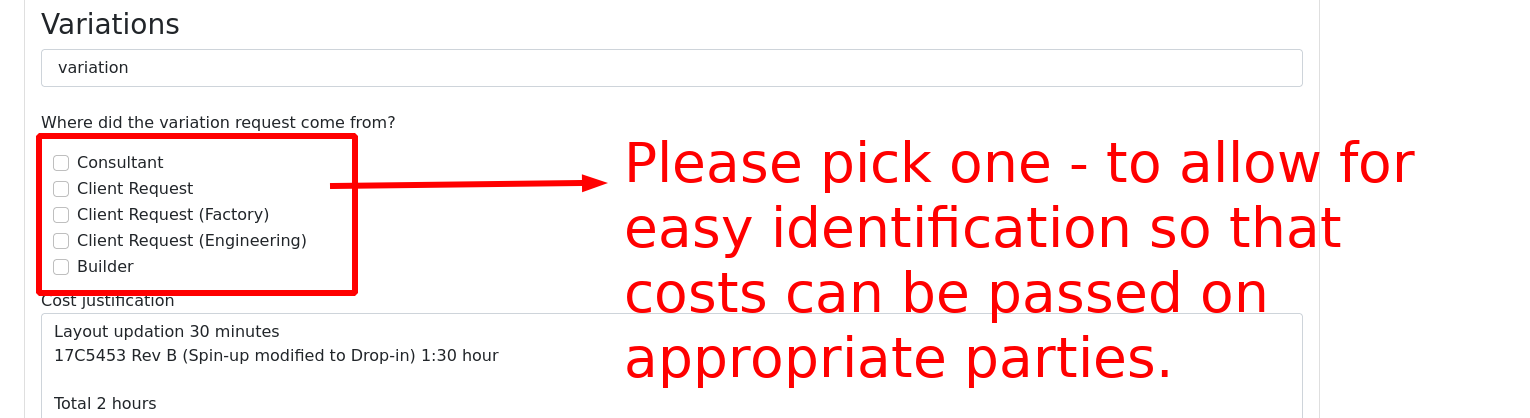
  • Memo 13 – How to Remind clients about variation approvals

    The Building industry in Australia is tough. The insolvency rate is over: 20%. Lies, non-paying etc. strikes, cost surges etc. is all de rigger. Builders are stressed. There’s no need to stress them out even more. Variation work is common the industry.

    Simply use the forms on our quote app – they are standard template fields which will save you a lotta headaches.

    If you need to remind clients about a variation:

    1. Ask nicely.
    2. Ask the proper way.

    DO NOT DO THIS:

    • “This is a variation for both of us”.
    • “Please approve the variation. So that we will proceed with the changes”.

    No: it is not a variation for both of you: the client will decide the variation. You shouldn’t tell him that. If you do, you will simply annoy the client.

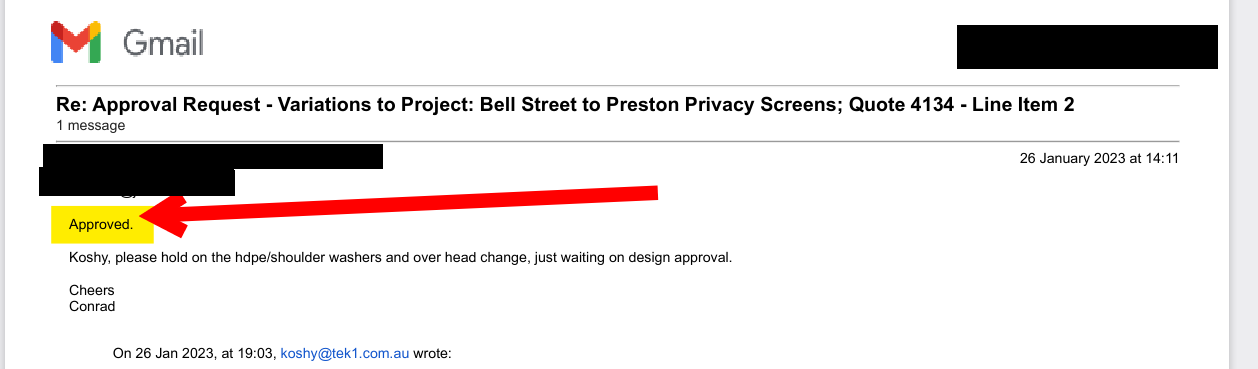
    No: do not ever say: “please approve so that we will proceed”. This is akin to threatening the client, and holding up the job. Never, ever do this! It’s the worst way. You will annoy the client and he will walk – this has actually happened (yes there were other factors contributing) but it could be avoided.

    Never do this!
    Never do this either!

    WHAT SHOULD I DO?

    • We want our clients to voice objections. That’s right, we WANT to hear the objections. Everything we do should be clear, fair, transparent, and should have the consent of all parties. The communication should reflect that. So ask like this:

    These are all “no-orientated” questions. They are decided to illicit a “no” – to make it easy and welcoming for the client to object. Use the exact wording above.

    1. Do you have any objections to this proposed variation request?
    2. Do you object?
    3. Sounds like you have an issue with this request?

    Fixed Price Contracting

    • Some clients agree to our contract, knowing full well that we do not do fixed price contracting. If any client rejects variations because they want fixed price contracting – then please feel to contact me directly about this.

    Be Honest

    • If it takes 1 hour, then write down: 1 hour.
    • Do not write down 3 hours. If you get caught, then clients will loose trust in you, in our firm, and so will I. You will get a reputation as a liar, and that reputation is hard to shake.
  • The Beauty of Status Updates

    The Beauty of Status Updates

    At scale, efficient systems of communication and coordination are required in order to efficiently prosecute projects. These systems will likely be of immense value to yourself, and your clients. Consider the following example:

    Our critical path sits within the ABCD building, I have run a target date commencing 29/6/22.

    Is this possible for the ABCD given the attached review?

    What further do you need from us to mitigate any time frames lost?

    Can we get ahead on the procurement of the Steel while we look to focus on getting the SD’s to IFC this week with Tek1?

    Email received for the ABCD Building.

    The critical question: what are the hold-ups for the project?

    Likely our client, has no idea, let alone the builder/developer (a large one). Projects are held up in the weeds. The folks at the top of the supply chain need to make resource allocation decisions. Right now, they’re doing so, effectively blind. Or they have to send out emails like this one.

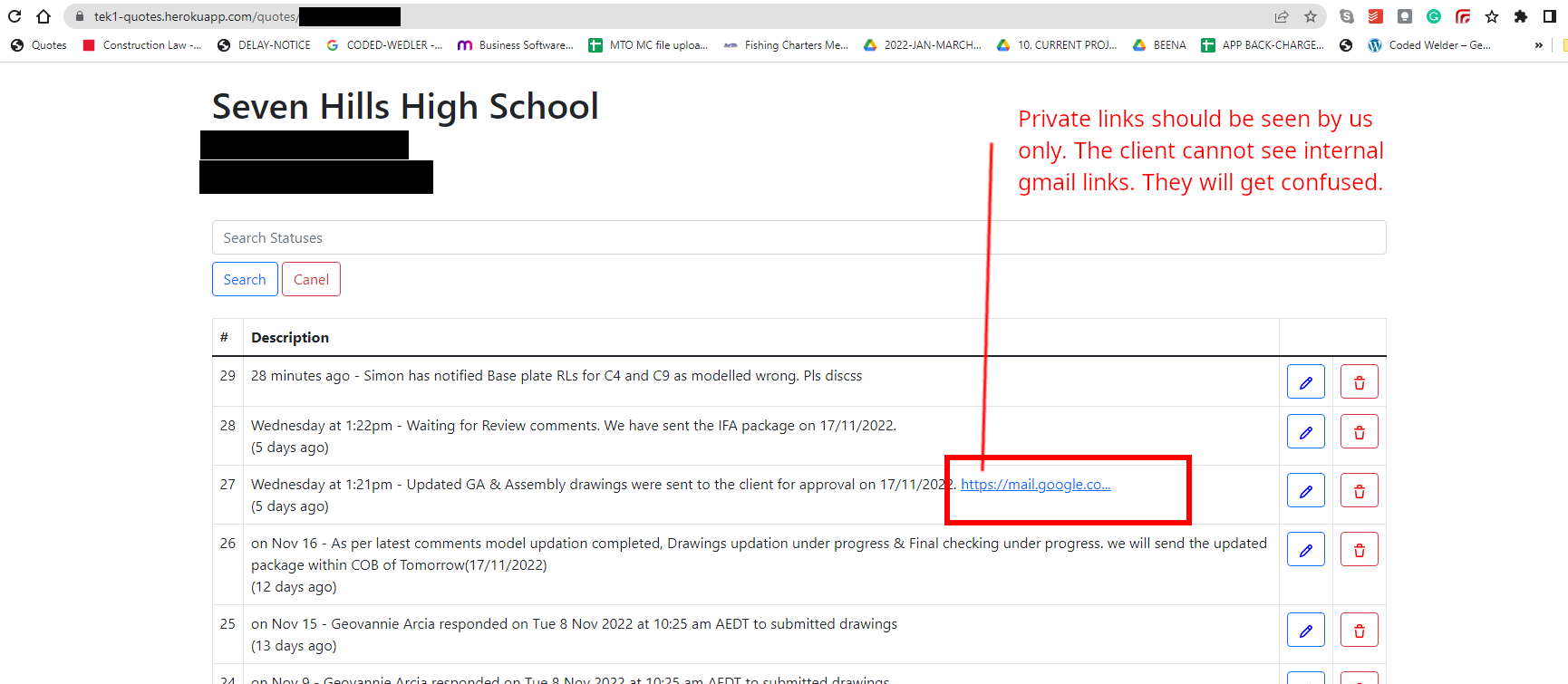
    Would anyone remember, what the specific hold up for the project was a few months ago? It’s very hard to remember. And it’s hard to dig it out of the 100s of emails you would have received over that time period. But if you have built up a timeline, it is relatively easy to see what’s happened. All I had to do was to check out our status reports:

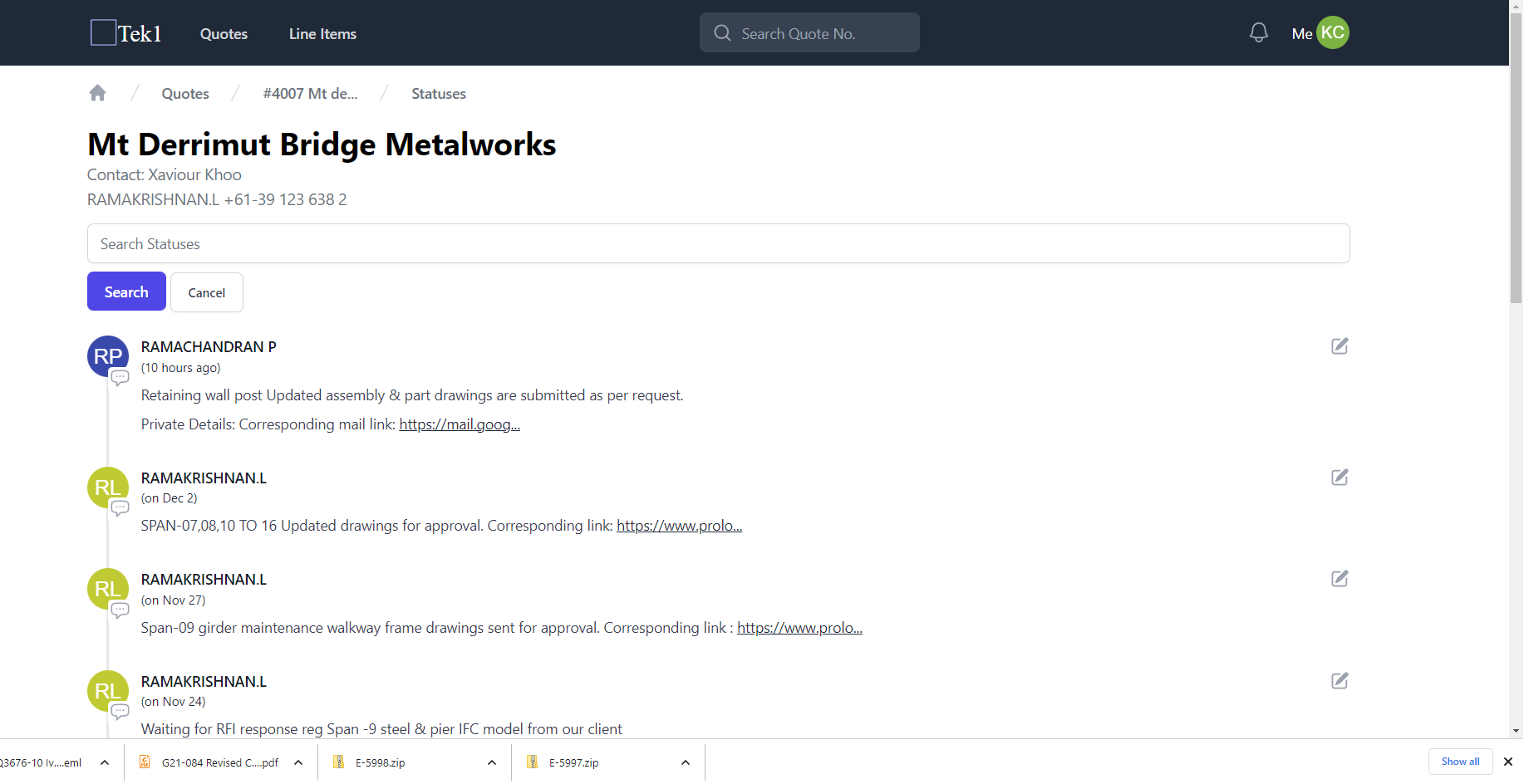
    Status reports for this project. Details redacted.

    As you can see: the project has been in limbo since the 20th of April. It’s self evident. If you didn’t have a timeline, you’d have to bury your head in 100s of emails to retrace your footsteps. We’ve been waiting for this review for three weeks. That’s roughly three weeks ago.

    As usual, the reviewers are holding up the show. Except now, given everything is tracked, it’s very hard for them to conceal their inefficacy. Then there were the delays due to: (i) asking RFIs, and (ii) waiting on those answers. (The RFIs are usually asked in the first place, due to the poor quality drawings that are received). The price of inefficient designers (architects / engineers) is monumental. Add poor coordination into the mix, as well as ballooning material / labour costs, and that spells a perfect storm for builders.

    Building up a simple status timeline massively improves transparency, improves communication with your client – and all this for very little cost.

  • Memo #9 – Justify Variation Hours to Clients

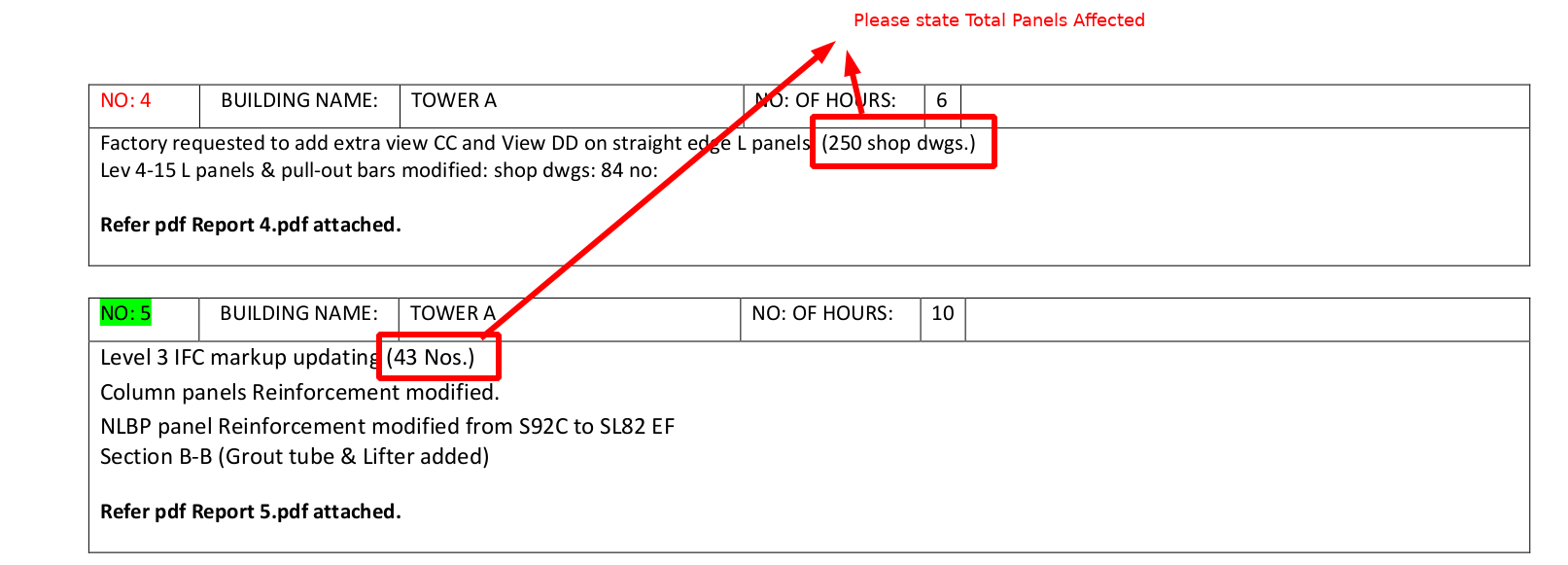
    If you have 20 hours worth of variations: do you think your client will rejoice? Typically, no!

    Clients demand transparency! They have every right to know: (i) why you are charging them, and (ii) what they will get in return. It will not do to simply say: variation: 20 hours. Why not? Clients will assume you are pulling the wool over their eyes. If you wanna get paid, you need to justify your pricing and proposed scope of works to them.

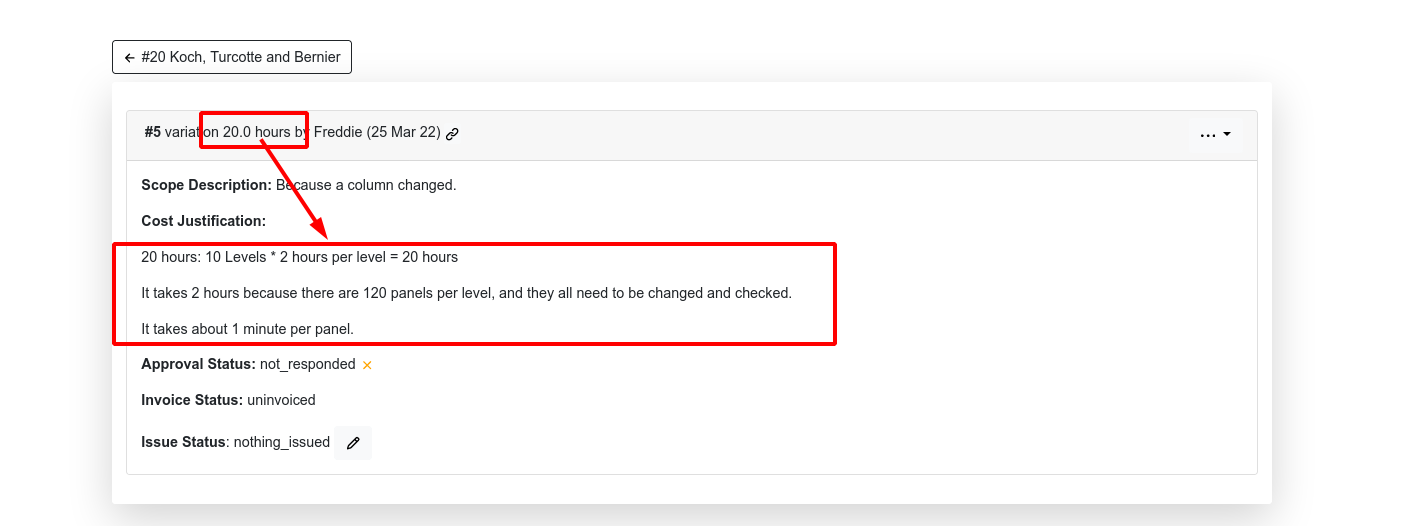
    Justify variations - and break them down.

    Break your costs / hours down!

    Where are these 20 hours going? Well, that’s 2 hours per level. And there are 120 panels per level. Which equates to a change of about 1 minute a panel. That seems extraordinarily efficient, now that you state it in those terms.

    Your clients will thank you. Remember, they’re going to use your justifications so they can in turn claim costs from their clients. And best of all, it means you’re more likely to get paid for your labour.

  • Memo #8 – Don’t use private emails/channels etc for firm correspondence

    This will probably apply wherever you work: don’t send project and firm related correspondence on your private whatsapp chats, or on your private emails etc.

    Why not? It’s very hard to track. We have no record. Nothing can be verified.

    Protect yourself, your careers, your firm, and your clients: it’s pretty simple: avoid using private channels for firm correspondence.

  • Memo #7 – How to on Statuses, ETAs must be accurate

    When traveling overseas, especially India, I often hear the following:

    “Where are you?

    “I’m almost there”

    “When will you arrive?”

    “Five minutes!”

    They always say: “five minutes”.

    Once, I remember waiting, for at least 45 minutes.

    Not sure if this is a cultural thing. I’ve heard Indians say:

    “Oh, that’s IST – Indian Standard Timing”.

    Friends – Indian Standard Timing might work very well for your own personal arrangements, but it will not work well in the USA / UK / Europe / Australia / NZ, on construction projects, where tight deadlines are involved, and where “Liquidated Damages” are at stake.

    Why are ETAs important?

    Because clients need to order material, organise labour, and equipment. It will not do to organise a crane, and hire labour, only for them to sit idle for a couple of weeks because you were overly optimistic with your delivery times. Cranes alone might cost $5000 – $15,000 per day. What about site crews? If you give the wrong ETA, then it could cost your client a lot of money. Which means it’s gonna cost you a lot of money.

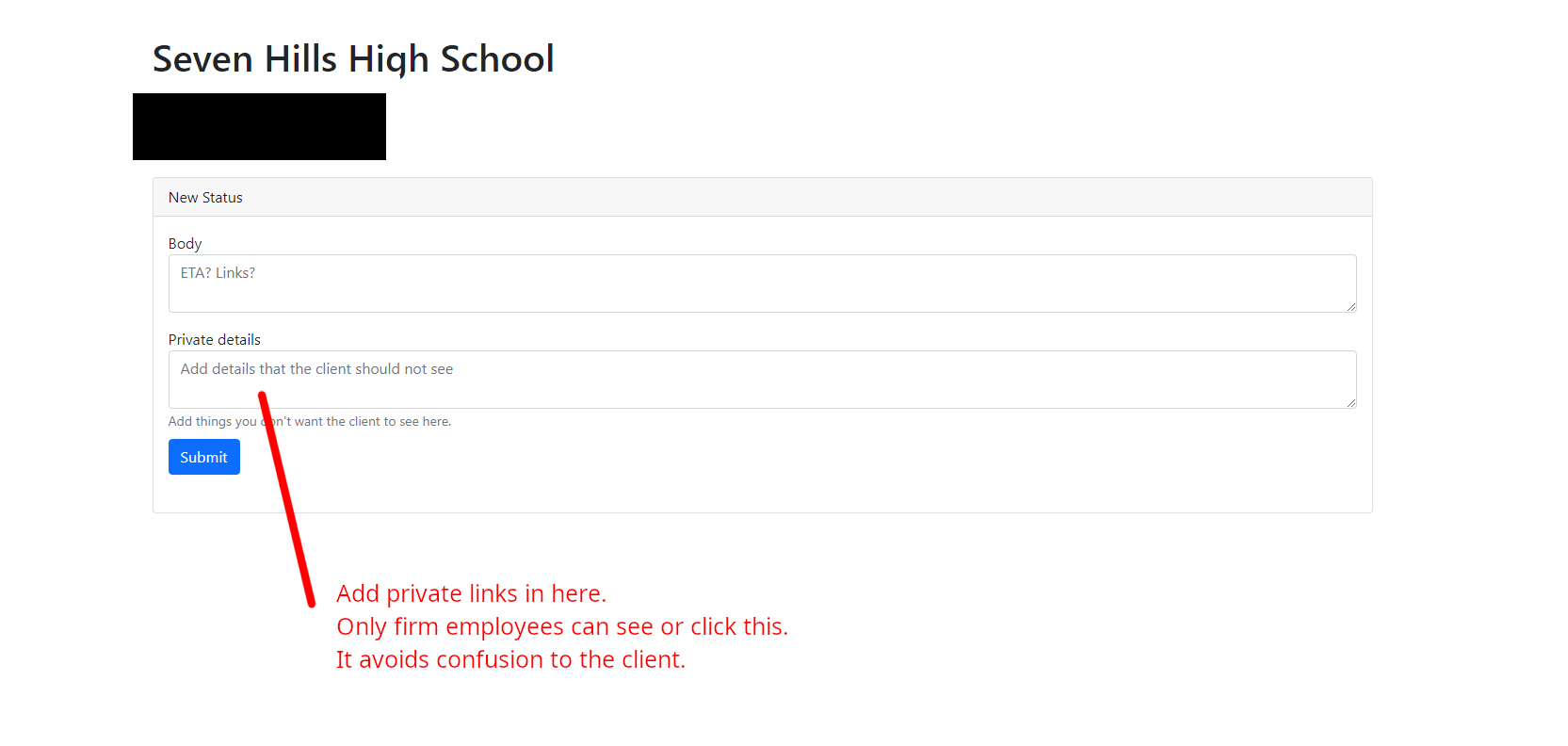
    Give real ETA. Not the typical: “5 minutes later” ETA. Update your clients constantly on your Tek1 status reports.

    Summary: Give the correct ETA, and make sure you meet it.

    Lesson – Keep the statuses short and sweet

    ETA – This means Estimated Time of Arrival. Just put the ETA and then the date, the time and the time zone:

    e.g. We will issue the Takeoff reports by the end of 02.04.2025

    Don’t do that.

    ETA: COB 2025-04-02 (AEST)

    Clients care about their time zone, not yours.

    Lesson – Clients Pyramid Their ETAs on top of Your ETAs – so add a buffer

    Why is a client asking for an ETA? Because they need to:

    1. Tell their client the ETA.
    2. They need to plan / arrange resources. So does their client. e.g. if they hire workers to come to their factory on date: XYZ to do work – how can they do any work without any drawings to work on? These workers will be sitting on the site twiddling their thumbs, and it is very expensive.
    3. If you promise a time and don’t deliver: then you will lose your client.

    The Cost of promising ETAs and not meeting them is large – if it does not come on time, and the communication is poorly managed – then we’re hurting our clients

    Let’s take this job for example: https://tek1-quotes.herokuapp.com/organisations/2/quotes/12046

    It was filled with issues: some from our side, the other from the client, and the other just due to coordination issues.

    We need to ensure that our communication on the hold-up points is clear.

    I’m not here to lay blame: but to make people understand the cost.

    • You promise a time to the client.
    • That time gets blown out. The reasons must be clearly communicated. If it is not communicated clearly you will get blamed.
    • The client promises a time to his client based on your ETA. If the drawings don’t come on the time, then the client cannot meet his ETA. In this case, the delays became so egregious that our client’s client – was threatening to de-scope him from the job, cancel his contract and go somewhere else.
    • This particular job is worth over $100,000 to our client. And our client is about to lose millions of dollars because he will have burned his client – because of the ETA issues and delays. Again not laying blame on anyone.
    • Think of the cost: our poor ETA management and poor communication costing our client, but it is also costing our client’s client.
    • In addition I had x2 clients who were about to be severely compromised because of LGS delays, and I was delayed in my other projects.
    • The cost? My x2 clients potentially burned (they were not), our client potentially burned, and our client’s client also potentially burned.
    • The cost is very very high.

    Do me a favour: add buffer time, and communicate your hold-ups effectively. Perhaps this might require a technological solution.

  • Memo #6 – Drawings not to be issued “IFC” markings without approvals

    Here is a memo we received from one of our clients. Such memos are not infrequent:

    I am pushing for stamped drawings, however from the IFAs issued there should be no changes made. I need to begin the steel ordering process tomorrow. There is a lead time on the ordering of the steel, and by that stage we should have the finalised drawings. Anything that gets altered can be held at the processing of steel stage.

    Can you please issue the full pack for the Spiral tonight.

    Thanks

    Question: what should you do?

    1. Do whatever the client says, because the client is always right?
    2. Stamp with IFC and send to the client?
    3. Ask your boss what you should do?
    4. Send the drawings without the IFC stamp?
    5. Send the drawings with an IFA stamp + a disclaimer on the drawing + another disclaimer in the same email?

    To answer this question, you need to first understand the approval work-flow in building and construction projects:

    Process in Building and Construction

    1. You do the shop drawings.
    2. You submit them for approval.
    3. The architects and engineers then approve the documents.
    4. AFTER they have been approved (not before, but after), then you can mark: “For Construction” and release the drawings.

    Please follow this process. It is very important from an insurance and legal liability point of view.

    Why is the process important?

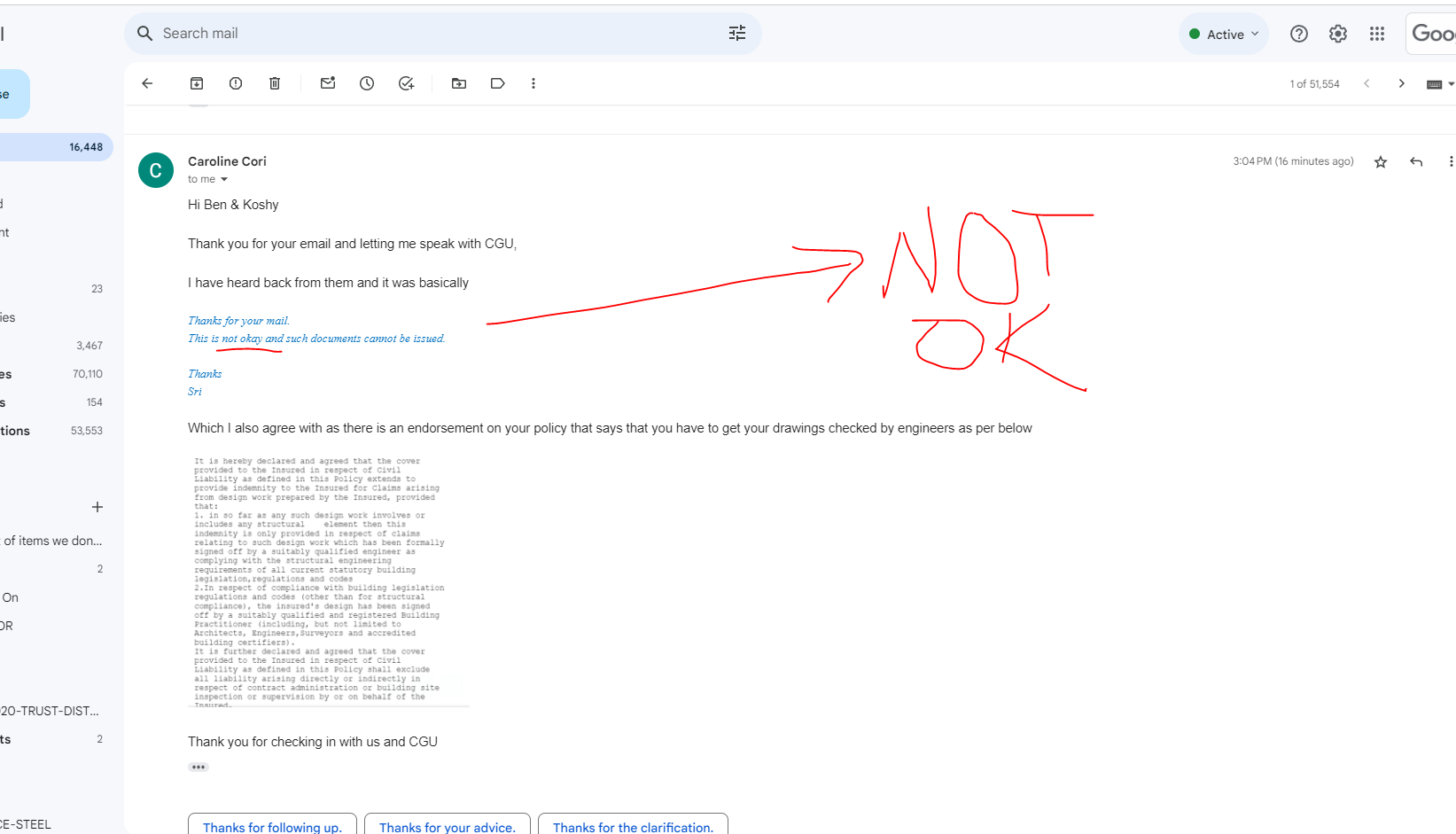
    In every building and construction job, there is risk. If something goes wrong, then fabricators and builders are likely to start blaming people – lawyers will blame anyone who is not insolvent so they can recover the loss. If people fabricate from IFC drawings without a stamped approval, then we will not be covered by insurance: the entire firm could go under.

    When things aren’t approved: the things are likely to be in a rush, and things are likely to be poorly planned and coordinated. When the builder starts blaming you for releasing IFC without stamped approval, even though he demanded it: what are you going to say in response? We want to avoid problems and disputes at all hazards. To keep it simple:

    DO NOT MARK AS IFC WITHOUT STAMPED APPROVAL

    So what should I do?

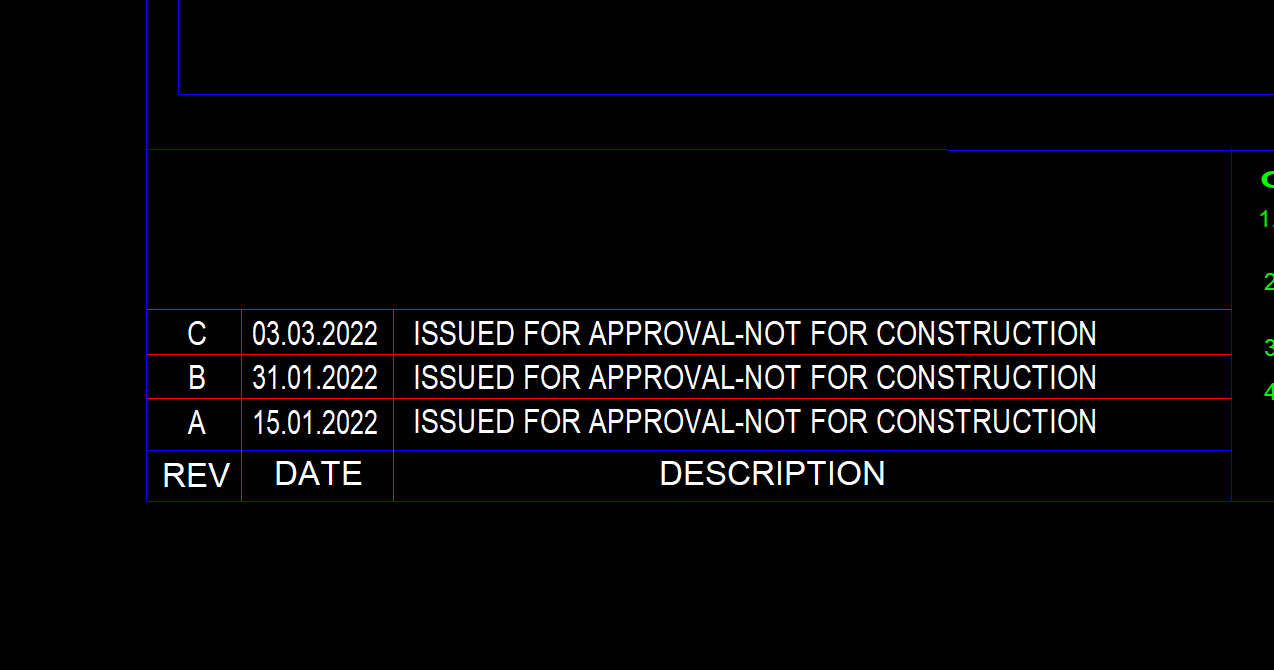
    1. Release the drawings as IFA with the following annotation:

    Shows how to annotate when you don't have the stamped approvals
    You defeinitely don’t want to mark as IFC without stamped approvals. If the client wants to fabricate, then he must very clearly understand that he is playing with fire.

    2. Add in the following disclaimer ON THE DRAWING:

    Summary:

    DO NOT MARK AS IFC WITHOUT STAMPED APPROVAL

    Why? Check the insurance documentation here (internal link):

  • Steel Detailing Primers and Processes

    The following codifies our processes. It is made for the following reasons:

    (i) to educate our own staff, about what they need to know and secondly,

    (ii) to make transparent to our clients, how we operate. We are essentially inviting you into our kitchen, so you can see for yourselves how we cook, and to then decide, whether you would like to dine with us.

    1. Mistakes are expensive. (Why this is the case?)
    2. Understanding risk and liability.
      1. Understanding risk: liquidated damages, contractual obligations, insurance. Understanding the legal system in Australia, USA, UK.
      2. e.g. to NEVER issue drawings for construction without consultant approvals.
    3. Confirm important details in writing. (Why is this the case?)
    4. Understanding: the importance of accurate estimation(s) of deliveries (Why is this the case?)
    5. What do clients value?
      1. To make things as easy as possible for the client, and to make the client money. This might involve:
        1. Quick drawings.
        2. Accurate drawings.
        3. Timely feedback (i.e. what is the status of their project?)
        4. Pushing the job along.
        5. Solving problems with minimal noise
        6. If they client asks for something, we need to either: (i) deliver what they ask exactly, or (ii) give clear reasons why it can’t be delivered. If the client asks for an program schedule, it will not do to say: “yes sir” and completely forget what the client asked for.
        7. Delivering on your promise. If you say “5 minutes” then deliver in extra 300 seconds, and not, 6 hours later. (Why is this important? (the client might allocate an entire team to fabricate something in 5 minutes, and you will cost the client $10,000s of dollars if they are sitting around in the factory floor, without nothing to fabricate, because you didn’t deliver the drawings when promised)).
        8. Making things easy for the client to fabricate and/or manage their projects.
        9. Good grammar, good English, and clear communication.
        10. Extra material: to be immediately communicated to the client. (Why? So clients can recover their costs).
        11. Tender drawings vs for construction drawings to be compared and the differences reported to the client in a report. (Why? So the client can recover costs).

  • AWS VPN to Tekla License Server

    AWS VPN to Tekla License Server

    Documentation on how to do it, for all Tek1 Staff Only.

    Rules

    (1) DO NOT HAVE PIRATE LICENSES ON YOUR COMPUTER.

    Please contact me if you have any questions.

    No pirate licenses. This means genuine Windows, MS Office, and genuine Tekla licenses. In this organisation we pay developers/companies for their labour and services. We don’t steal. Moreover, I need to know the cost of operations, and costs we incur should be added to our invoicing. It is critical that our costs are accurate. If we have to resort to piracy in order to maintain profitability, then we ought to quit the business entirely and do something else.


    (2) Disconnect your VPN connection when not in use. So others in our team can access. VPN connections are very expensive.
    (3) Do not share your username / password with anyone else.
    (4) Do not use these licenses for your own personal work – i.e. for Tek1 use only. This ties in closely with the first point re: piracy.

    VPN Access to our Tekla Licenses
    VPN Access to Our License Server

    Outside the Office

    • If you are accessing our VPN from outside the office, please follow the instructions in the following video:

    I will tell you the client vpn passwords and codes that you need in order to connect. Just msg me please.

    Problems or Errors?

    Please read the trouble shooting page here.

    Administration Notes

    • Users must be added to the “Steel Detailing Group” to get access.
    • External users must be added to the: “External Contractors” group if they are contractors.
    • If staff should leave the organisation, they must be deleted from both groups. Access via Azure Active Directory’s portal.
  • How to do material take offs cheaply

    Take offs needn’t be expensive. If you want accurate reports and a good IFC model you can spin around, you can get it done easily, with some custom software. Now you can get your take-offs done cheaply, and with the quality being just as good.

    Check out this video, which explains it all:


    How we do Material Take-offs – Tek1 from Tek1 on Vimeo.