Category: Stair

Tek1s stair projects at Sydney, melbourne, WA and SA.
While detailing any stair, we check compliance of stair to AS1428, AS1657 or applicable building code.

  • Designing a Multi-Level Staircase: Common Mistakes and Key Considerations

    Designing a Multi-Level Staircase: Common Mistakes and Key Considerations

    When designing a staircase, one of the most overlooked aspects is the correct distribution of risers, especially when integrating a mid-landing with a falling finish.

    Understanding the Mid-Landing Design:

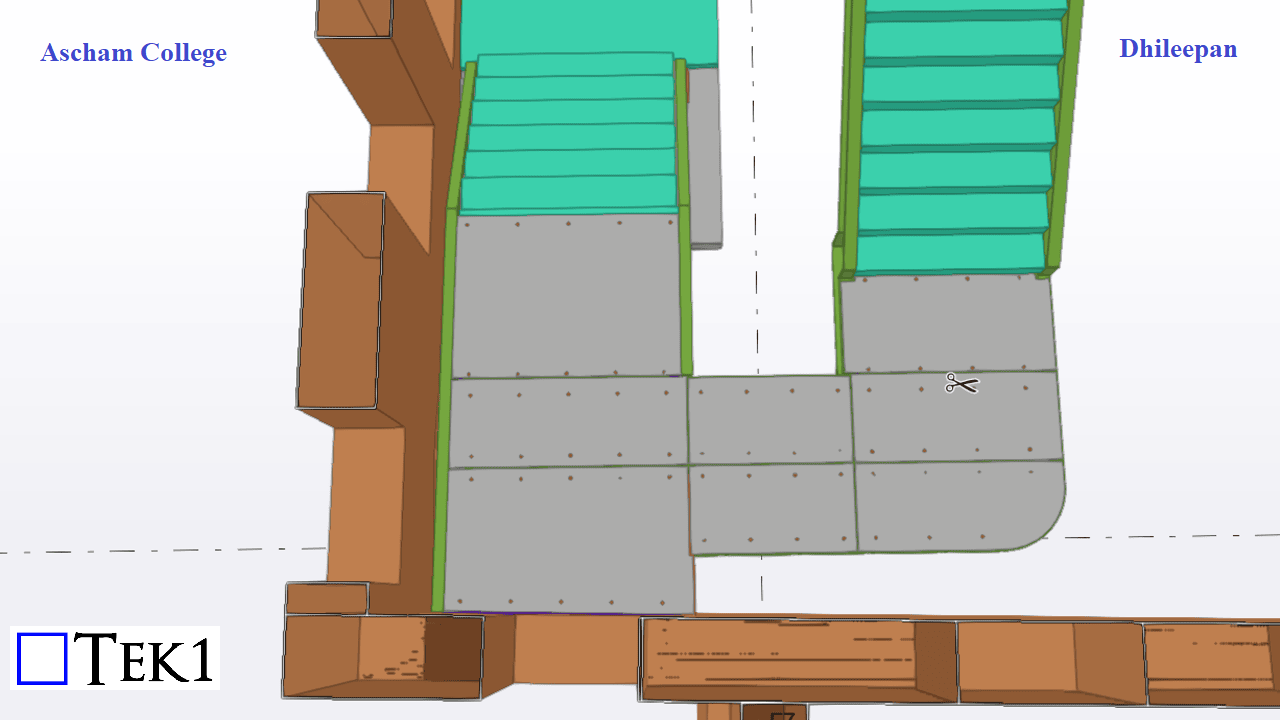
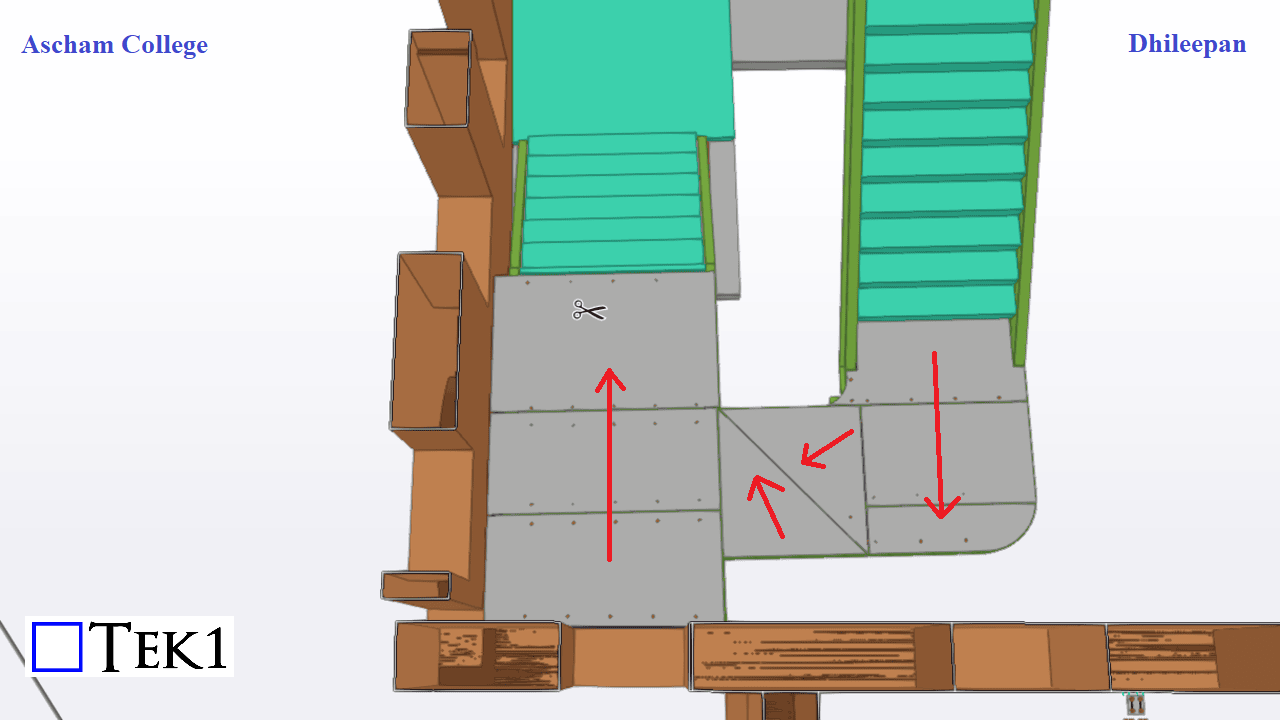
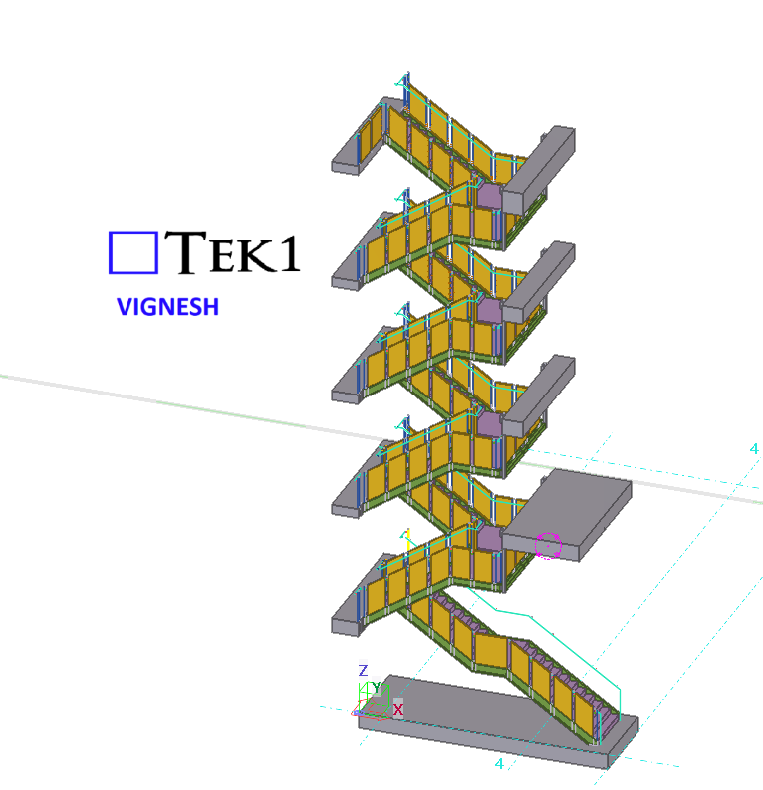
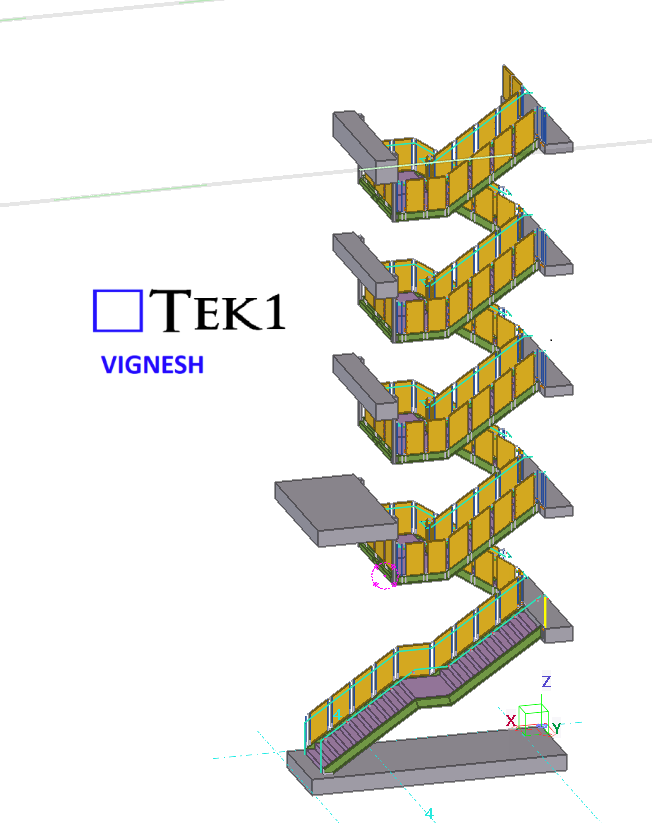
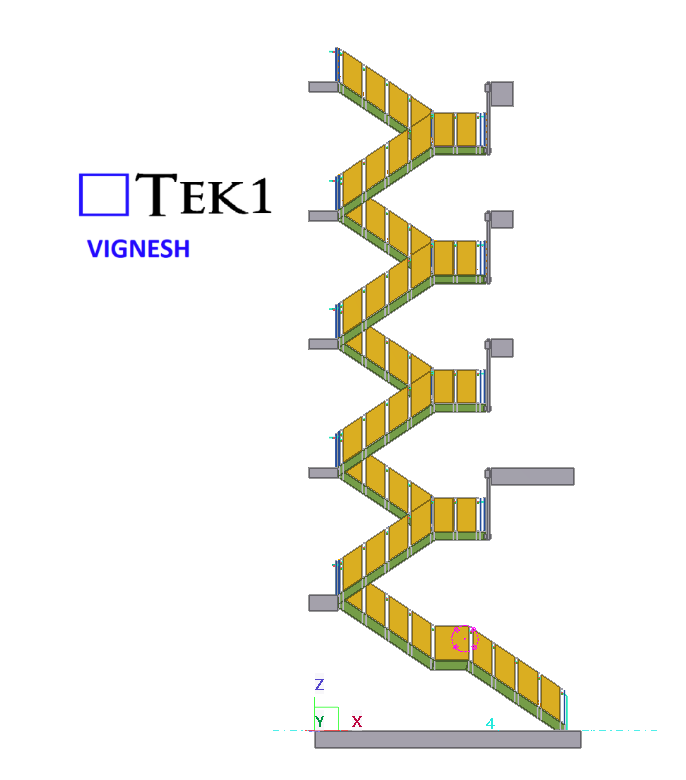
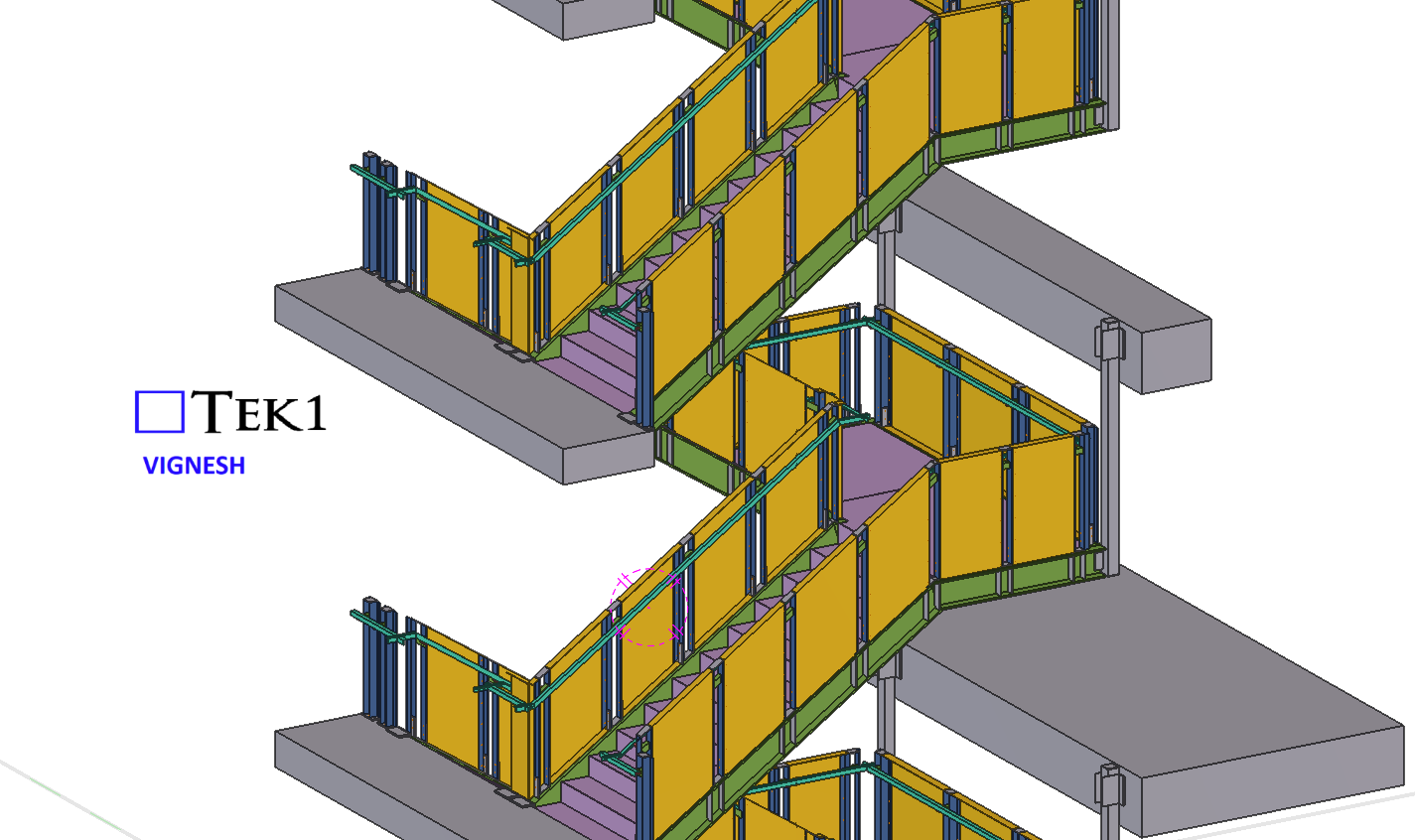
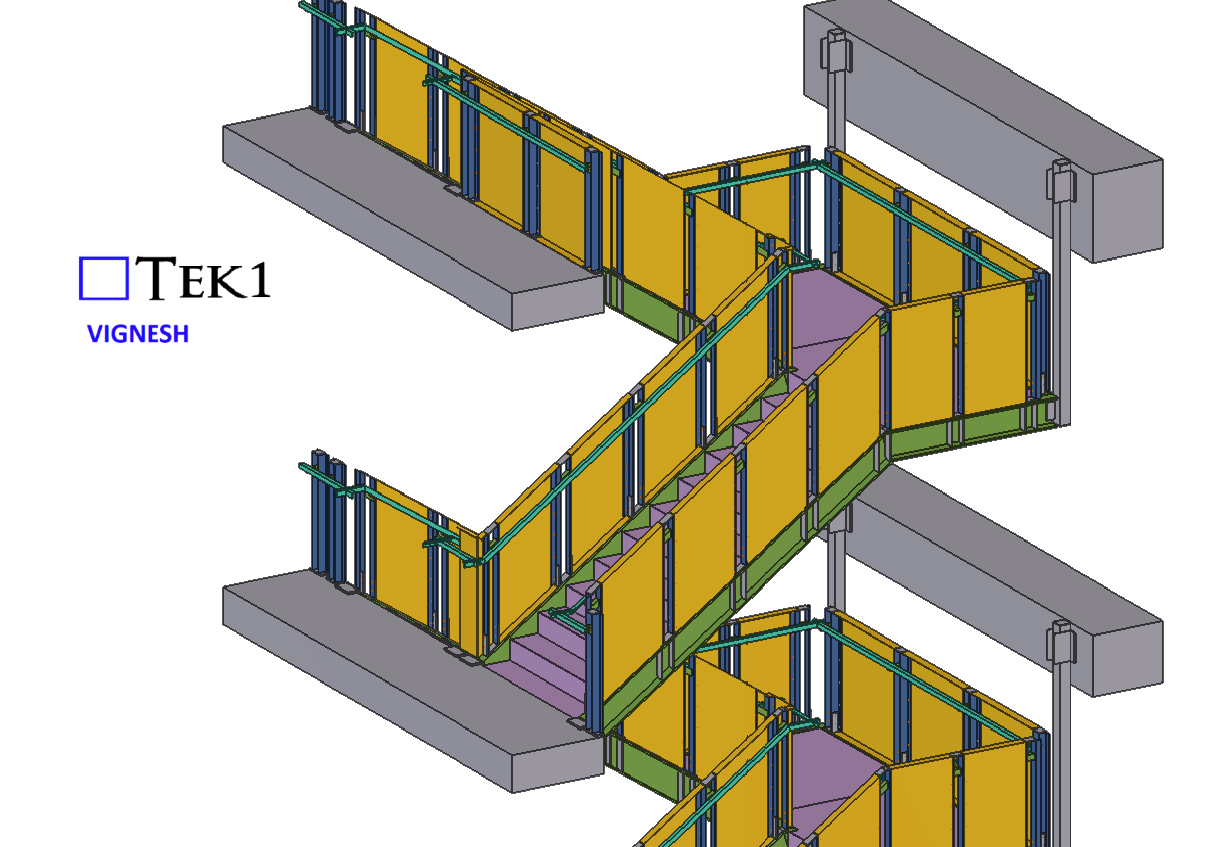
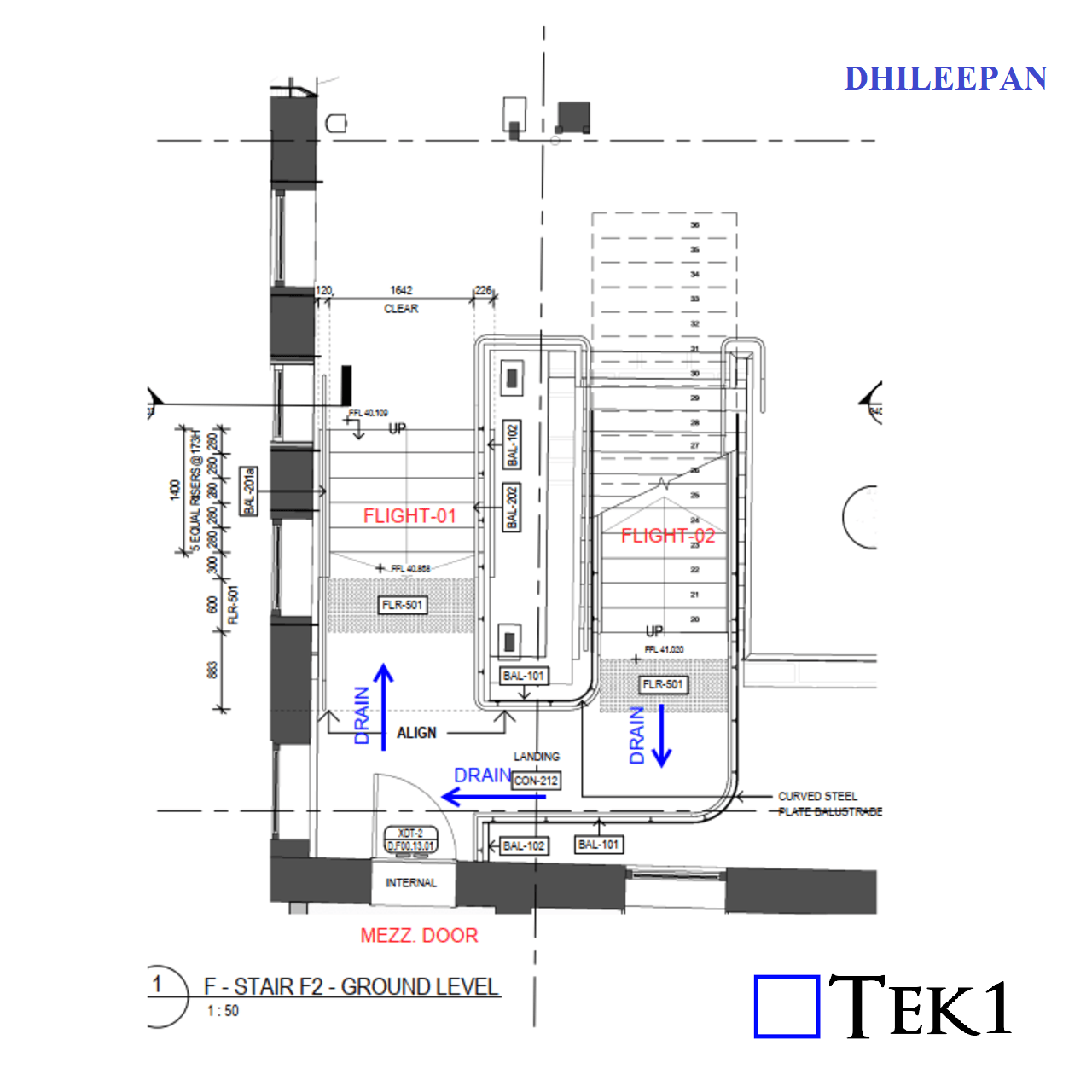
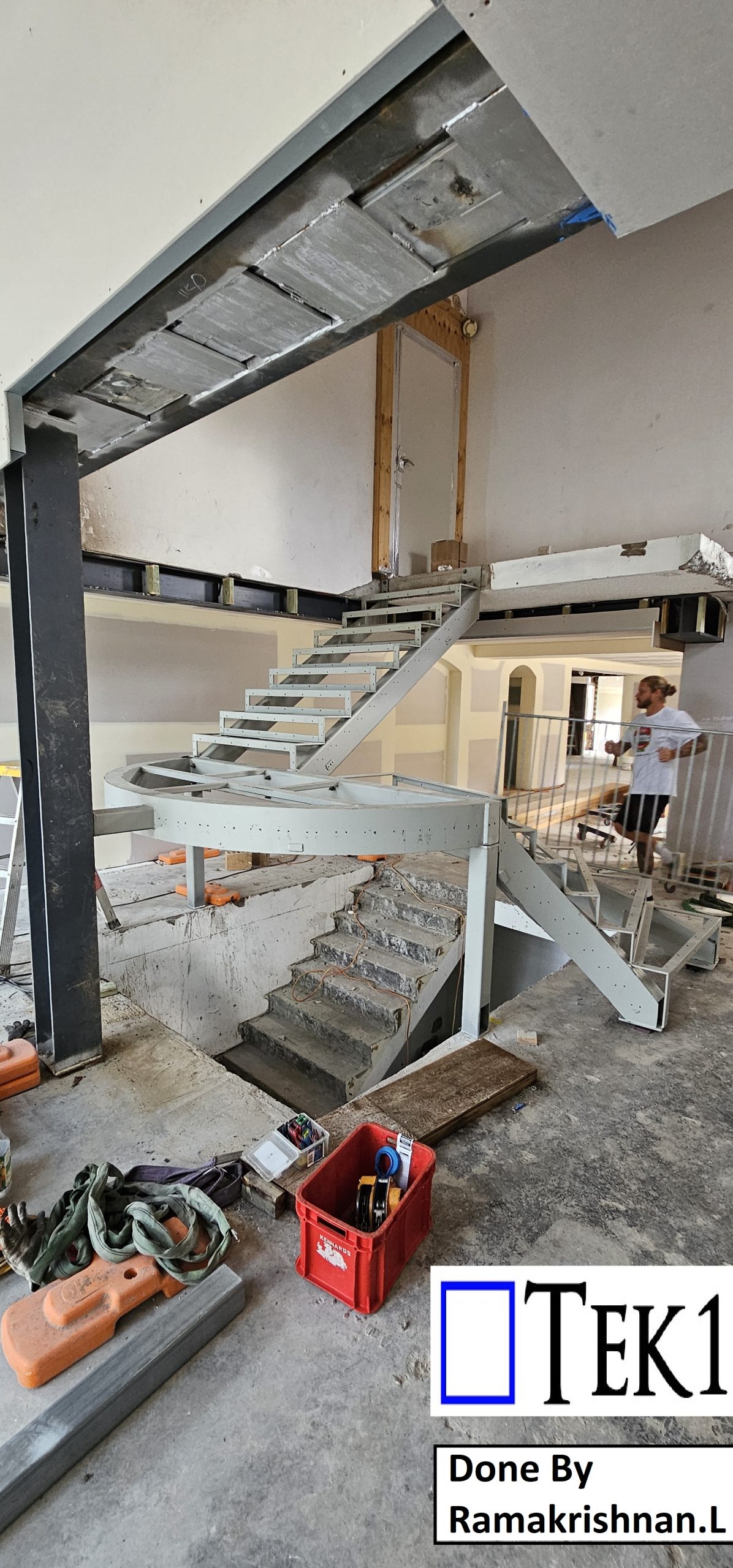
    In this case, the staircase consists of two flights turning 180° with a mid-landing. The purpose of this stair is not only to provide access between Ground Floor (GF) and Level-01 but also to facilitate movement to the mezzanine level from the mid-landing. The design for the mid-landing incorporates a 10mm plate with a 50mm paver on top. However, an important requirement was added: allowing for a fall in the paver to prevent water stagnation.
    We received an instruction to keep the landing RL 20mm lower than the door near the mezzanine level to incorporate falls in the paver.


    Common Mistake in Flight-02 Design
    :


    For a steel detailer, just paver RL which is 20 mm below the door level & 50mm paver thickness is enough to place the steel below. The sloping surface in the paver will be taken by some other parties. But the key thing to notice here is, the slope continues to the bottom of flight-02 as well.
    At the end of Flight-01, the paver thickness remains 50mm.
    Near the mezzanine door, the thickness increases to 70mm (50mm + 20mm fall).
    A frequent error occurs when designing Flight-02. Many assume the risers should be evenly divided between Level-01 FFL (Finished Floor Level) and the RL of the mid-landing, neglecting the impact of the paver thickness variation.


    To achieve the correct stair profile:

    The mid-landing RL should be set based on the increased paver thickness near the flight-02.
    Flight-02 risers should be distributed between Level-01 FFL and the actual top surface of the paver (which is 70mm at the bottom of Flight-02, not 50mm).
    Else, the first riser in the flight-02 will be comparatively smaller than the rest of the risers.

    Key Takeaways for Stair Detailing:

    Account for varying thickness: Do not assume uniform paver thickness; adjust accordingly at different points.


    Correct riser distribution: Ensure the risers of the second flight are calculated based on the actual mid-landing RL, factoring in paver thickness variations.


    Clarify detailing instructions: Steel detailers do not need to model the paver exactly but must ensure the mid-landing RL is accurately set.

    By paying close attention to these details, staircases can be designed more efficiently, reducing costly rework and ensuring a smooth construction process. Proper coordination between architectural and structural teams is essential to avoid misalignment and achieve a seamless build.

  • Can You Spot the Mistake in This Stair Design?

    Can You Spot the Mistake in This Stair Design?

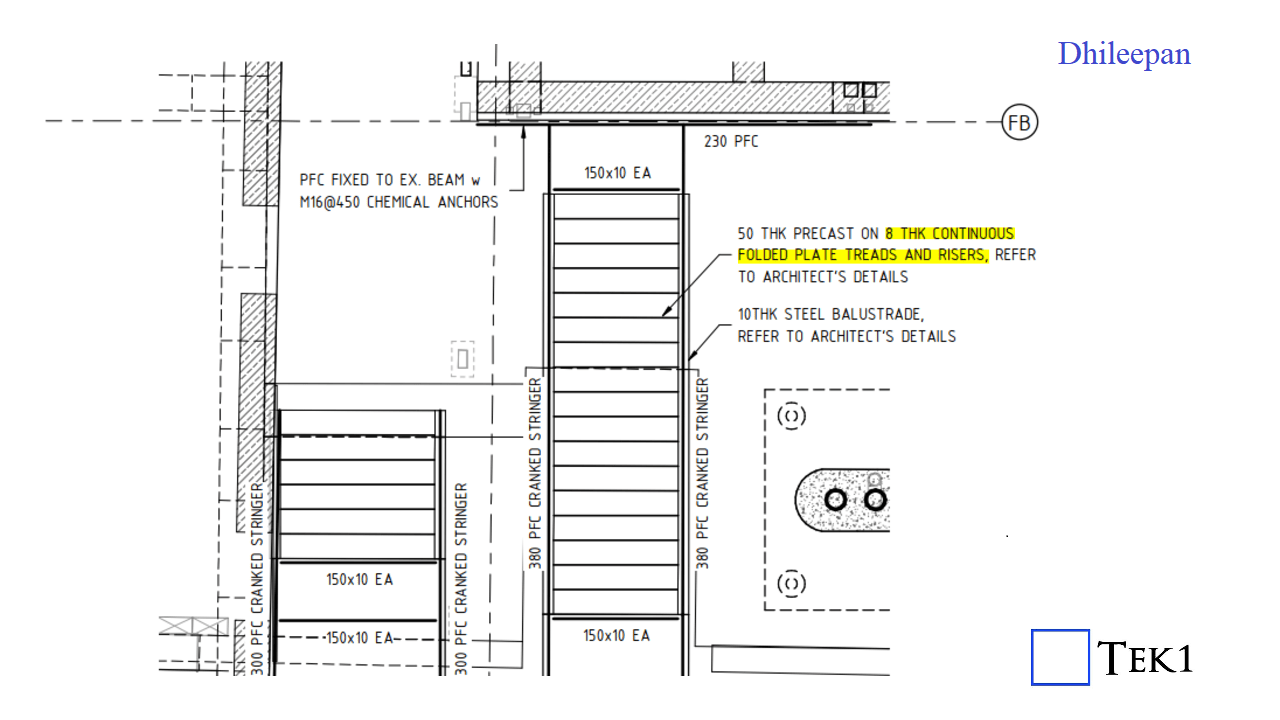
    Imagine you’re reviewing a staircase drawing, and you see this note:

    “8 THK CONTINUOUS FOLDED PLATE TREADS AND RISERS.”

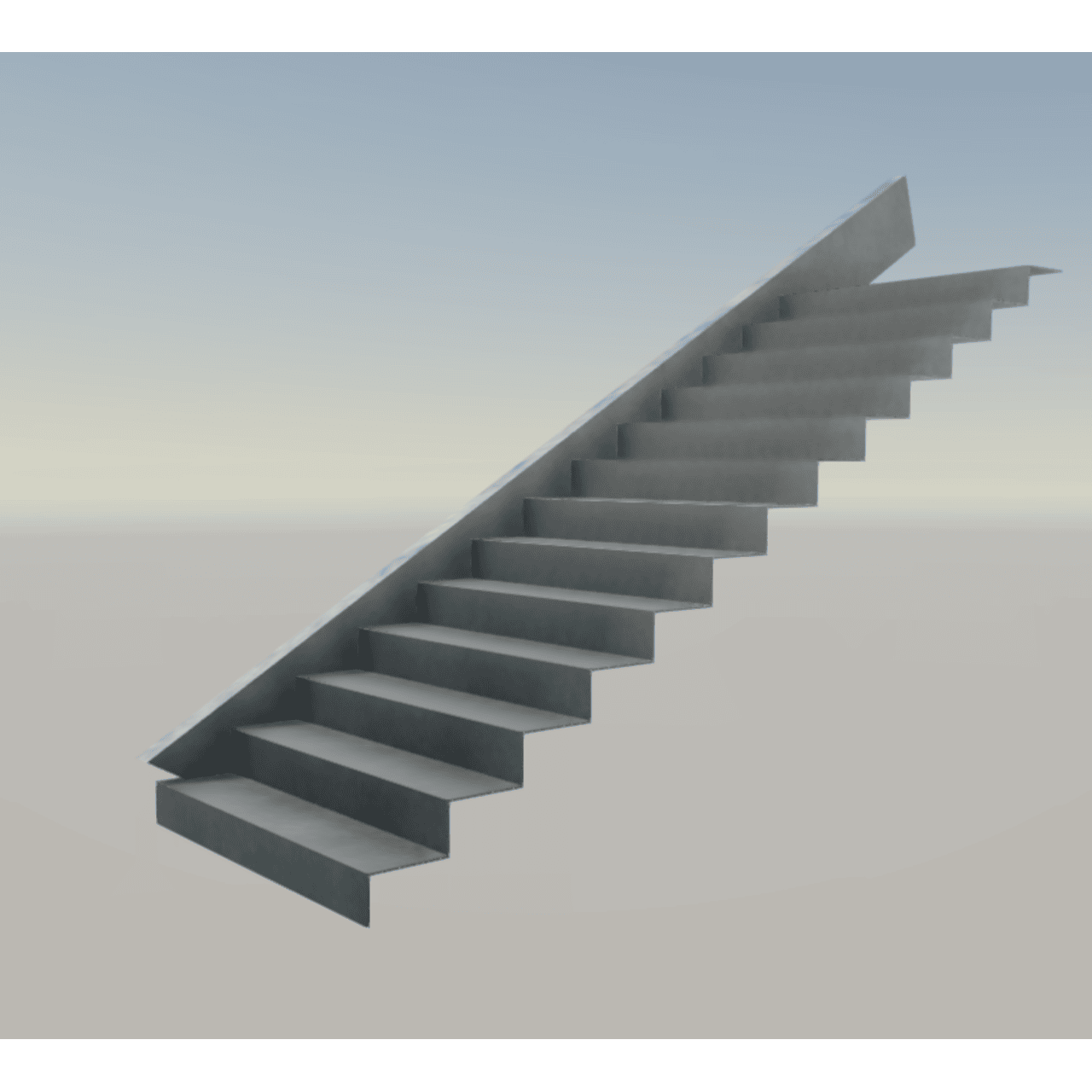
    Sounds fine, right? But here’s the catch—is it actually possible to fold a single plate continuously for an entire stair flight? 🤔

    The Hidden Problem

    A plate cannot be folded continuously to form multiple stair treads and risers because:

    • Fabrication limitations – Bending steel plate repeatedly at stair angles is nearly impossible.
    • Structural concerns – Excessive bending weakens the material and creates stress points.
    • Installation challenges – A long, folded plate is difficult to transport and position correctly.

    The Right Approach

    Instead of one continuous folded plate, each tread and riser should be a separate, single-folded plate. These individual elements can then be welded or bolted together to form a strong and practical staircase.

    So next time you see a similar detail, take a closer look—is it actually buildable?

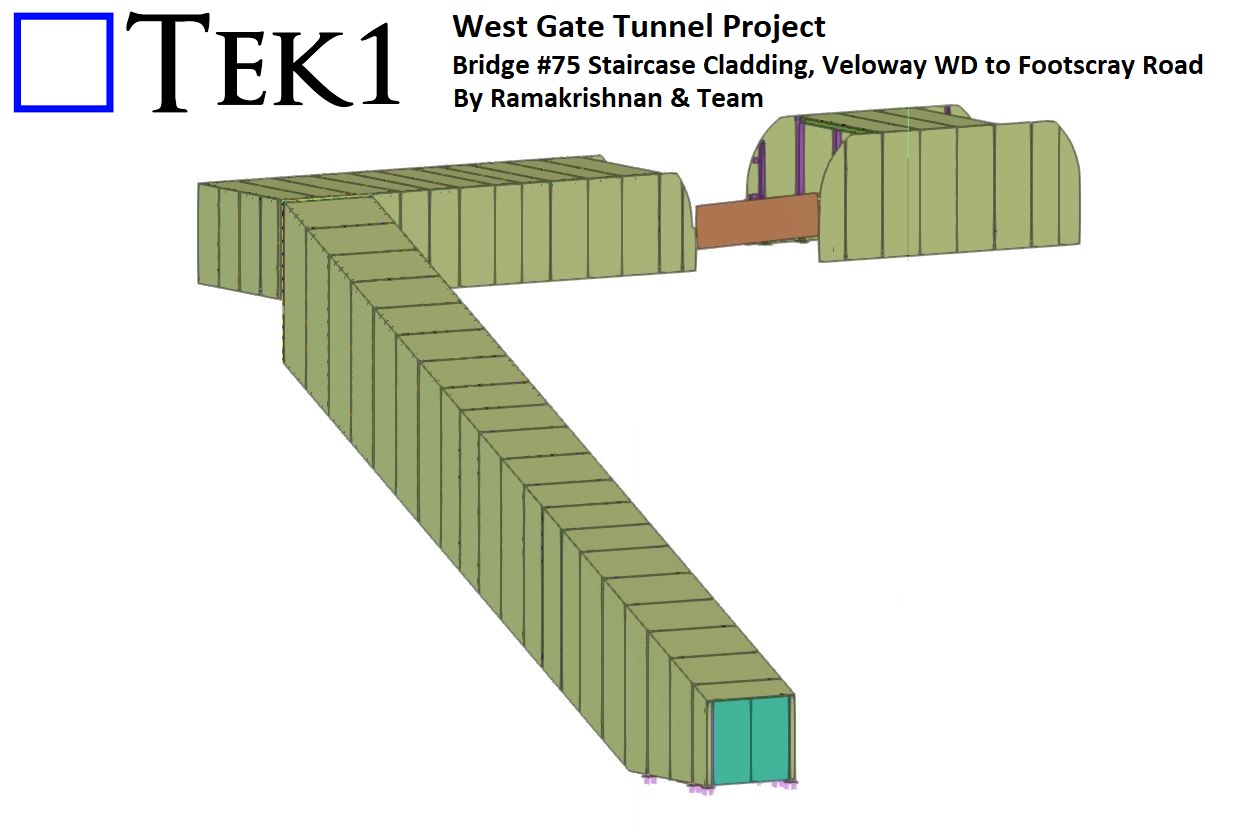
  • Staircase Cladding -Tunnel Project | Melbourne

    Staircase Cladding -Tunnel Project | Melbourne

    This is Challenging Metal Works Project by Tek1 for one our long standing clients in Melbourne

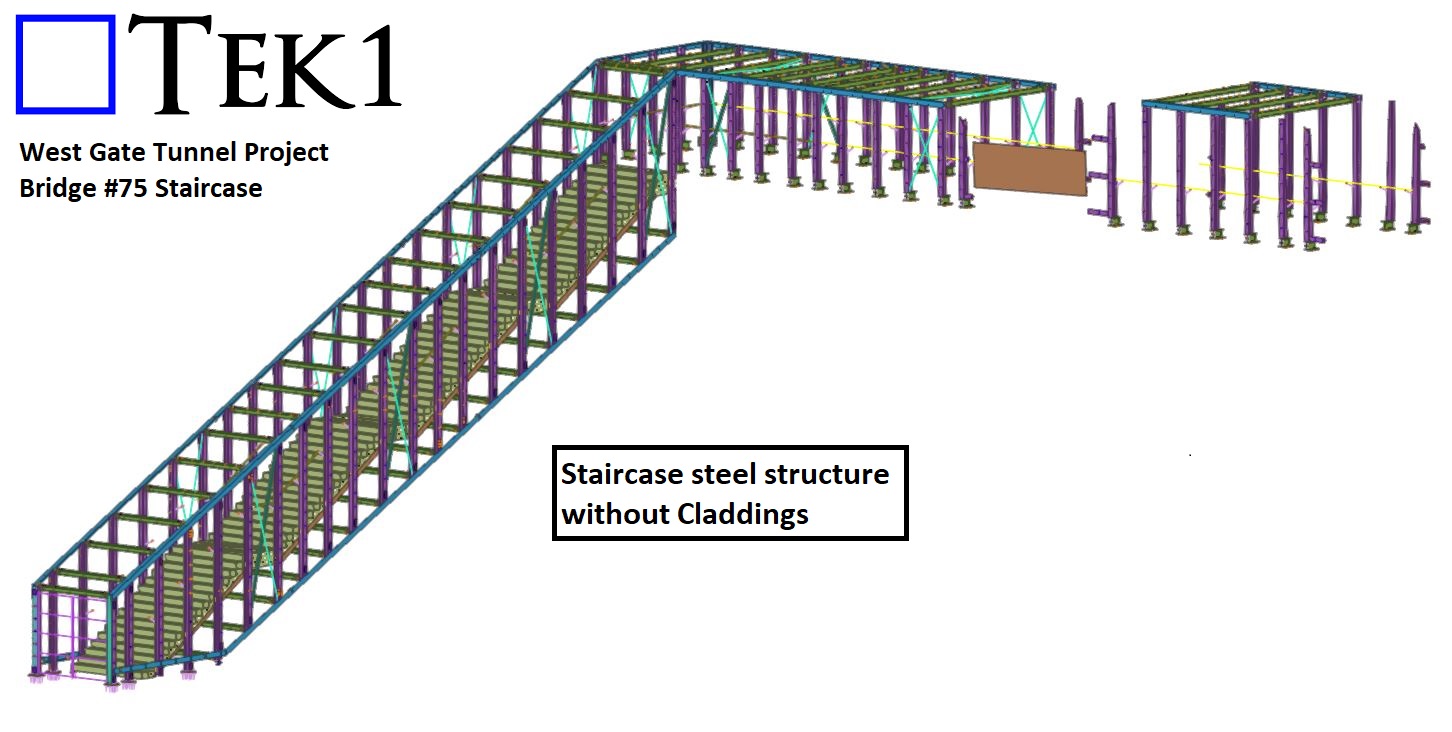
    TEK1 is share our involvement in the West Gate Tunnel Project – specifically with Bridge #75 Veloway WD to Footscray Road. As part of this prestigious infrastructure development, we successfully detailed the steel staircase cladding, adding both functionality and visual appeal to the project.

    Read more: Staircase Cladding -Tunnel Project | Melbourne

    Engineering Precision

    The cladding is securely fixed to the main steel structure of the staircase, requiring precise coordination between steel and aluminium detailing. Our team at TEK1 ensured that all fixing points were carefully detailed to accommodate the unique requirements of perforated cladding, maintaining structural integrity and ease of installation.

    The aluminium cladding for the staircase not only adds to the project’s aesthetic value but also demonstrates our expertise in combining materials for functional and visually striking results.

  • Step-by-Step Guide to Commercial Stair Detailing (According to AS1428.1 and ABCB Housing Provisions Standard 2022)

    Step-by-Step Guide to Commercial Stair Detailing (According to AS1428.1 and ABCB Housing Provisions Standard 2022)

    If you would like me to assist with your project, please send an email to koshy@tek1.com.au with your project specifications. Kindly use ‘Raj’ as the subject header.

    Overview
    This guide provides instructions for designing and detailing commercial stairs per the Australian Standards AS1428.1 and ABCB Housing Provisions Standard 2022. These standards ensure safe and accessible stairways in commercial buildings, with specific provisions related to the National Construction Code (NCC) and the Disability (Access to Premises-Buildings) Standards.

    1. General Stair Requirements (Non-Spiral Stairs)

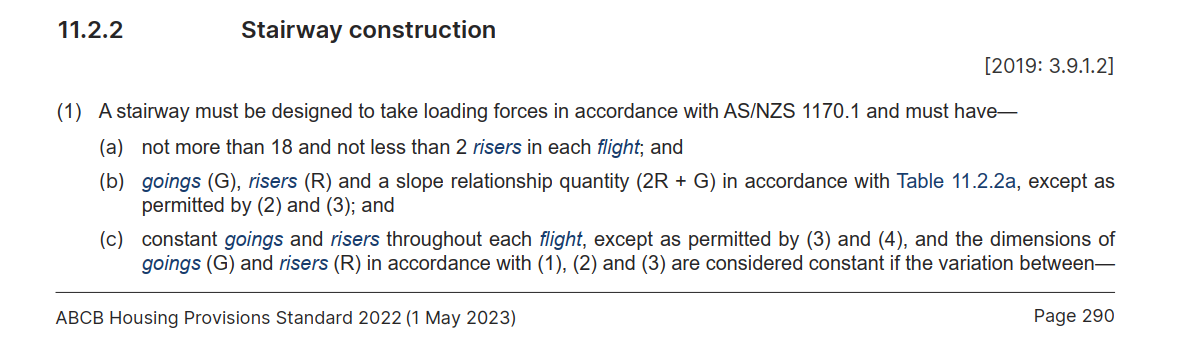
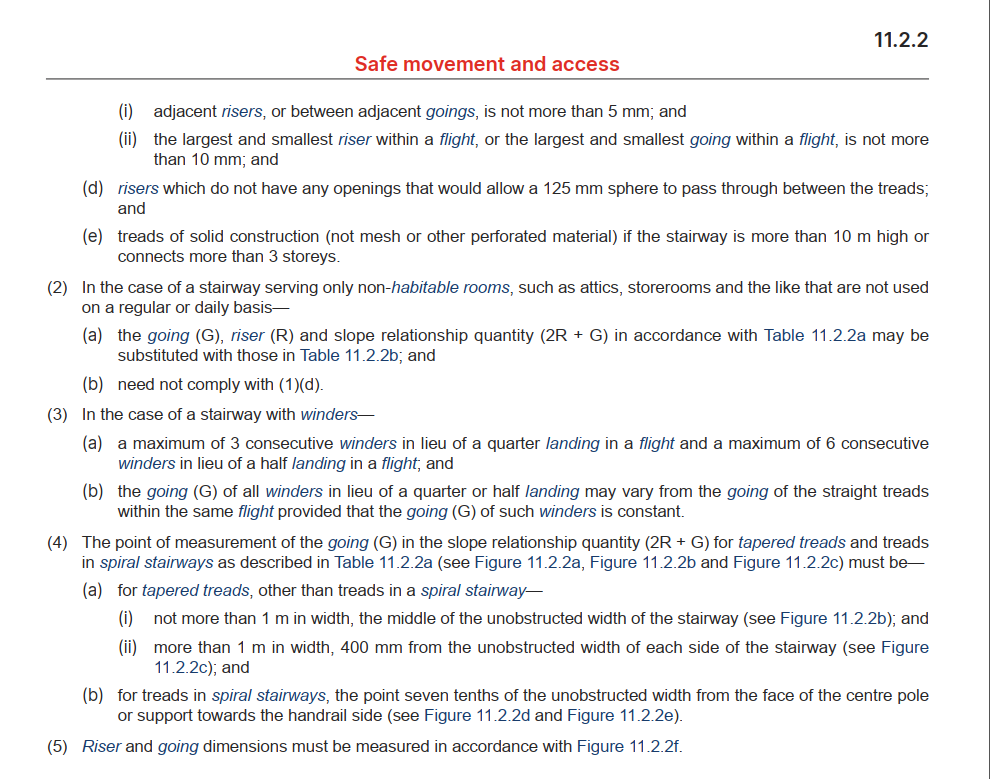
    • Riser Quantity: Each flight should have at least 2 risers but no more than 18 risers.
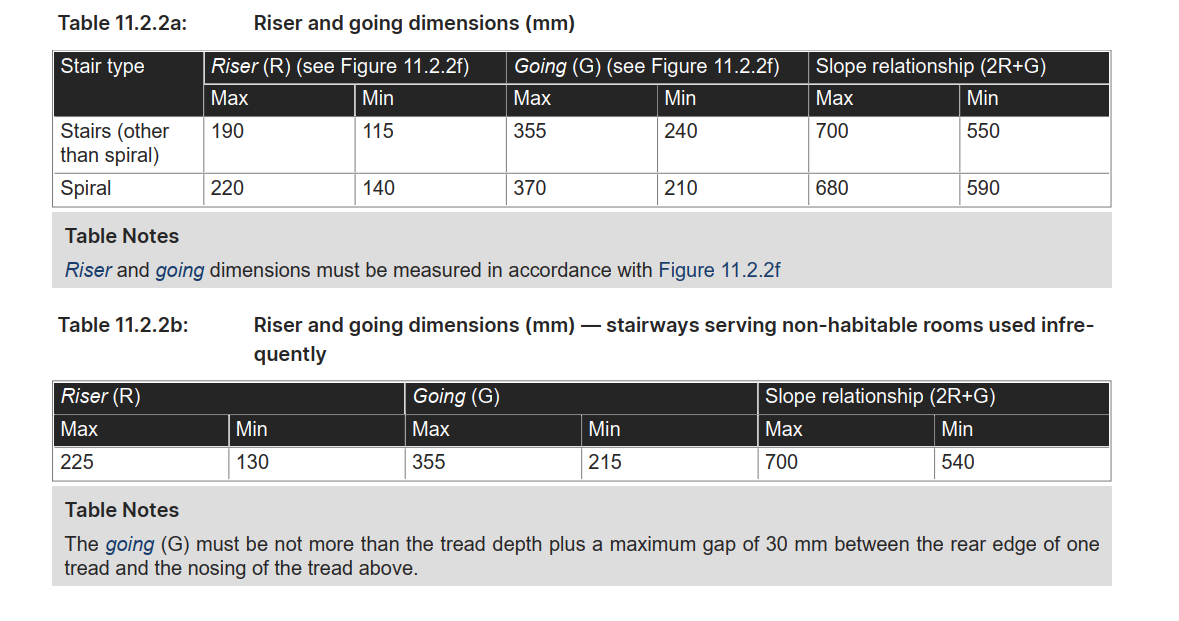
    • Riser Height: Must be between 115mm and 190mm.
    • Going Width (Tread Depth): Must be between 240mm and 355mm.
    • Stair Slope Rule: Follow the formula 2R+G, where:
      • Minimum Slope: 550mm
      • Maximum Slope: 700mm
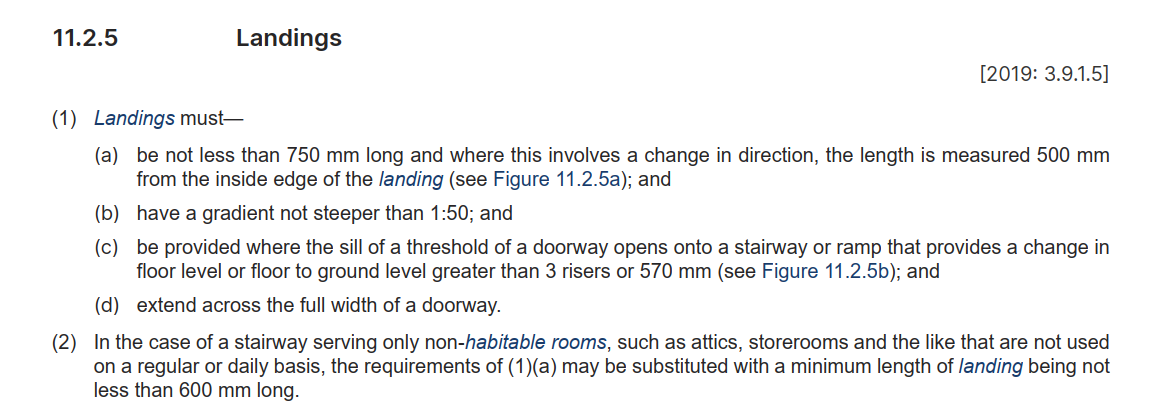
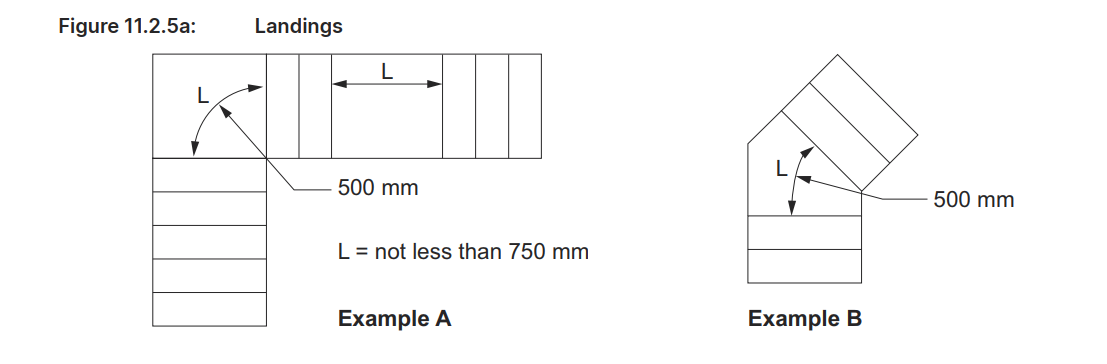
    • Landing Requirement: Landings must be at least 750mm in length. If the landing changes direction, measure at least 500mm from the inside edge of the landing​(abcb-housing-provisions…).

    2. Spiral Stairs Specifics

    • Riser Quantity: Similar to regular stairs, spiral stairs must have at least 2 risers and no more than 18 in each flight.
    • Riser Height: Must be between 140mm and 220mm.
    • Going Width: Must be between 210mm and 370mm.
    • Stair Slope Rule: Use the formula 2R+G with the following limits:

    3. Landings Specifications

    • Minimum Length: Landings must be at least 750mm in length.
    • Directional Change: For landings with a change in direction, measure at least 500mm from the inside edge.
    • Gradient: The landing slope must not exceed 1:50 to ensure levelness while allowing for slight drainage.
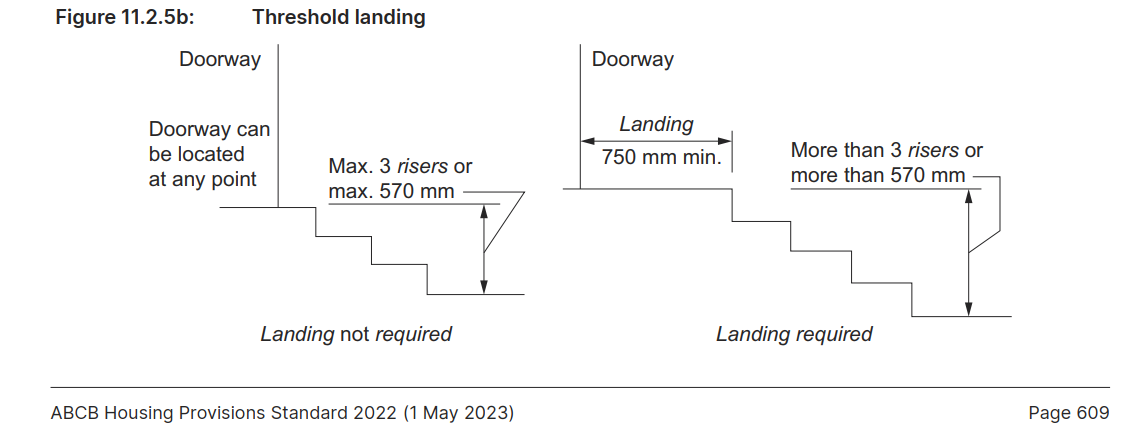
    • Threshold Requirement: A threshold landing is required where there is a floor level change of more than 570mm or three risers​(abcb-housing-provisions…).

    4. Slope and Safety Measures

    • The 2R + G formula is essential for the slope and safety of both standard and spiral stairways, ensuring each stairway is easy to ascend and descend.
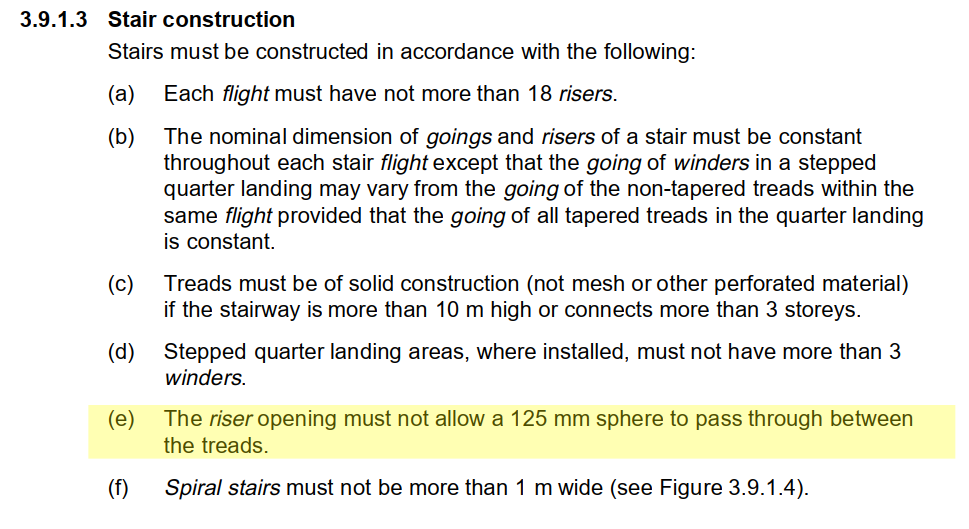
    • Open Risers: Risers must not have openings wide enough to allow a 125mm sphere to pass through, minimizing the risk of small children or objects falling through.
    • Tread Solidness: Stairs that are taller than 10m or connect more than three floors must have solid, non-perforated treads for additional safety​(abcb-housing-provisions…).

    5. Consistency in Dimensions

    • Uniformity Across Flights: All risers and goings within each flight should be consistent.
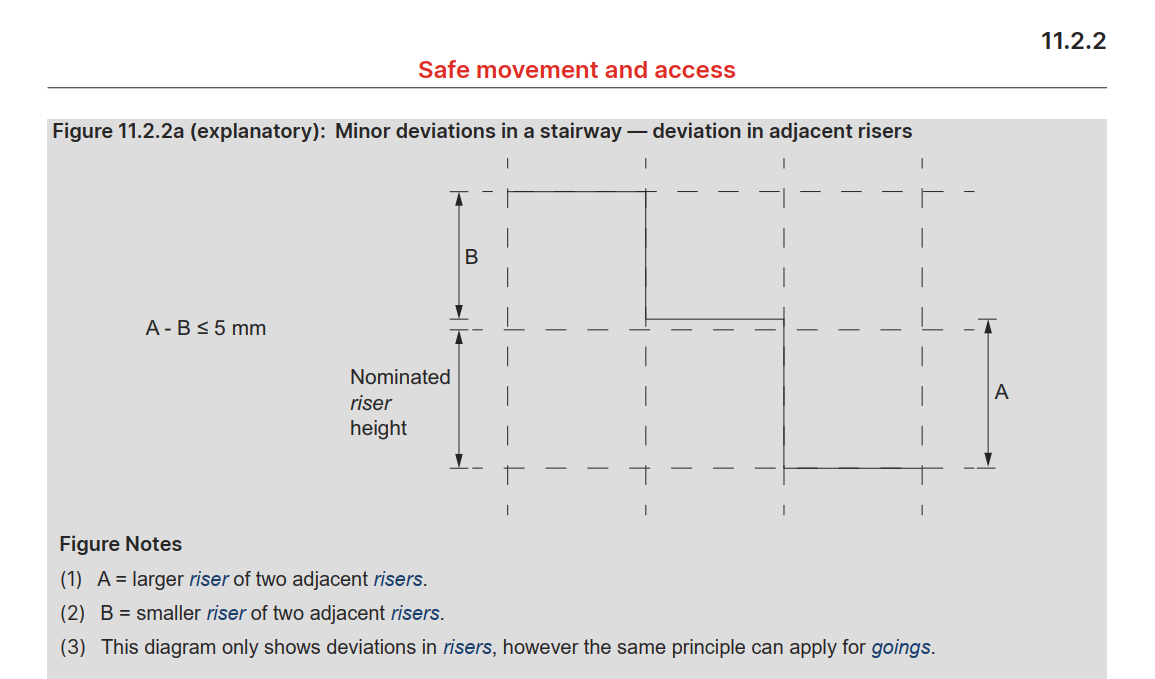
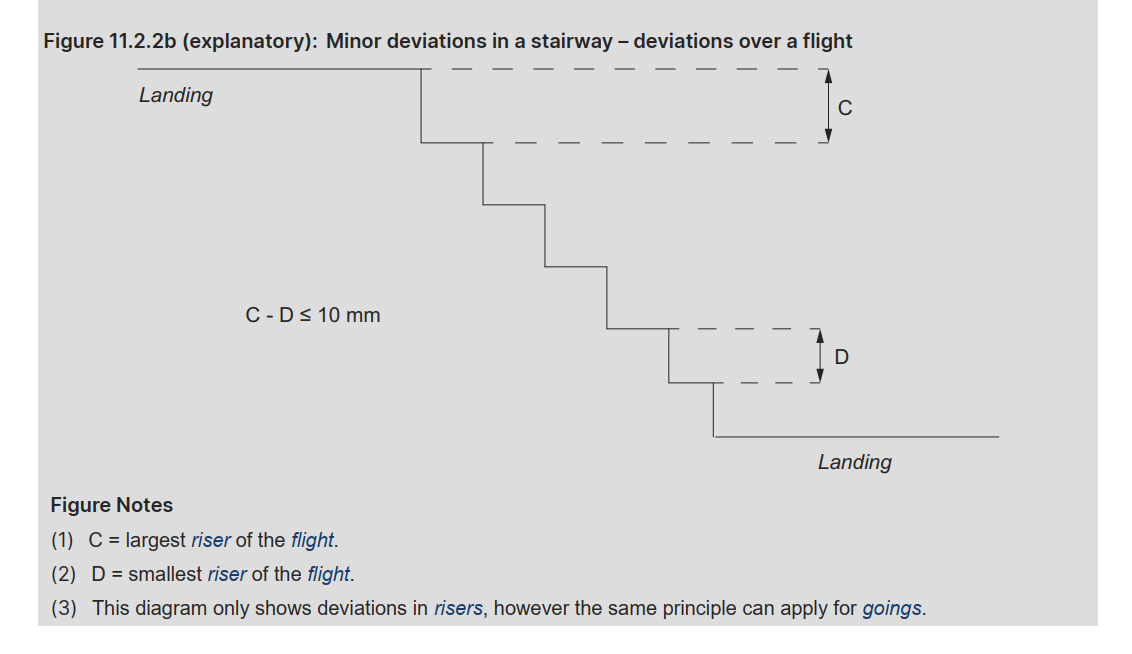
    • Permitted Variations: Adjacent risers and goings may vary up to 5mm, but the difference between the largest and smallest within a flight should not exceed 10mm​(abcb-housing-provisions…).

    6. Slip Resistance Requirements

    • Slip Resistance Testing: All treads, landings, and ramps should meet slip resistance classifications as per AS 4586. This includes:
      • Dry Conditions: Minimum P3 or R10 for treads; P3 for nosing or landing edge strips.
      • Wet Conditions: Minimum P4 or R11 for treads; P4 for nosing or landing edge strips​(abcb-housing-provisions…).

    7. Barriers and Handrails

    • Barrier Height: Barriers should be at least 865mm above the nosing of stair treads, and 1m above landings and other access surfaces.
    • Handrails: Must be placed on at least one side of the stairway, running the full length of each flight and at a height of no less than 865mm.
    • Opening Limitations: No opening in the barrier should allow a 125mm sphere to pass through​(abcb-housing-provisions…).

    By following these steps, builders and architects can ensure that commercial stairs meet the safety and accessibility requirements established in AS1428.1 and the ABCB Housing Provisions Standard 2022.

  • Compliance with AS 1428.1 and BCA: Limiting Riser Openings to 125 mm in Commercial Staircases

    Compliance with AS 1428.1 and BCA: Limiting Riser Openings to 125 mm in Commercial Staircases

    If you would like me to assist with your project, please send an email to koshy@tek1.com.au with your project specifications. Kindly use ‘Raj’ as the subject header.

    When performing detailed engineering for commercial staircases and balustrades, it’s essential to ensure that all aspects comply with AS 1428.1 and the relevant provisions from the Building Code of Australia (BCA), particularly those regarding accessibility and safety. Here’s a breakdown of the critical points you must address:

    Compliance with AS 1428.1:
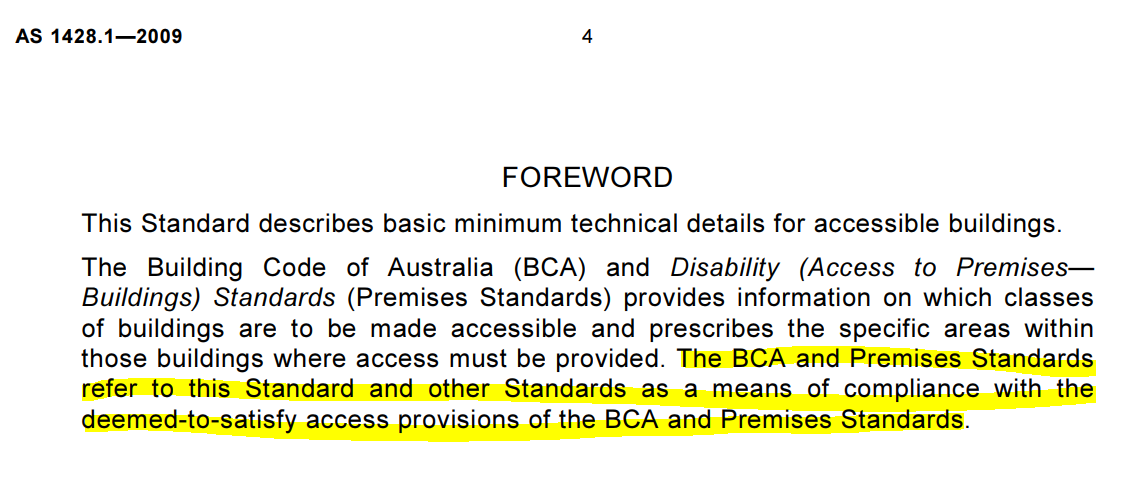
    1. This standard outlines the minimum technical requirements for accessible buildings. Engineers must reference the BCA to align with safety and access provisions. AS 1428.1 directs engineers to follow BCA for detailed requirements related to stair and balustrade design, ensuring all safety standards are met, particularly for disabled access.
    2. BCA 3.9.1.3 – Riser Opening Requirement:
    One of the key safety provisions under BCA 3.9.1.3 is ensuring that the riser openings on stairways are restricted. Specifically, the gap between treads must not allow a 125 mm sphere to pass through. This rule is vital for preventing accidents, such as children slipping through open risers. As a detailed engineer, you must ensure that this riser opening specification is incorporated into the technical drawings and calculations to meet safety compliance.

    3. BCA 3.9.1.4 – Riser and Going Dimensions:
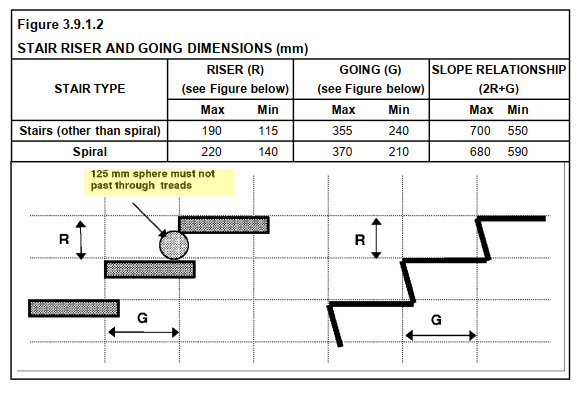
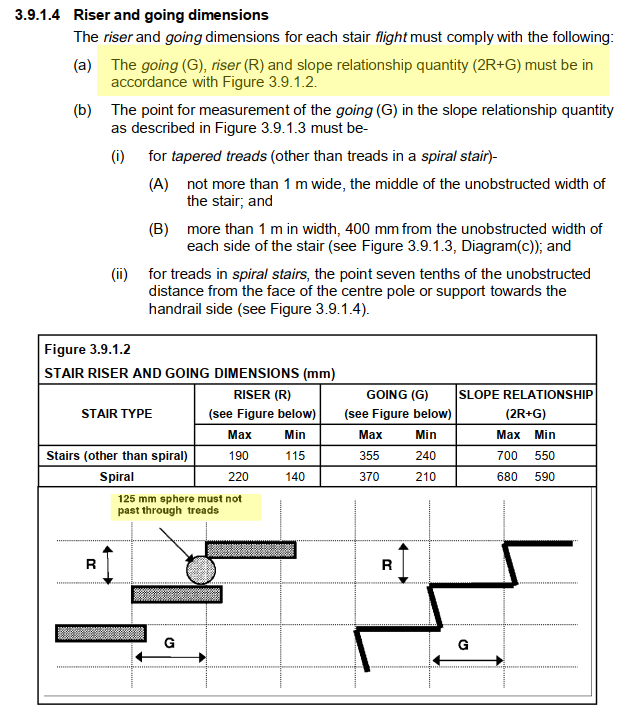
    Further, BCA 3.9.1.4 provides specific dimensional requirements for stair risers and goings, as illustrated in Figure 3.9.1.2. This figure shows the maximum and minimum values for risers (R) and goings (G), as well as the slope relationship (2R + G). Engineers must adhere to these dimensions for both spiral and non-spiral staircases to ensure that the stairs are not only safe but also ergonomically comfortable for users.

    4. Critical Figures:

    Riser (R): Must be within the maximum and minimum values—115 mm to 190 mm for standard stairs and 140 mm to 220 mm for spiral stairs.

    Going (G): Must be within the maximum and minimum values—240 mm to 355 mm for standard stairs and 210 mm to 370 mm for spiral stairs.

    Slope Relationship (2R + G): Must fall between 550 mm and 700 mm for standard stairs and 590 mm to 680 mm for spiral stairs. These values ensure that stairs provide both safety and comfort.

    5. Ensuring Compliance:
    As part of the detailed engineering process, it’s your responsibility to ensure that all specifications, such as the 125 mm riser opening limit and the exact riser and going dimensions, are strictly followed in the drawings, materials, and construction processes. This involves validating these measurements on-site and ensuring they are reflected accurately in both the design and construction stages.

    In conclusion, the detailed engineering process must ensure compliance with AS 1428.1 and the BCA, particularly regarding the requirement that the riser opening must not exceed 125 mm, as outlined in BCA 3.9.1.3. Additionally, the riser and going dimensions must conform to the standards specified in BCA 3.9.1.4. By adhering to these standards, you will ensure that commercial stairs and balustrades are safe, accessible, and compliant with Australian building regulations.

  • Plate Formed Spiral Stair

    Plate Formed Spiral Stair

    Author : Ramakrishnan.L

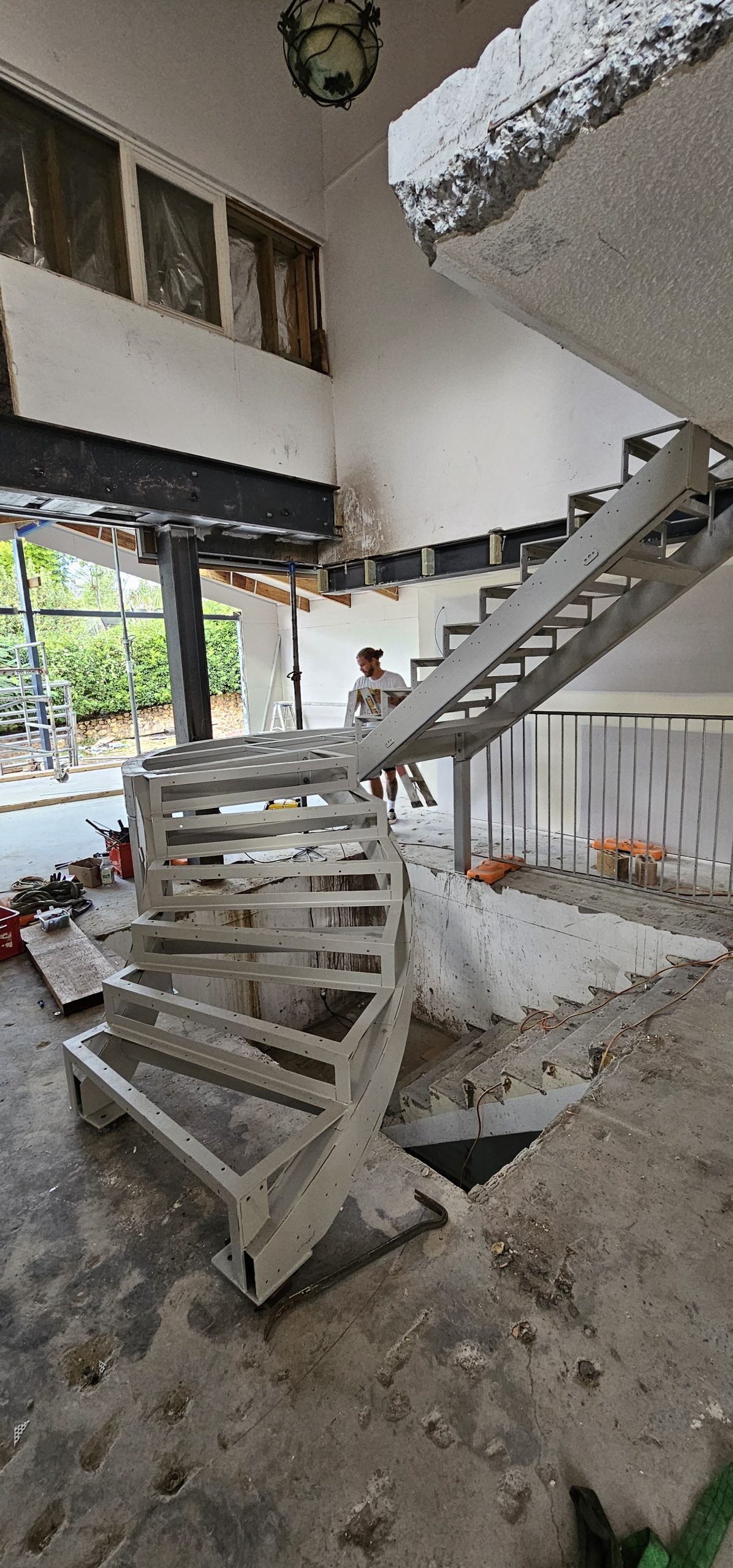
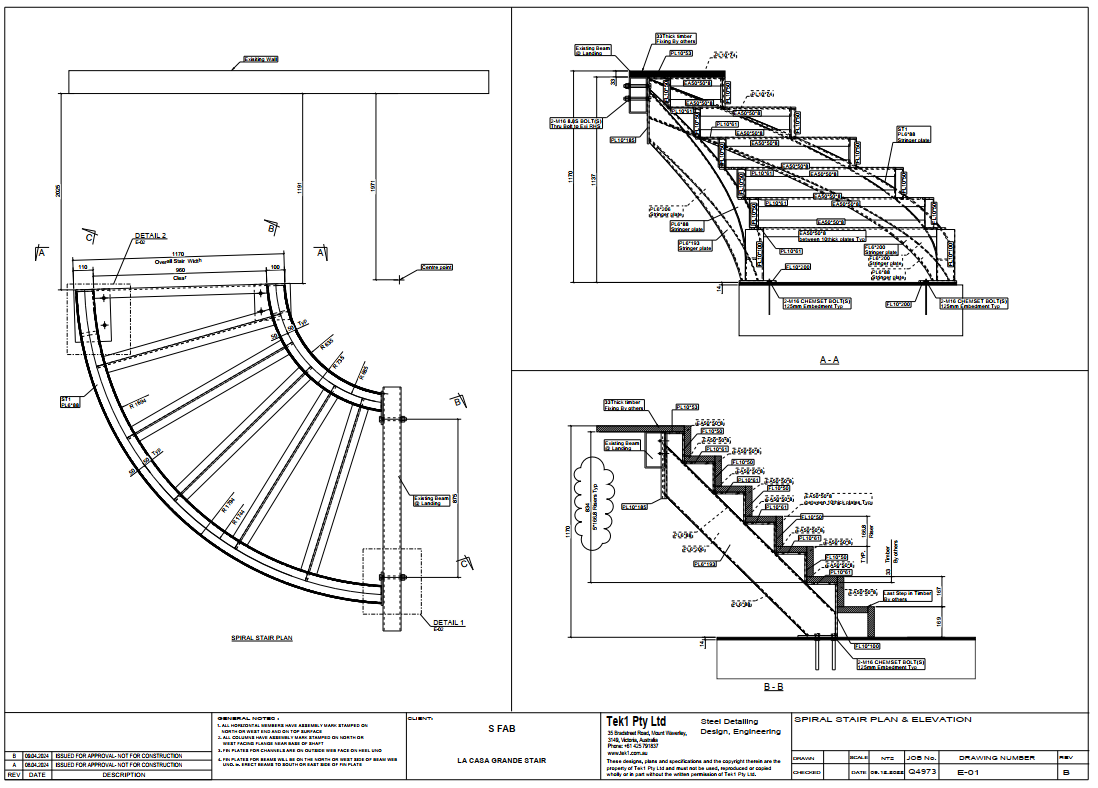
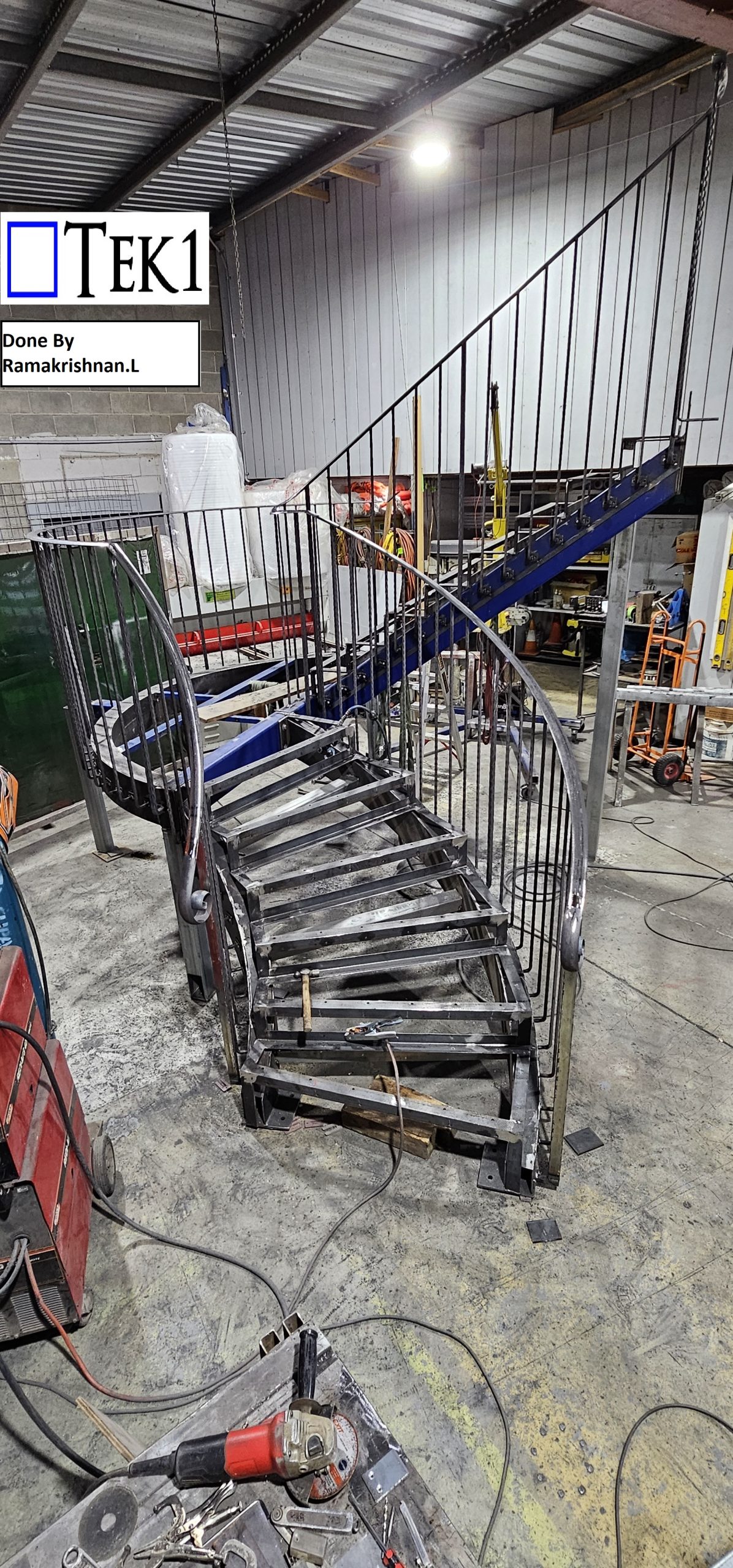
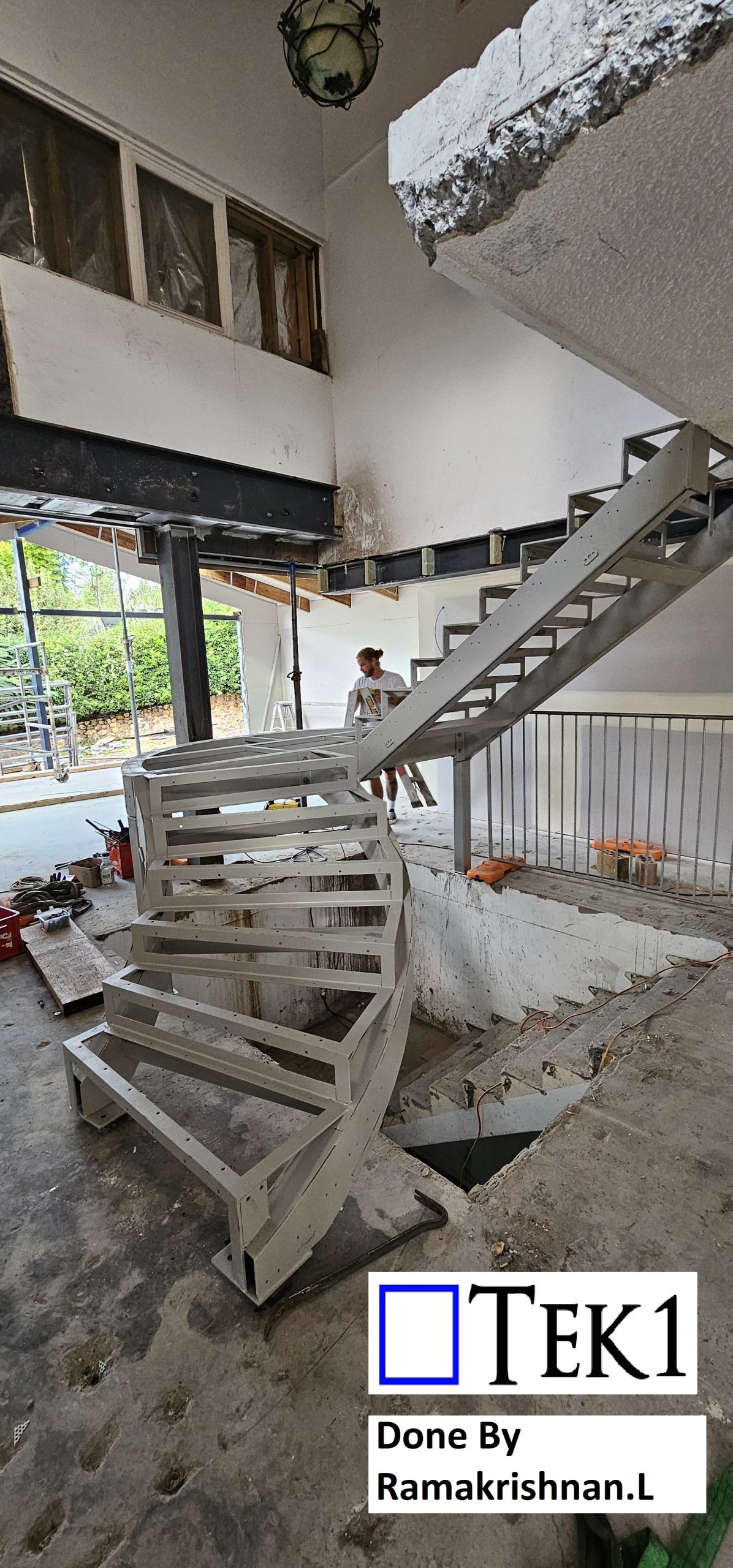
    We are pleased to inform you that TEK1 has accepted the task of detailing the spiral plate-formed RHS stringer stair as requested by our client. Our team is well-equipped to handle this design, ensuring that all details meet the highest standards.

    At TEK1, we have consistently provided top-notch miscellaneous steel detailing services to our esteemed clients, adhering to all relevant codes and standards. We are committed to delivering precise and reliable shop drawings tailored to your needs.

    Should you have any queries related to miscellaneous steel shop drawings, please do not hesitate to contact us. We will promptly provide you with the necessary answers and support.

    For any steel shop drawings you require for an ongoing project, feel free to reach out to Koshy at (03) 9560 6397 or +61 3 9560 6397.

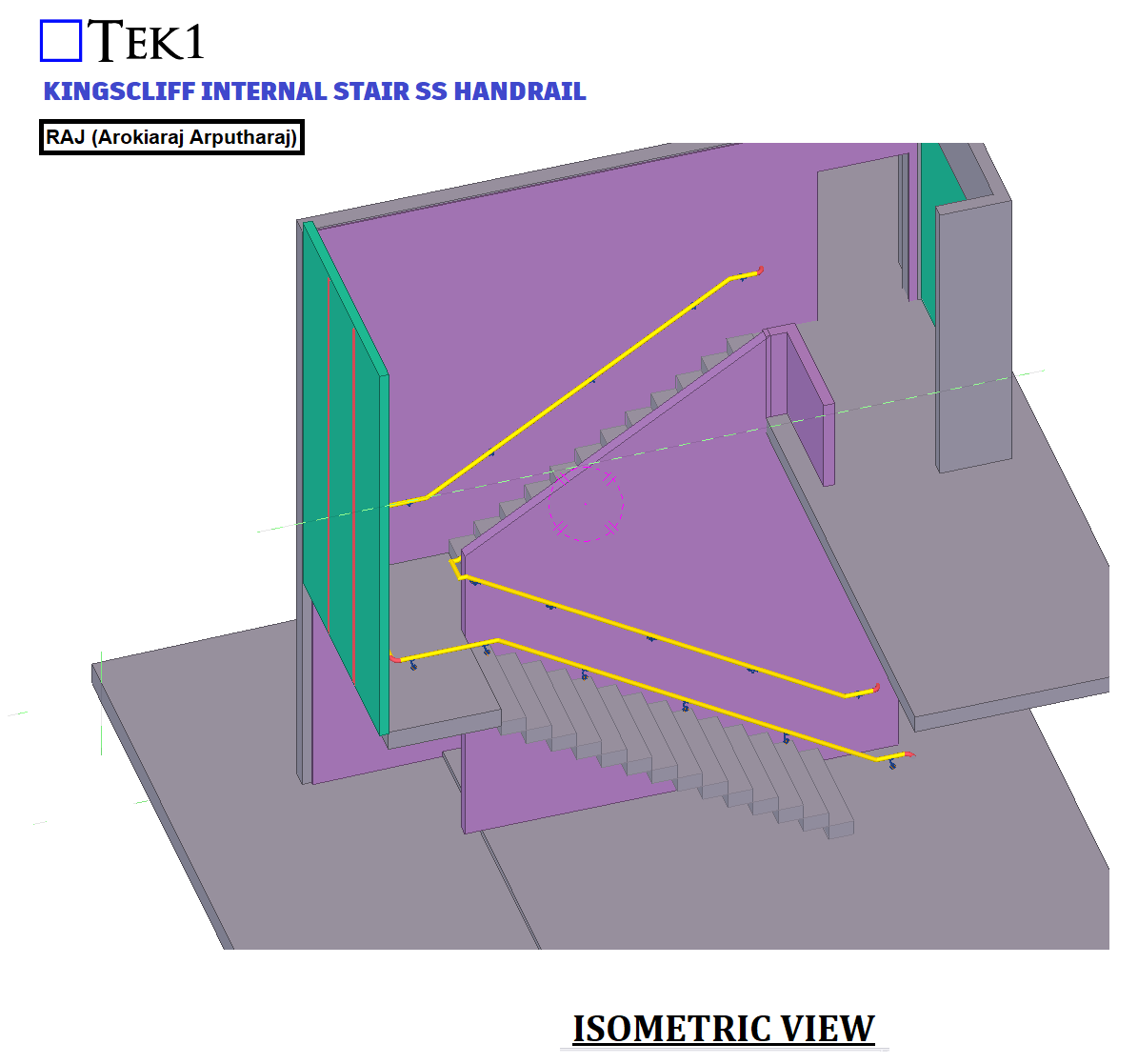
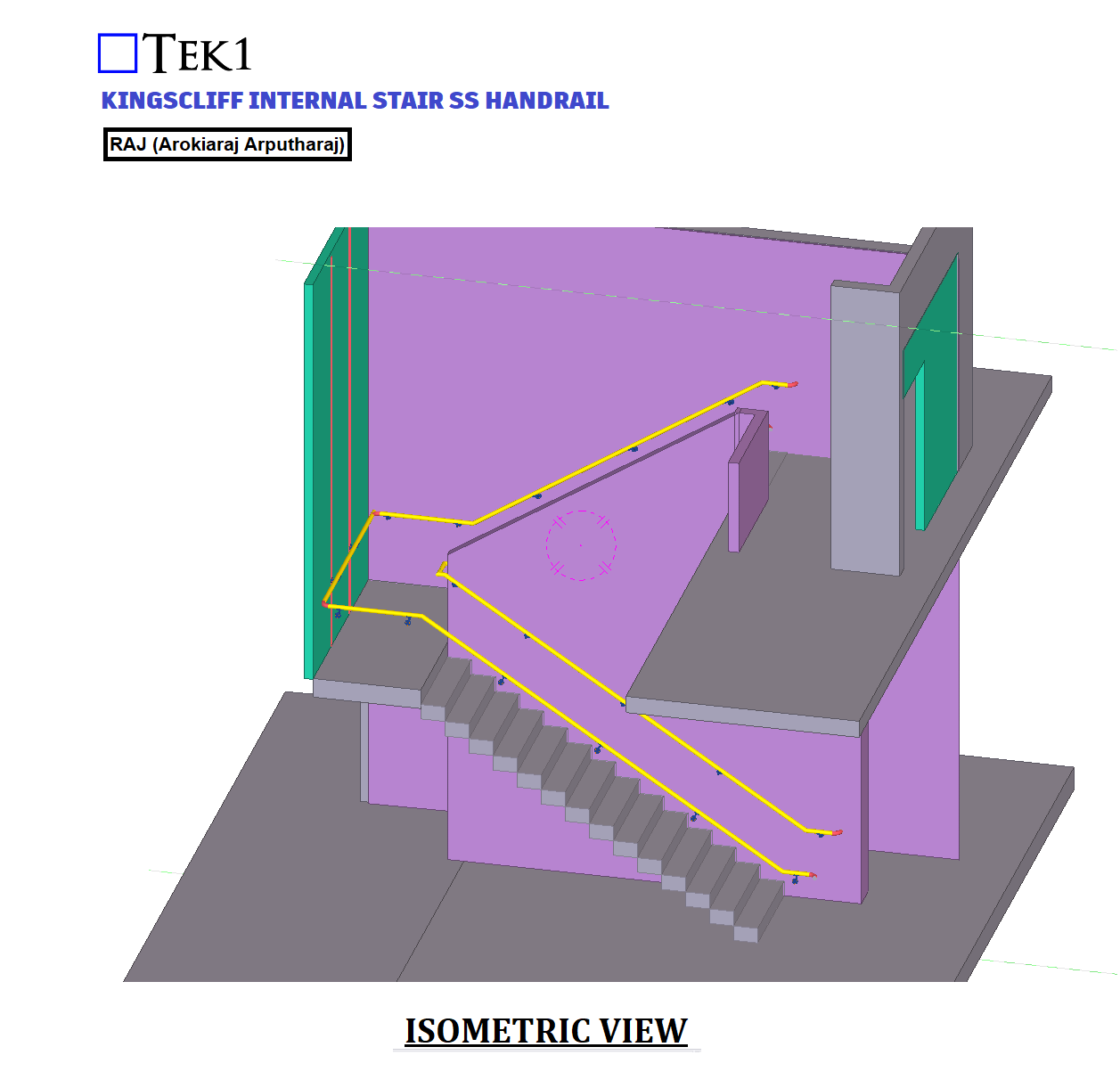
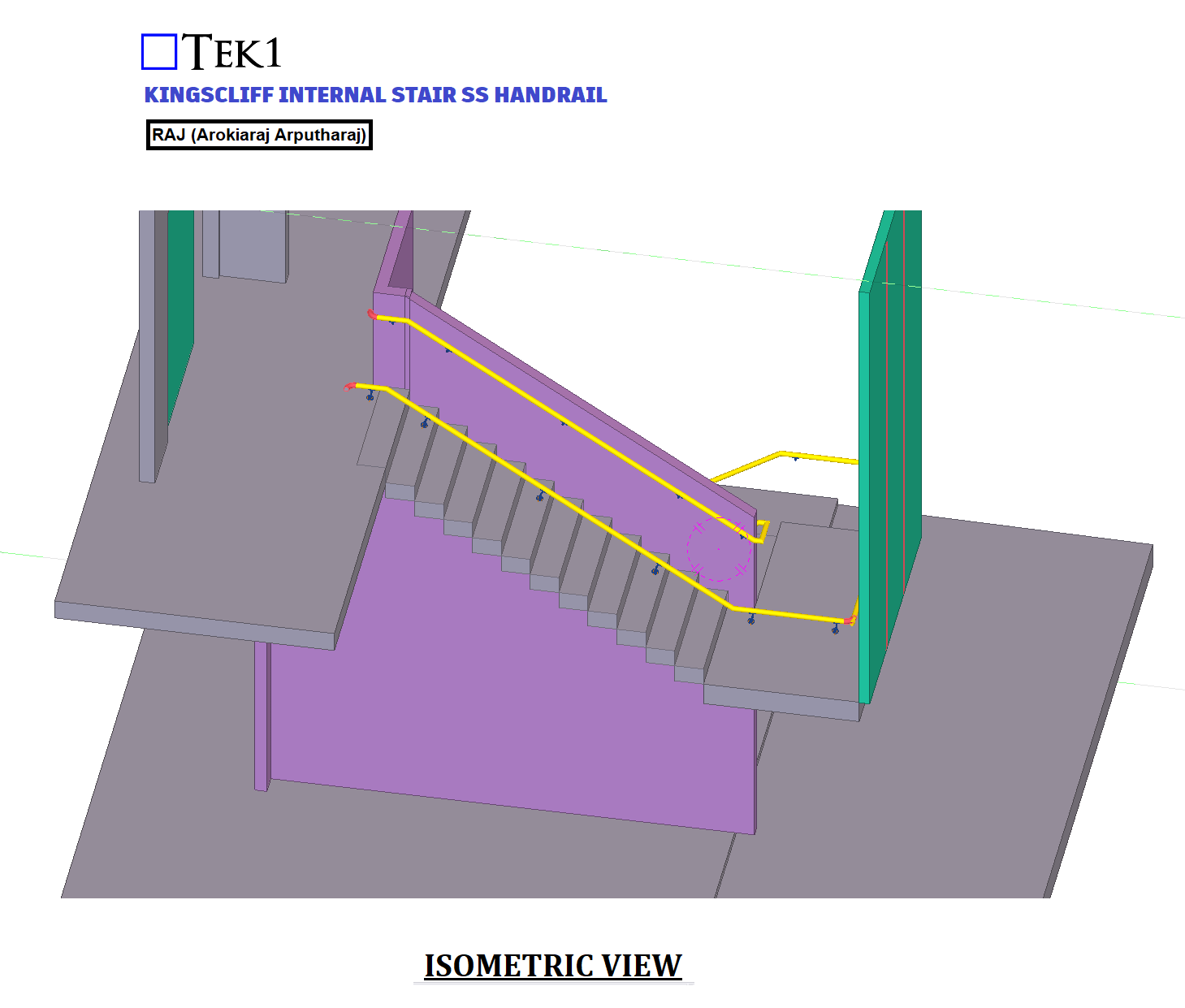
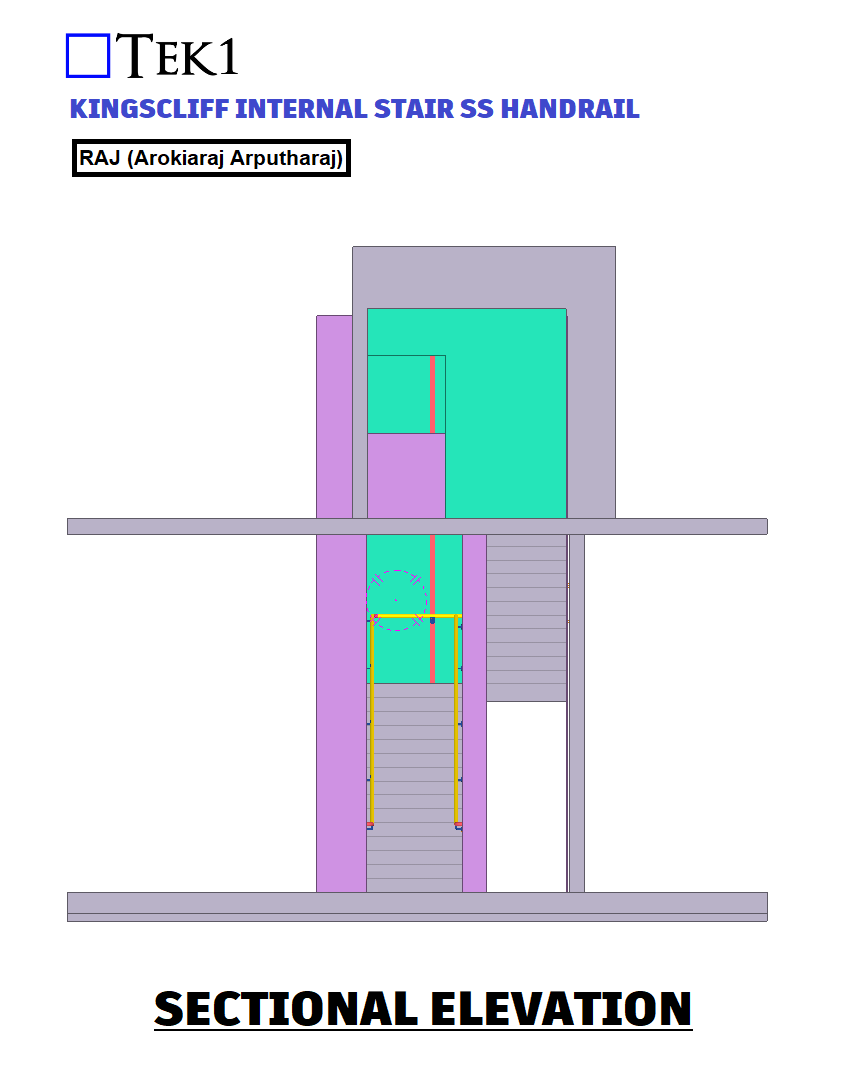
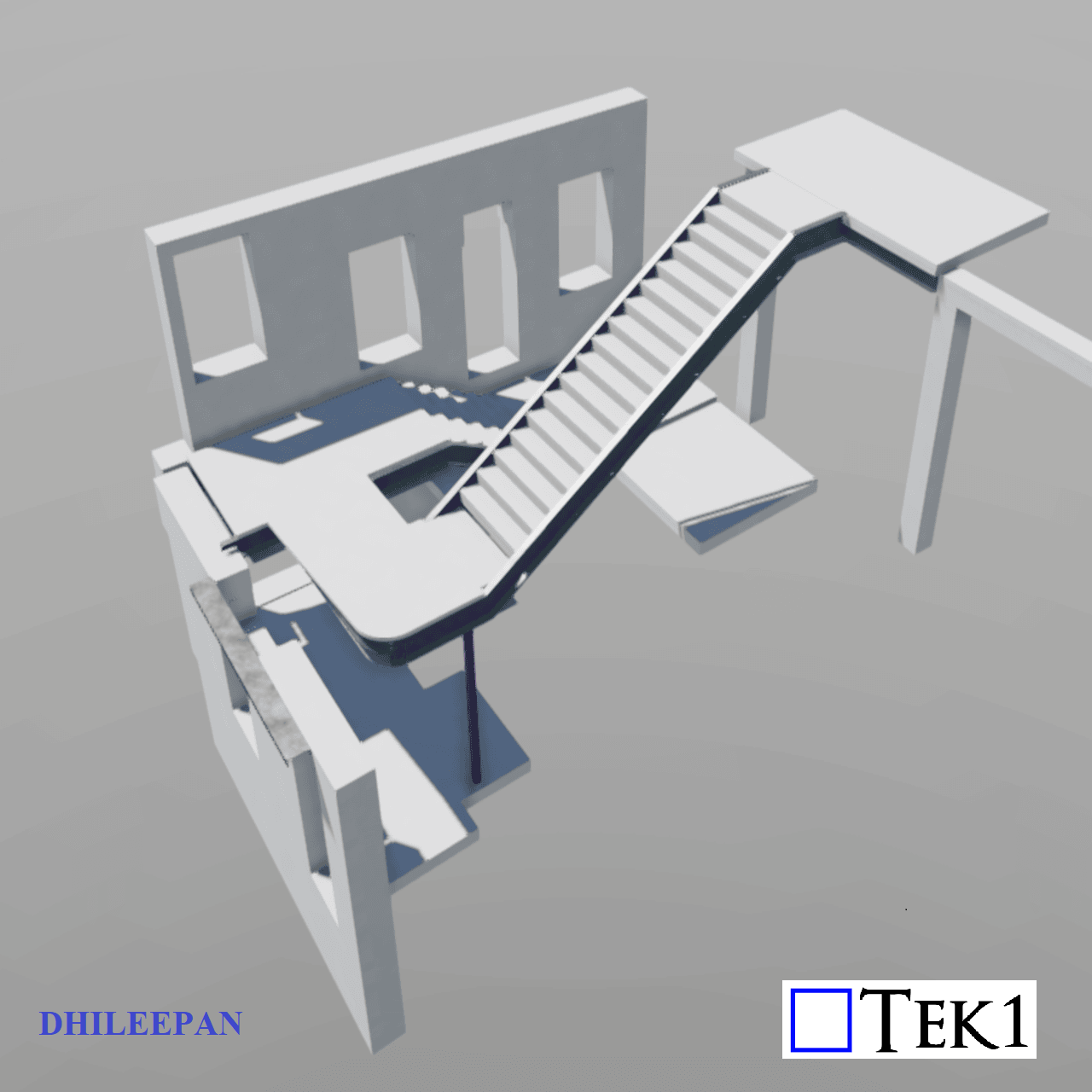
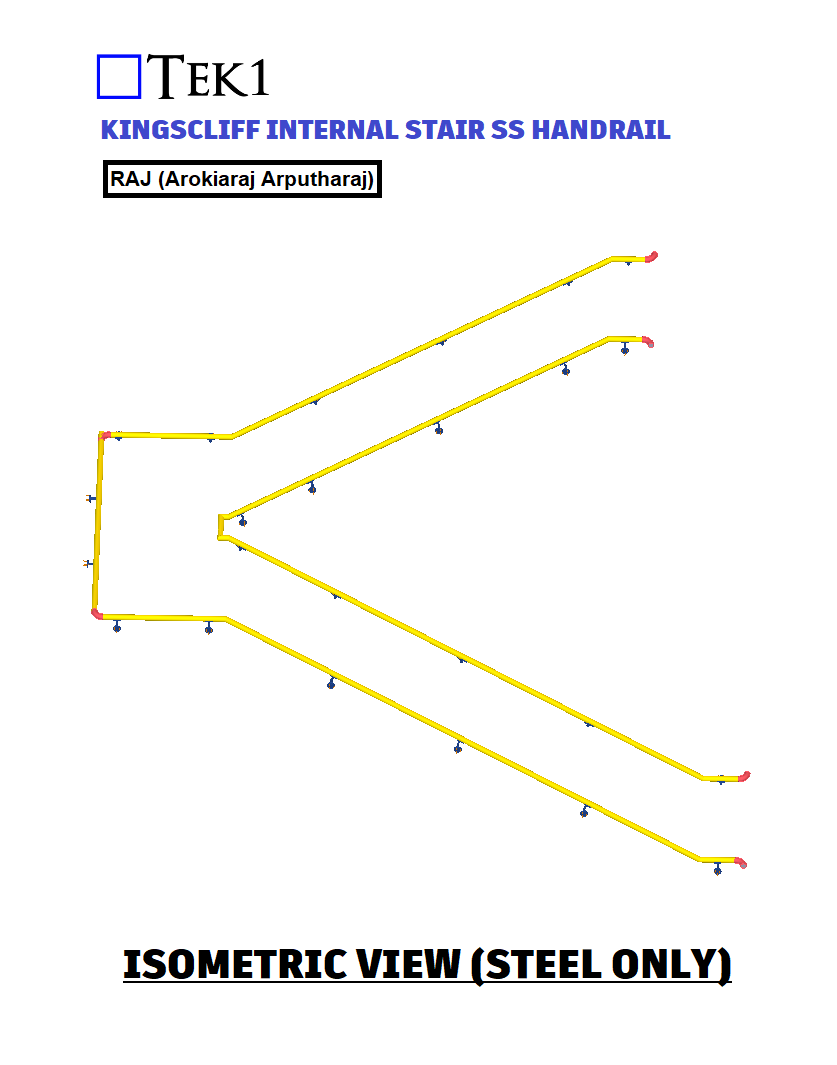
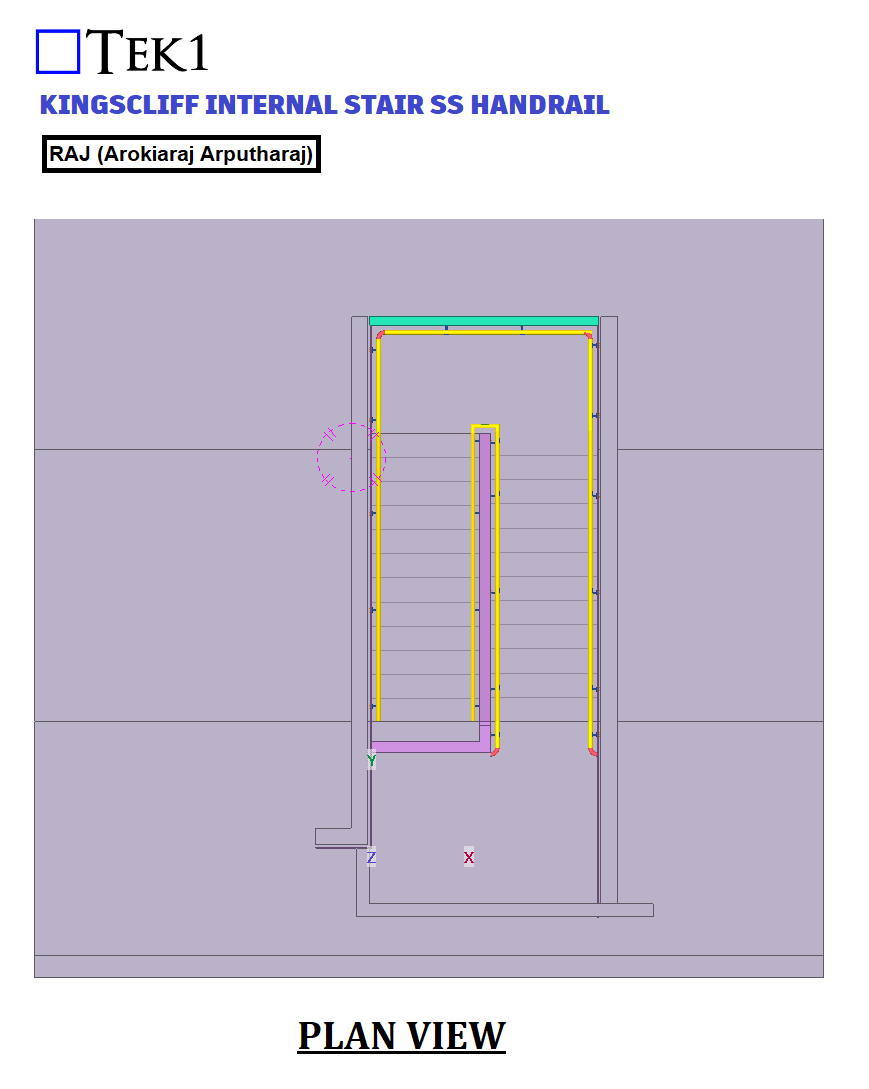
  • KINGSCLIFF INTERNAL STAIR SS HANDRAIL

    KINGSCLIFF INTERNAL STAIR SS HANDRAIL

    Author: RAJ (Arokiaraj Arputharaj)

    Drafting Service Provider for Structural Steel

  • RIPLEY COLLEGE RAMP 02, RAMP 03 AND STAIR 5

    RIPLEY COLLEGE RAMP 02, RAMP 03 AND STAIR 5

    Author: RAJ (Arokiaraj Arputharaj)

    Ramp Shop drawing Model
    L Type Ramp Balustrade
    Entry Stair Balustrade by steel draftsman
    Steel balustrade drawings by expert steel draftsman
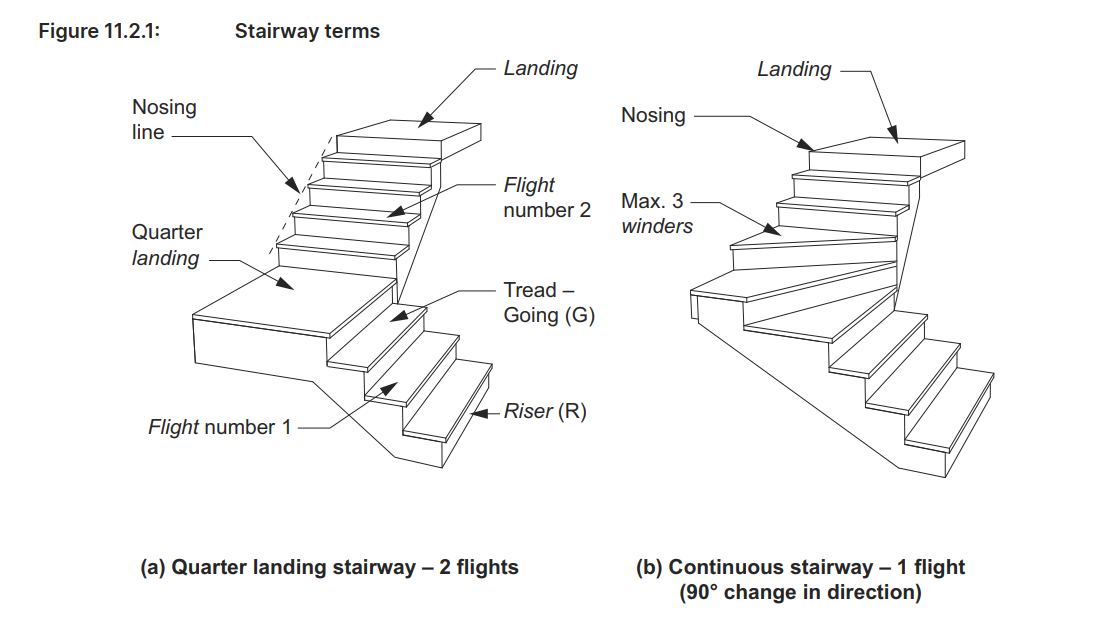
  • Today I learned : Types of stairs in Australia

    Commonly used stairs in Australia:

    1. Straight Stairs:

    Straight stair consists of a single stair flight from lower to upper level. Straight stairs are the most common type of stair used in residential, commercial and industrial buildings not just in Australia but all over the world as it is easy to design and build.

    Stair Flight: It refers to a series of steps or a staircase that leads from one level or floor to another.

    2. L-Shaped stairs:

    L-Shaped stair consists of 2 stair flight which bends by 90° at the landing forming a L shape. It is used when staircase is needed to fit in the corner of the building. It is more visually appealing than straight stairs.

    Landing: A Stair landing is a level platform found at the top, bottom or in the middle of the stairs. An Intermediate landing acts as connecting platform between two stair flights.

    3. U-Shaped stairs:

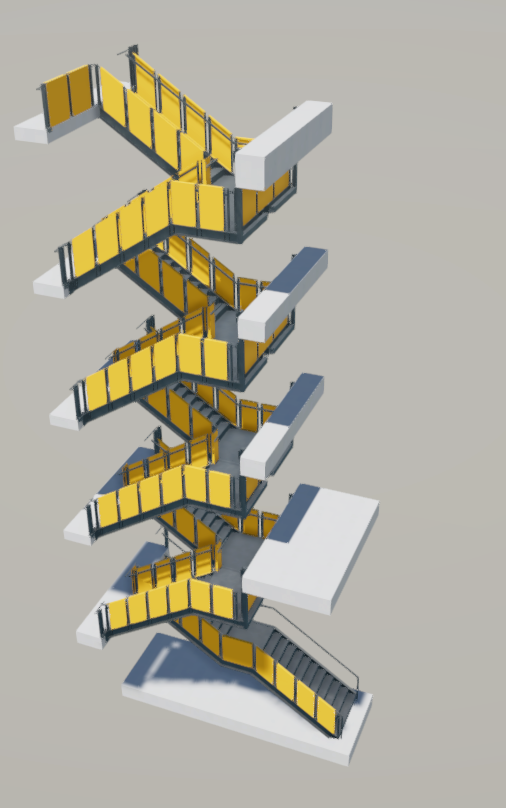
    U-Shaped stair consists of 2 stair flights which bends by 180° at the landing forming a U shape. It is commonly used in multistory buildings.
    4. Winder Stairs:

    Winder Stair is similar to L-shaped stair and U-shaped stair, but here the landing is replaced by triangular or trapezoidal steps. It is commonly used in older homes or used as a secondary stair.

    5. Spiral Stairs:

    Spiral Stairs have a circular or helical shape with stair flight winding around a central pole or column. It is commonly used in space-constrained areas and as outdoor stairs. Spiral stairs can be challenging to use for people with mobility issues.

    6.Curved Stairs:

    Curved Stair’s stair flight follows a curved or circular path. Curved stairs are mostly used for its aesthetic appeal rather than functionality. Curved stairs can be challenging to use for people with mobility issues.

    7.Floating Stairs:

    Floating Stairs are also known as cantilever stairs. These stairs are anchored to the wall on one side while leaving out the other side support less, thus creating an illusion of floating. Floating stairs are used where minimalistic design is desired by the architect.


    Sources:

    Staircase Building Regulations: Our Comprehensive Guide (adara.co.uk)

    STAIRCASE TERMINOLOGY | An Architect Explains | ARCHITECTURE IDEAS