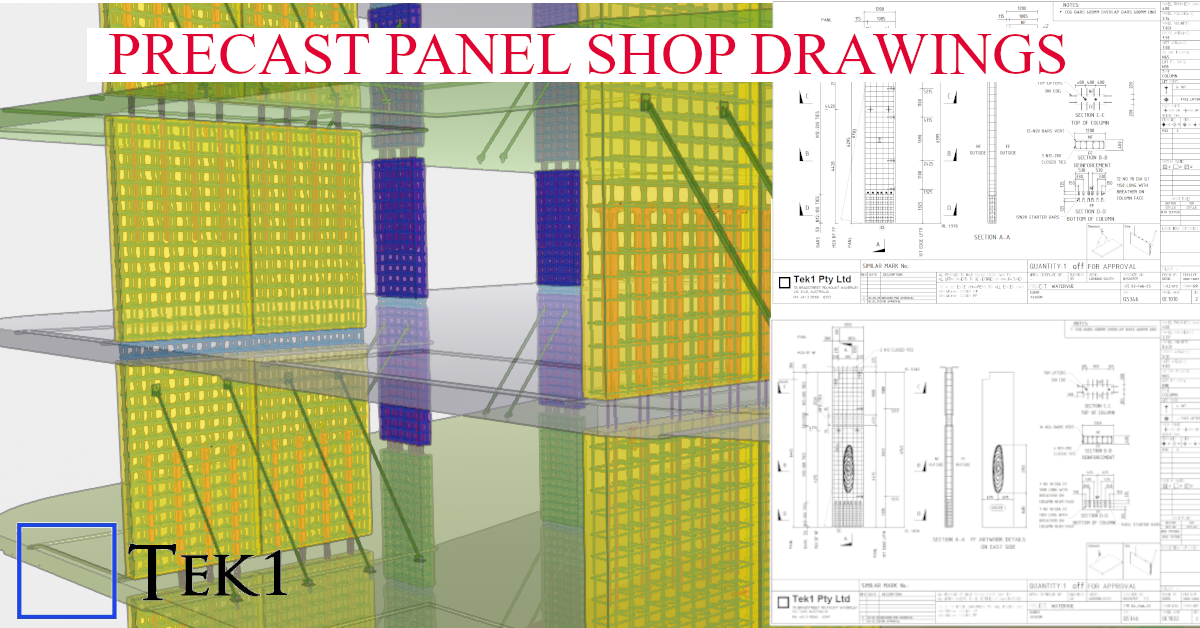
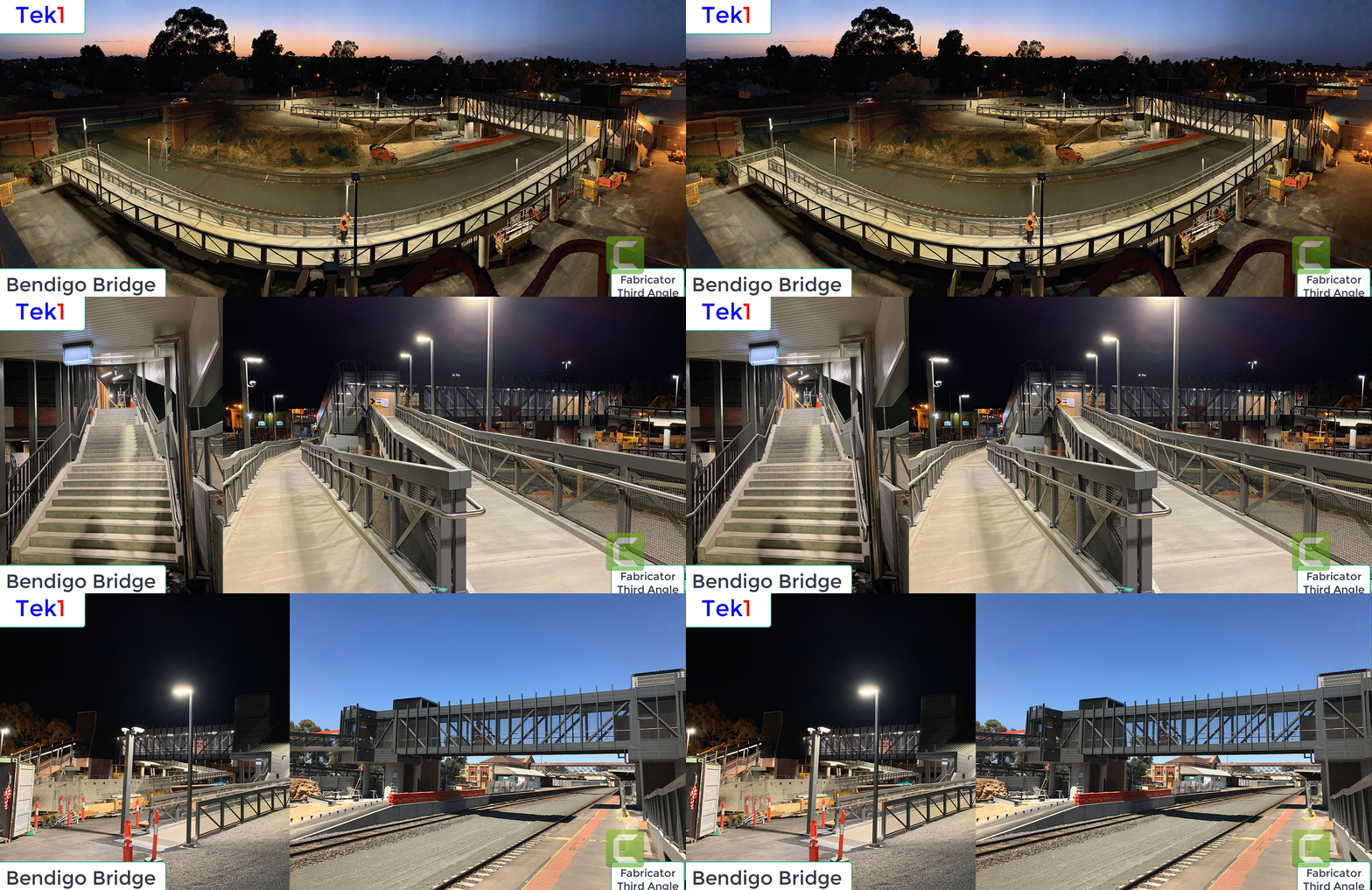
At Tek1, we specialize in transforming complex architectural visions into constructible shop drawings. This model snapshot showcases a recent precast project where aesthetic texture meets structural integrity.
Technical Highlights:
Software: Modeled 100% in Tekla Structures for BIM-ready accuracy.
Surface Treatment: Seamless integration of Reckli formliner patterns, ensuring the architectural finish aligns perfectly across panel joints.
Detailing Depth: Full reinforcement modeling (rebar and mesh), including lifting anchors, grout tubes, and connection hardware.
Manufacturer Ready: Our shop drawings are designed to minimize onsite clashes and streamline the casting process at the precast yard.
When the model is amended after issuing the first set of drawings, the affected assembly drawings will appear as “Parts Modified” after numbering is completed. While updating such drawings, certain considerations are important to ensure effective and quick detailing.
1. Freeze Option
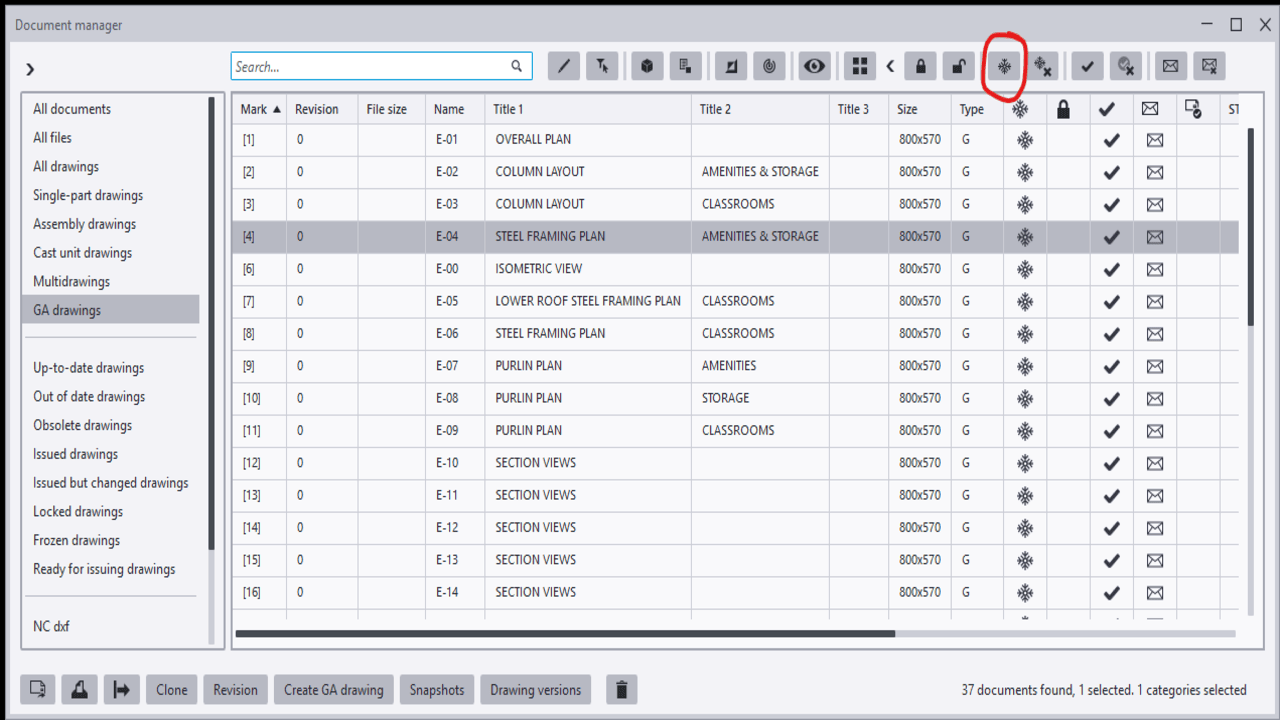
When Freeze is OFF, Tekla automatically updates dimensions according to the movement of parts. While this may seem convenient, the decision to turn Freeze ON or OFF depends on the nature of the amendment.
If no new members are added to the assembly and only existing parts are moved, it is recommended to keep Freeze OFF, as Tekla will correctly update the dimensions.
If new parts are added to the assembly and Freeze is turned OFF, Tekla will automatically generate additional dimensions for the new members and may also alter existing dimensions. This can result in extra work to restore the original dimensioning arrangement.
Guideline:
When no new parts are added, turn Freeze OFF.
When new parts are added, turn Freeze ON.
2. Snapshot Option
Among the drawings marked as “Parts Modified,” not all drawings necessarily contain actual changes. Some assembly drawings may appear as modified because they share common connection components with other assemblies that were amended.
In such cases, the drawing may not have any visible changes and may only require an open-and-close action. However, there is a risk that certain dimensions may be automatically deleted or altered by Tekla during the update.
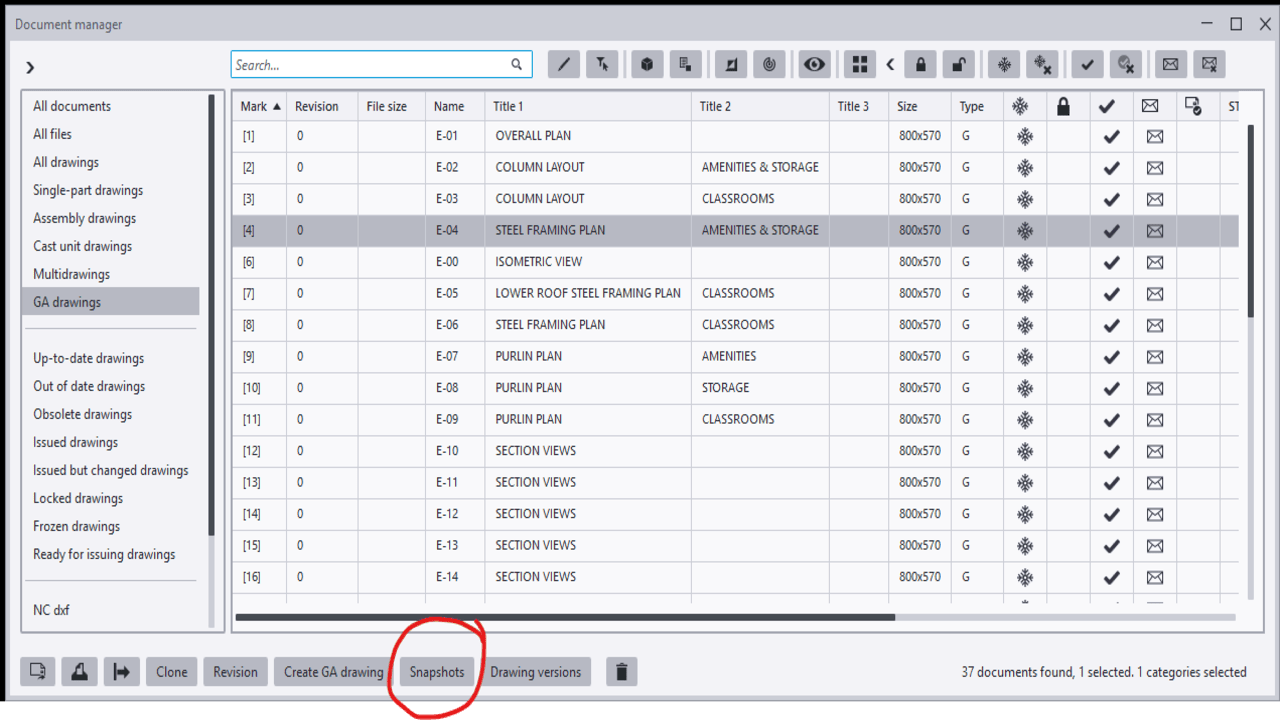
To avoid missing dimensions or unintended changes, the Snapshot option is highly useful. It allows detailers to compare the drawing before and after the update. By reviewing the differences, any unnecessary or unintended modifications can be identified and corrected, thereby minimizing the risk of errors.
We are now placing smart QR codes on drawings. Why? What benefit is accrued by doing so?
You can see a 3d view of an assembly.
You can conduct spot measurements of the assembly.
You can check whether your drawing is the latest revision.
You can add markups directly to a document number – and see it’s revisions over time
Instructions on how to make it work
Set up a project on prolox.io
Get the project’s public access token.
Log into the Prolox’s Tekla’s client application. Use your prolox login email and password and the project’s public access token.
Using Tekla 2023 and with the relevant model open (please open only 1 model) – run the client code.
All the values will be updated.
Rules – To prevent obsolete data from being used or shown
If you update the model, you must re-upload the IFC file in prolox.
If you update the revision number, you must re-do the prolox Tekla client program. This will update the revision numbers in prolox.
If you delete a drawing you must update the revision number for the deleted drawing and re-run the TeklaQRCode program. (so that all revision numbers are updated on the cloud, and so that if anyone scans an old drawing, they will be immediately notified.)
Updating the Drawings:
When you update the drawing PLEASE USE THE SAME REPOSITORY. This is so that we can have old revisions.
Setting up the template
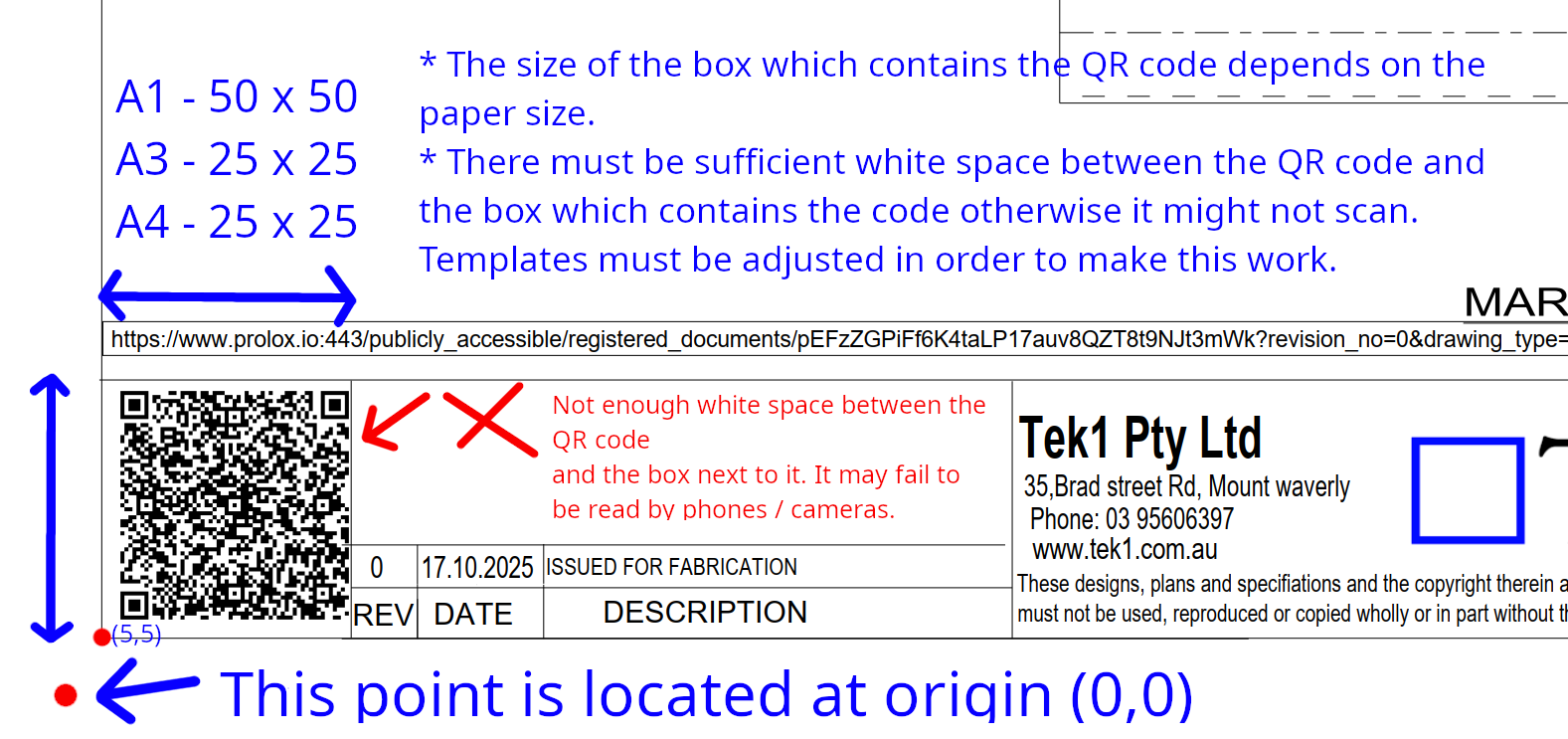
You must set up the drawing template to that the QR Code program works and puts the QR code in the right location. If you don’t set it up properly it will fail.
Assume each page has an origin point of (0,0) at the bottom left hand side of the page.
The drawing template’s borders start at (5,5).
There must be a good amount of white space between the QR code and borders, otherwise the QR code may fail to be read. Which means the entire thing fails.
Tekla Structures’ object lock is a crucial feature, particularly in multi-user environments like Tekla Model Sharing, designed to prevent accidental modification and control access to specific model objects and drawings. It acts as a protective measure to maintain model integrity and streamline collaborative workflows.
Here’s a breakdown of how it works and its key aspects:
Purpose of Object Locks:
Prevent Accidental Modifications: The primary goal is to stop users from unintentionally changing or deleting parts, assemblies, cast units, or drawings that are considered complete or sensitive. This is especially important when multiple users or even different organizations are working on the same shared model.
Control Access: It allows you to regulate who can modify specific elements. For example, an organization can lock objects they’ve created to prevent other organizations working on the same project from altering them.
Maintain Numbering: Locking objects can prevent changes that would affect the numbering of parts, assemblies, or cast units, which is critical for fabrication and erection.
Protect Drawing Integrity: Drawings are linked to the model. Locking drawings helps prevent unintended edits or deletion, especially when they are “issued” or nearing completion.
How Object Locks Work:
User-Defined Attribute (UDA) “OBJECT_LOCKED”: At its core, Tekla Structures uses a user-defined attribute called “OBJECT_LOCKED.” This is a boolean value (Yes/No or 1/0) that can be applied to various model elements, including:
Parts (beams, columns, plates, etc.)
Assemblies
Cast units
Bolts
Welds
Specific drawing types
Reference models (prevents movement and detail updates)
Setting Locks:
Manual Locking: You can manually select objects in the model and set their “Locked” UDA to “Yes” through the “Object locks” dialog (Manage > Locks) or the object’s properties.
Organization Lock: In Tekla Model Sharing, new assemblies and cast units created by a specific organization can be automatically locked “For others” by default (controlled by the XS_OBJECTLOCK_DEFAULT advanced option). This means only users from that organization can modify them.
Drawing Locks: Drawings can also be locked independently through the Document manager.
Effect of Locking:
When an object is locked, any attempt to modify it (move, delete, change properties, etc.) will result in a “There are locked objects, see report. The operation could not be performed.” message.
Tekla Structures will write the IDs of the locked objects to the session history log, helping you identify what is preventing the operation.
Locked drawings can be opened but require manual unlocking to be edited.
Unlocking Objects:
Objects can be unlocked by changing their “Locked” UDA back to “No.”
The “Object locks” dialog provides a central place to manage locks.
There are also methods and even macros to unlock multiple objects or all locked objects in a model, which can be useful if an object becomes “stuck” due to an invisible locked sub-object (e.g., a locked point preventing a part from being unlocked).
Important Considerations:
Hierarchy: If a sub-object within an assembly or cast unit is locked, it can prevent modifications to the entire assembly/cast unit.
Tekla Model Sharing: Object locks are particularly vital in shared models to prevent conflicts and ensure smooth collaboration. When a lock is shared, other users will see the locked status.
Drawing vs. Freeze: It’s important to distinguish between “locking” and “freezing” drawings. Locking indicates that a drawing should not be edited, while freezing prevents associative objects (like dimensions and marks) from updating automatically due to model changes.
Visibility: You might encounter situations where an object seems locked, but you can’t find the lock. This could be due to small, invisible sub-objects being locked. Tekla’s log files provide valuable information in such cases.
In essence, Tekla Structures’ object lock is a powerful tool for managing and protecting your model data, especially in complex, collaborative projects. It provides a layer of security and control that is essential for efficient and error-free structural modeling.